
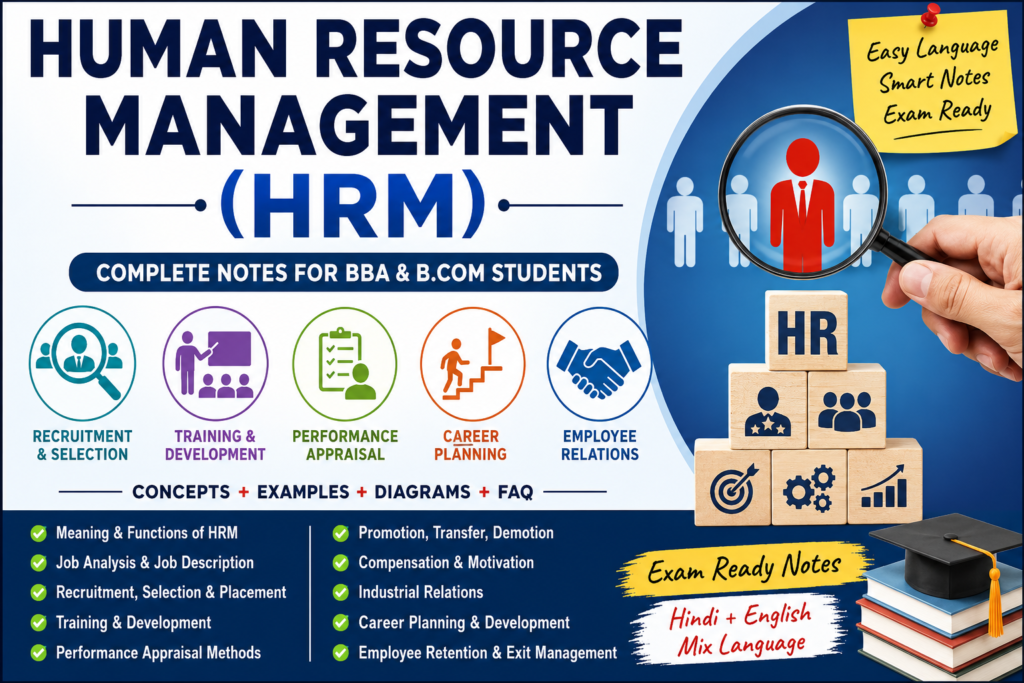
Human Resource Management (HRM): Meaning, Concept & Importance
Dear Students, before understanding Human Resource Management (HRM), let us first understand how any business or organization actually works. Whenever a business starts, it requires several resources. These resources are commonly known as the 5 M's of Management.
The 5 M's of Management
- Man (Human Resources) – Employees, workers, managers.
- Money – Capital required for business operations.
- Material – Raw materials used in production.
- Machine – Equipment and technology.
- Method – Procedures and techniques used to perform work.
अब यहाँ एक बहुत महत्वपूर्ण प्रश्न आता है— अगर किसी कंपनी के पास करोड़ों रुपये की मशीनें हों, पर्याप्त पैसा हो, बेहतरीन कच्चा माल हो और आधुनिक तकनीक भी हो, लेकिन उन सभी को चलाने वाला कोई व्यक्ति न हो, तो क्या कंपनी सफल हो पाएगी?
बिल्कुल नहीं। यही कारण है कि Man (Human Resource) को सबसे महत्वपूर्ण संसाधन माना जाता है।
Human Resource Management का मुख्य उद्देश्य संगठन में कार्यरत लोगों को सही तरीके से चुनना, उन्हें प्रशिक्षित करना, प्रेरित करना, उनका मूल्यांकन करना और उनकी क्षमता का सर्वोत्तम उपयोग करना है।
Teacher's Explanation
Suppose a company wants to manufacture mobile phones. For this, the company needs:
- Raw Material (Material)
- Machines
- Investment (Money)
- Production Process (Method)
- Employees (Man)
इन सभी संसाधनों को नियंत्रित करने और उपयोग करने का कार्य कर्मचारी (Employees) करते हैं। इसलिए कर्मचारियों का प्रबंधन करना ही Human Resource Management कहलाता है।
Simple Definition of HRM
Human Resource Management is the process of planning, organizing, directing and controlling human resources in order to achieve organizational goals efficiently and effectively.
सरल शब्दों में, "किसी संगठन में कार्यरत कर्मचारियों का चयन, प्रशिक्षण, प्रेरणा, मूल्यांकन और विकास करना HRM कहलाता है।"
Real Life Example
Suppose a school hires a new teacher. The school first advertises the vacancy, conducts interviews, selects the best candidate, provides orientation and training, evaluates performance and gives salary and promotion.
यह पूरी प्रक्रिया Human Resource Management का हिस्सा है।
Quick Revision
- HRM focuses on managing people.
- People are the most valuable asset of an organization.
- HRM helps achieve organizational goals.
- HRM includes recruitment, training, motivation and performance evaluation.
- Without human resources, other resources become useless.
Definitions of Human Resource Management (HRM)
Dear Students, in the previous section we understood that Human Resource Management is concerned with managing people working in an organization. Now the question is: How do management experts define HRM?
Different management scholars have explained HRM from different perspectives, but the central idea remains the same— People are the most valuable resource of an organization.
Definition by Edwin B. Flippo
"Human Resource Management is the planning, organizing, directing and controlling of procurement, development, compensation, integration, maintenance and separation of human resources to achieve individual, organizational and societal objectives."
अब इस परिभाषा को आसान भाषा में समझते हैं।
Teacher's Explanation
Flippo के अनुसार HRM केवल कर्मचारियों की भर्ती (Recruitment) तक सीमित नहीं है। बल्कि यह एक सम्पूर्ण प्रक्रिया है जिसमें:
- Employees को नियुक्त करना (Procurement)
- उनकी Training करना (Development)
- Salary एवं Benefits देना (Compensation)
- Organization में समायोजित करना (Integration)
- उनकी सुरक्षा एवं Welfare का ध्यान रखना (Maintenance)
- Retirement या Resignation की प्रक्रिया को संभालना (Separation)
इन सभी गतिविधियों को मिलाकर HRM कहा जाता है।
Simple Definition
Human Resource Management is the process of acquiring, developing, motivating and maintaining human resources in an organization.
सरल शब्दों में, "संगठन में कार्यरत कर्मचारियों को सही तरीके से चुनना, प्रशिक्षित करना, प्रेरित करना और उनकी क्षमता का उपयोग करना HRM कहलाता है।"
Functions of Human Resource Management
अब हम HRM के सबसे महत्वपूर्ण भाग को समझेंगे— HRM वास्तव में क्या-क्या कार्य करता है?
किसी भी कंपनी में HR Department का काम केवल भर्ती करना नहीं होता। वह कर्मचारियों से जुड़ी लगभग सभी गतिविधियों को संभालता है।
1. Human Resource Planning (HRP)
यह HRM का पहला कार्य है। इसमें यह निर्धारित किया जाता है कि भविष्य में संगठन को कितने कर्मचारियों की आवश्यकता होगी।
For example, if a company plans to open two new branches next year, it will require additional employees. HR department estimates these requirements in advance.
2. Recruitment
Recruitment means attracting suitable candidates for vacant positions.
जब कंपनी में कोई पद खाली होता है, तो HR Department Newspaper, Job Portals, Social Media या Company Website पर Vacancy Advertisement जारी करता है।
3. Selection
Selection means choosing the most suitable candidate from among the applicants.
इस प्रक्रिया में Interview, Written Test, Group Discussion तथा Skill Assessment जैसे चरण शामिल हो सकते हैं।
4. Orientation & Induction
जब कोई नया कर्मचारी कंपनी में शामिल होता है, तो उसे कंपनी के नियम, विभाग, सहकर्मी और कार्य संस्कृति से परिचित कराया जाता है।
This process is known as Orientation or Induction.
5. Training and Development
Training helps employees improve their current job performance, while Development prepares them for future responsibilities.
आज के प्रतिस्पर्धात्मक वातावरण में Training बहुत आवश्यक है, क्योंकि Technology और Business Practices लगातार बदल रहे हैं।
6. Performance Appraisal
Performance Appraisal means evaluating employee performance.
HR Department समय-समय पर कर्मचारियों की कार्यक्षमता का मूल्यांकन करता है और यह देखता है कि वे संगठन के लक्ष्यों को किस हद तक प्राप्त कर रहे हैं।
7. Compensation Management
Compensation refers to salary, wages, incentives, bonus and other benefits provided to employees.
यदि कर्मचारियों को उचित वेतन एवं सुविधाएँ मिलती हैं, तो उनकी Motivation और Productivity दोनों बढ़ती हैं।
8. Employee Welfare & Safety
HR Department employees की Health, Safety और Welfare का ध्यान रखता है।
उदाहरण: Medical Facilities, Insurance, Canteen Facilities, Leave Benefits, Workplace Safety आदि।
9. Industrial Relations
Industrial Relations refers to maintaining healthy relationships between management and employees.
यदि कर्मचारियों और Management के बीच अच्छे संबंध बने रहते हैं, तो संगठन में Productivity बढ़ती है और Conflicts कम होते हैं।
Classroom Summary
- HRM is more than recruitment.
- It covers planning, hiring, training, motivation and welfare.
- Edwin Flippo's definition is one of the most important exam definitions.
- Training improves skills and productivity.
- Compensation and welfare increase employee satisfaction.
- Good industrial relations help organizations grow smoothly.
Exam Tip for BBA/B.Com Students
यदि प्रश्न आए: "Explain the Functions of Human Resource Management." तो कम से कम निम्न बिंदु अवश्य लिखें:
- Human Resource Planning
- Recruitment
- Selection
- Training & Development
- Performance Appraisal
- Compensation Management
- Employee Welfare
- Industrial Relations
Nature of Human Resource Management (HRM)
Dear Students, after understanding the meaning and functions of Human Resource Management, the next important topic is the Nature or Characteristics of HRM.
Nature of HRM means understanding the basic features and characteristics that make Human Resource Management different from other management functions.
जब हम HRM की प्रकृति (Nature) की बात करते हैं, तो हम यह समझने का प्रयास करते हैं कि HRM वास्तव में कैसे कार्य करता है और इसकी मुख्य विशेषताएँ क्या हैं।
Teacher's Introduction
Suppose a company has the latest technology, modern machines and sufficient capital. Still, if employees are not motivated, not trained and not properly managed, the company cannot achieve its goals.
यही कारण है कि HRM केवल एक विभाग नहीं, बल्कि संगठन की सफलता का आधार माना जाता है।
1. Universal Nature (सार्वभौमिक प्रकृति)
Human Resource Management is universal in nature. It is required in every type of organization.
चाहे संगठन छोटा हो या बड़ा, सरकारी हो या निजी, स्कूल हो, कॉलेज हो, अस्पताल हो या बहुराष्ट्रीय कंपनी— हर जगह HRM की आवश्यकता होती है।
Wherever people work together to achieve objectives, HRM becomes necessary.
2. People-Oriented (मानव केन्द्रित)
HRM is people-oriented because its main focus is on human beings.
अन्य प्रबंधन क्षेत्रों का ध्यान मशीनों, धन या उत्पादन पर हो सकता है, लेकिन HRM का मुख्य ध्यान कर्मचारियों पर होता है।
It focuses on employee satisfaction, motivation, welfare and development.
3. Action-Oriented (कार्य उन्मुख)
HRM is action-oriented rather than record-oriented.
इसका अर्थ है कि HRM केवल कर्मचारियों का रिकॉर्ड रखने तक सीमित नहीं है। यह कर्मचारियों की समस्याओं का समाधान करता है और उनकी कार्यक्षमता बढ़ाने के लिए कदम उठाता है।
The main objective is to achieve organizational goals through effective employee performance.
4. Individual and Group Oriented
HRM deals with both individuals and groups.
किसी संगठन में केवल एक कर्मचारी नहीं होता, बल्कि कई विभाग और टीमें कार्य करती हैं। इसलिए HRM को व्यक्तिगत तथा सामूहिक दोनों स्तरों पर कार्य करना पड़ता है।
It balances individual goals with organizational goals.
5. Development-Oriented
One of the most important features of HRM is employee development.
HRM कर्मचारियों के ज्ञान, कौशल, क्षमता और व्यक्तित्व का विकास करता है।
Training, workshops, seminars and career development programs help employees improve their performance.
6. Continuous Process (निरंतर प्रक्रिया)
HRM is a continuous process.
यह एक बार की जाने वाली गतिविधि नहीं है। भर्ती, प्रशिक्षण, मूल्यांकन, पदोन्नति और कर्मचारी विकास लगातार चलते रहते हैं।
Organizations continuously monitor employee performance and workforce requirements.
7. Future-Oriented
HRM focuses on future organizational needs.
यह केवल वर्तमान कर्मचारियों के प्रबंधन तक सीमित नहीं है, बल्कि भविष्य की मानव संसाधन आवश्यकताओं का भी अनुमान लगाता है।
HR planning helps organizations prepare for future challenges.
8. Integration of Organizational and Employee Goals
HRM tries to integrate organizational objectives with employee objectives.
एक कर्मचारी अपनी आय, करियर और विकास चाहता है, जबकि संगठन लाभ और विकास चाहता है।
HRM ensures that both employee goals and organizational goals are achieved together.
Quick Comparison
| Nature of HRM | Meaning |
|---|---|
| Universal | Needed in all organizations |
| People-Oriented | Focuses on employees |
| Action-Oriented | Focuses on performance and results |
| Development-Oriented | Improves employee skills |
| Continuous Process | Works continuously |
| Future-Oriented | Plans future manpower needs |
BBA / B.Com Exam Tip
If the question asks: "Explain the Nature of Human Resource Management."
Write at least these points:
- Universal Nature
- People-Oriented
- Action-Oriented
- Individual and Group Oriented
- Development-Oriented
- Continuous Process
- Future-Oriented
- Goal Integration
Writing brief explanations with examples can help score higher marks.
Classroom Summary
Human Resource Management is universal, people-centered, action-oriented, development-focused and continuous in nature. It helps organizations achieve their goals by effectively managing and developing employees.
संक्षेप में, HRM का उद्देश्य कर्मचारियों की क्षमता का सर्वोत्तम उपयोग करके संगठन की सफलता सुनिश्चित करना है।
Scope of Human Resource Management (HRM)
Dear Students, after understanding the meaning, definitions and nature of Human Resource Management, now we will study the Scope of HRM.
The term "Scope" means the area or range of activities covered by HRM. In simple words, scope tells us what activities are performed by the Human Resource Department.
सरल भाषा में कहें तो Scope of HRM का अर्थ है— "HR Department संगठन में कौन-कौन से कार्य करता है?"
Teacher's Explanation
कई विद्यार्थियों को लगता है कि HR Department का काम केवल भर्ती (Recruitment) करना होता है। लेकिन वास्तविकता में HR Department कर्मचारियों से जुड़ी लगभग सभी गतिविधियों को संभालता है।
From manpower planning to retirement, every stage of an employee's career is managed by HRM.
1. Human Resource Planning (HRP)
Human Resource Planning is the process of forecasting future manpower requirements and ensuring that the right number of employees are available at the right time.
HR Planning का अर्थ है भविष्य में कर्मचारियों की आवश्यकता का अनुमान लगाना।
किसी संगठन को पहले से पता होना चाहिए कि आने वाले समय में कितने कर्मचारियों की आवश्यकता होगी।
Example
Suppose a company plans to open three new branches next year. The HR Department must estimate how many managers, accountants, sales executives and support staff will be required.
यह कार्य Human Resource Planning कहलाता है।
Objectives of HR Planning
- Right person at the right job.
- Right number of employees.
- Avoid manpower shortage.
- Avoid excess employees.
- Improve organizational efficiency.
2. Recruitment
Recruitment means searching for and attracting potential candidates for job vacancies.
Recruitment is the process of inviting qualified candidates to apply for vacant positions.
जब संगठन में कोई पद खाली होता है, तो योग्य उम्मीदवारों को आवेदन करने के लिए आकर्षित करना Recruitment कहलाता है।
Teacher's Explanation
मान लीजिए किसी कंपनी में 10 Sales Executive की आवश्यकता है।
अब कंपनी Newspaper Advertisement, Job Portal, LinkedIn, Company Website या Employment Agency के माध्यम से Vacancy की सूचना जारी करती है।
इस प्रक्रिया को Recruitment कहते हैं।
Sources of Recruitment
| Internal Sources | External Sources |
|---|---|
| Promotion | Newspaper Advertisement |
| Transfer | Campus Recruitment |
| Employee Referral | Job Portals |
| Existing Employees | Employment Agencies |
3. Selection
Selection is the process of choosing the most suitable candidate from among the applicants.
Recruitment attracts candidates, while Selection chooses the best candidate.
Recruitment और Selection में अंतर समझना बहुत जरूरी है।
- Recruitment = Inviting Applications
- Selection = Choosing the Best Candidate
Classroom Example
Suppose 500 candidates apply for a vacancy.
The company conducts:
- Written Test
- Group Discussion
- Personal Interview
- Medical Examination
Finally, only 10 candidates are selected.
This process is called Selection.
Selection Process
- Receiving Applications
- Screening Applications
- Written Test
- Interview
- Reference Check
- Medical Examination
- Final Selection
- Appointment Letter
4. Orientation and Induction
After selection, employees need to understand the organization.
Orientation is the process of introducing new employees to the organization.
जब कोई कर्मचारी पहली बार संगठन में शामिल होता है, तो उसे कंपनी के नियम, नीतियाँ, विभाग, सहकर्मी और कार्य संस्कृति के बारे में बताया जाता है।
Example
A newly selected employee is introduced to:
- Company History
- Company Rules
- Department Structure
- Reporting Manager
- Working Hours
- Salary Policies
This is called Orientation or Induction.
5. Training and Development
Training and Development is one of the most important functions of HRM.
Organizations cannot grow if employees do not learn new skills.
आज का Business Environment बहुत तेजी से बदल रहा है। नई Technologies, Software और Management Techniques लगातार विकसित हो रही हैं।
इसलिए कर्मचारियों को समय-समय पर Training देना आवश्यक है।
Difference Between Training and Development
| Training | Development |
|---|---|
| Short-Term Process | Long-Term Process |
| Current Job Focus | Future Career Focus |
| Specific Skills | Overall Growth |
Example
A bank introduces new software.
Employees receive training to use the software effectively.
This is Training.
When the bank prepares an employee for future managerial responsibilities, that process is called Development.
Benefits of Training
- Improves employee skills.
- Increases productivity.
- Reduces mistakes and accidents.
- Improves quality of work.
- Boosts employee confidence.
- Enhances organizational performance.
Classroom Summary
The Scope of HRM is very wide. It includes:
- Human Resource Planning
- Recruitment
- Selection
- Orientation & Induction
- Training & Development
इन सभी गतिविधियों का मुख्य उद्देश्य सही व्यक्ति को सही कार्य पर नियुक्त करना और उसकी क्षमता का सर्वोत्तम उपयोग करना है।
A well-managed Human Resource Department helps organizations achieve higher productivity, employee satisfaction and long-term growth.
BBA / B.Com Exam Tip
यदि परीक्षा में प्रश्न आए:
"Explain the Scope of Human Resource Management."
तो निम्न बिंदु अवश्य लिखें:
- Human Resource Planning
- Recruitment
- Selection
- Orientation & Induction
- Training & Development
- Performance Appraisal
- Compensation Management
- Employee Welfare
- Industrial Relations
Job Analysis in Human Resource Management
Meaning, Objectives, Process, Job Description & Job Specification
Introduction
Dear Students, अब तक हमने Human Resource Planning, Recruitment, Selection, Orientation और Training को समझ लिया है। अब हम HRM के सबसे महत्वपूर्ण विषयों में से एक Job Analysis को समझेंगे।
किसी भी संगठन में सही व्यक्ति को सही कार्य पर नियुक्त करने के लिए सबसे पहले यह जानना आवश्यक होता है कि उस Job में वास्तव में करना क्या है।
यही कार्य Job Analysis करता है।
Meaning of Job Analysis
Job Analysis means a detailed study of a job.
It is the process of collecting information regarding duties, responsibilities, skills, qualifications and working conditions of a particular job.
सरल शब्दों में:
"किसी पद पर कार्य करने वाले व्यक्ति को क्या-क्या काम करना होगा, उसकी क्या जिम्मेदारियां होंगी, कौन-कौन सी योग्यताएं चाहिए होंगी, और कार्य किन परिस्थितियों में किया जाएगा— इन सभी बातों का विस्तृत अध्ययन Job Analysis कहलाता है।"
Classroom Example
मान लीजिए किसी कंपनी में Marketing Manager की Vacancy है।
अब कंपनी को यह जानना होगा:
- Marketing Manager क्या काम करेगा?
- कितने लोगों को Handle करेगा?
- कौन सी Qualification चाहिए?
- कितना Experience चाहिए?
- क्या Computer Skills जरूरी हैं?
- क्या Travelling करनी होगी?
इन सभी प्रश्नों के उत्तर खोजने की प्रक्रिया ही Job Analysis कहलाती है।
Objectives of Job Analysis
Job Analysis का मुख्य उद्देश्य किसी भी Job के बारे में सही एवं विस्तृत जानकारी प्राप्त करना होता है।
- To determine duties and responsibilities.
- To identify skills and qualifications.
- To assist recruitment and selection.
- To prepare training programmes.
- To evaluate employee performance.
- To determine salary structure.
- To improve manpower planning.
- To increase organizational efficiency.
Importance of Job Analysis
Students, अगर Job Analysis नहीं होगा तो कंपनी को यह पता ही नहीं होगा कि किस पद के लिए किस प्रकार का व्यक्ति चाहिए।
Result क्या होगा? Wrong person, wrong job.
और जब गलत व्यक्ति गलत पद पर होगा तो Productivity, Quality और Performance तीनों प्रभावित होंगे।
Benefits of Job Analysis
- Right person for the right job.
- Better recruitment decisions.
- Effective training programmes.
- Fair salary determination.
- Improved employee performance.
- Reduced employee turnover.
- Higher organizational efficiency.
Process of Job Analysis
Job Analysis एक Step-by-Step Process है।
इसके मुख्य पाँच चरण होते हैं।
Step 1 : Organizational Analysis
सबसे पहले पूरे संगठन का अध्ययन किया जाता है।
यह देखा जाता है कि विभिन्न Jobs संगठन के Objectives को प्राप्त करने में किस प्रकार योगदान दे रही हैं।
Teacher Note: किसी Job को समझने से पहले Organization को समझना जरूरी है।
क्योंकि हर Job का उद्देश्य Organization के Goals को Achieve करना होता है।
Step 2 : Selection of Representative Jobs
सभी Jobs का Analysis करना हमेशा संभव नहीं होता।
इसलिए कुछ Representative Jobs का चयन किया जाता है।
उन्हीं Jobs का अध्ययन करके निष्कर्ष निकाले जाते हैं।
Step 3 : Collection of Job Analysis Data
इस चरण में Job से संबंधित सभी आवश्यक Data एकत्र किया जाता है।
जैसे:
- Job Duties
- Responsibilities
- Skills Required
- Working Conditions
- Authority Level
- Reporting Structure
Step 4 : Preparation of Job Description
Collected Data के आधार पर Job Description तैयार किया जाता है।
इसमें Job से संबंधित सभी कार्यों और जिम्मेदारियों का विवरण दिया जाता है।
Step 5 : Preparation of Job Specification
अब यह तय किया जाता है कि उस Job को करने के लिए व्यक्ति में कौन-कौन सी योग्यताएं होनी चाहिए।
यही Job Specification कहलाता है।
Methods of Collecting Job Analysis Data
Job Analysis के लिए Data एकत्र करने के विभिन्न तरीके होते हैं।
1. Interview Method
Employees और Supervisors से प्रश्न पूछकर जानकारी प्राप्त की जाती है।
यह सबसे अधिक उपयोग की जाने वाली विधि है।
2. Questionnaire Method
Employees को प्रश्नावली दी जाती है।
वे लिखित रूप में उत्तर देते हैं।
3. Observation Method
Job Analyst कर्मचारी के कार्य को सीधे Observe करता है।
इससे वास्तविक कार्य प्रक्रिया समझ में आती है।
4. Diary Method
Employees अपनी दैनिक गतिविधियों का रिकॉर्ड रखते हैं।
इसे Analyze करके Job Data प्राप्त किया जाता है।
5. Expert Panel Method
Senior Managers और Experts से जानकारी ली जाती है।
6. Job Performance Method
Job Analyst स्वयं Job Perform करता है।
इससे First-Hand Experience प्राप्त होता है।
7. Critical Incident Technique (CIT)
Employees से महत्वपूर्ण घटनाओं (Critical Incidents) की जानकारी ली जाती है।
इन घटनाओं का विश्लेषण करके Job Requirements समझी जाती हैं।
Job Description
Job Description is a written statement describing duties, responsibilities and working conditions of a job.
याद रखने की Trick:
Job Description = Job ka Description
यानी Job में क्या-क्या करना है।
Contents of Job Description
- Job Title
- Department
- Duties
- Responsibilities
- Authority
- Working Conditions
- Reporting Relationship
Job Specification
Job Specification is a written statement describing the qualifications and qualities required to perform a job.
याद रखने की Trick:
Job Specification = Employee Specification
यानी Job करने वाले व्यक्ति में क्या-क्या योग्यताएं होनी चाहिए।
Contents of Job Specification
- Educational Qualification
- Experience
- Technical Skills
- Communication Skills
- Physical Fitness
- Mental Ability
- Personality Traits
Difference Between Job Description and Job Specification
| Job Description | Job Specification |
|---|---|
| Describes the Job | Describes the Person |
| What work is to be done? | Who can do the work? |
| Focus on Duties | Focus on Qualifications |
| Job-Oriented | Person-Oriented |
Exam Point of View
Important Questions:
- Meaning of Job Analysis
- Objectives of Job Analysis
- Process of Job Analysis
- Methods of Job Analysis
- Job Description
- Job Specification
- Difference between Job Description and Job Specification
Performance Appraisal, Compensation Management, Employee Welfare & Industrial Relations
Human Resource Management (HRM) – BBA | B.Com | MBA Notes
Introduction
Dear Students, अब तक हमने HRM का Introduction, Functions, Human Resource Planning, Recruitment, Selection, Training तथा Job Analysis को समझ लिया है।
अब हम HRM के कुछ सबसे महत्वपूर्ण Functional Areas को समझेंगे—
- Performance Appraisal
- Compensation Management
- Employee Welfare
- Industrial Relations
ये चारों विषय किसी भी Organization की सफलता में अत्यंत महत्वपूर्ण भूमिका निभाते हैं।
Performance Appraisal
Performance Appraisal means evaluating the performance of employees.
It is a systematic process of assessing how well employees perform their assigned duties and responsibilities.
सरल भाषा में:
"कर्मचारी अपना कार्य कितनी अच्छी तरह कर रहा है, उसके प्रदर्शन को मापना और उसका मूल्यांकन करना ही Performance Appraisal कहलाता है।"
Why Performance Appraisal is Needed?
मान लीजिए किसी कंपनी में 100 कर्मचारी कार्य कर रहे हैं।
कुछ कर्मचारी उत्कृष्ट प्रदर्शन कर रहे हैं जबकि कुछ कर्मचारी अपेक्षित स्तर पर कार्य नहीं कर रहे।
यदि संगठन इन दोनों के बीच अंतर नहीं करेगा तो अच्छे कर्मचारियों का उत्साह कम हो जाएगा।
इसलिए Performance Appraisal आवश्यक है।
Objectives of Performance Appraisal
- To evaluate employee performance.
- To identify strengths and weaknesses.
- To determine promotion decisions.
- To decide salary increments.
- To identify training needs.
- To motivate employees.
- To improve productivity.
- To increase organizational efficiency.
Methods of Performance Appraisal
1. Ranking Method
Employees are ranked from best to worst according to performance.
सबसे अच्छा कर्मचारी प्रथम स्थान पर और सबसे कमजोर कर्मचारी अंतिम स्थान पर रखा जाता है।
2. Rating Scale Method
Employees are rated on various factors such as knowledge, communication and productivity.
अंक सामान्यतः 1 से 5 या 1 से 10 तक दिए जाते हैं।
3. Checklist Method
A checklist of performance factors is prepared and evaluated.
4. 360 Degree Feedback
Feedback is collected from seniors, colleagues, subordinates and customers.
यह आधुनिक एवं लोकप्रिय विधि है।
Compensation Management
Compensation refers to all monetary and non-monetary rewards given to employees in return for their services.
सरल शब्दों में:
"कर्मचारी द्वारा किए गए कार्य के बदले जो वेतन, बोनस, भत्ते और सुविधाएँ दी जाती हैं उन्हें Compensation कहते हैं।"
Types of Compensation
1. Direct Compensation
- Salary
- Wages
- Bonus
- Commission
- Incentives
2. Indirect Compensation
- Medical Facilities
- Insurance
- Housing Facility
- Travel Allowance
- Retirement Benefits
- Paid Leave
Importance of Compensation
- Attracts talented employees.
- Improves employee motivation.
- Reduces employee turnover.
- Increases productivity.
- Improves job satisfaction.
- Creates loyalty toward organization.
Employee Welfare
Employee Welfare refers to all services, benefits and facilities provided to employees for improving their physical, mental and social well-being.
कर्मचारी केवल वेतन से संतुष्ट नहीं होता।
उसे स्वास्थ्य, सुरक्षा, शिक्षा, आवास तथा सामाजिक सुविधाओं की भी आवश्यकता होती है।
इन्हीं सुविधाओं को Employee Welfare कहा जाता है।
Employee Welfare Measures
Health Welfare
- Medical Facilities
- Health Insurance
- Hospital Facilities
- Regular Health Checkups
Safety Welfare
- Protective Equipment
- Fire Safety Measures
- Emergency Exit Facilities
- Safety Training
Social Welfare
- Recreation Facilities
- Sports Activities
- Employee Clubs
- Cultural Programmes
Economic Welfare
- Loans
- Scholarships
- Retirement Benefits
- Housing Facilities
Industrial Relations
Industrial Relations means maintaining harmonious relationships between employers and employees.
सरल शब्दों में:
"Employer और Employee के बीच अच्छे संबंध बनाए रखना Industrial Relations कहलाता है।"
Importance of Industrial Relations
- Promotes industrial peace.
- Reduces conflicts and disputes.
- Improves productivity.
- Creates positive work environment.
- Improves employee morale.
- Supports organizational growth.
Causes of Industrial Disputes
- Low wages
- Poor working conditions
- Lack of communication
- Unfair treatment
- Promotion issues
- Job insecurity
- Violation of labour laws
Role of Trade Unions
Trade Union is an association of workers formed to protect their rights and interests.
Trade Unions help employees in:
- Collective bargaining
- Protection of rights
- Welfare activities
- Dispute settlement
- Improvement of working conditions
Teacher's Quick Revision
Students, Exam में अक्सर ये प्रश्न पूछे जाते हैं:
- What is Performance Appraisal?
- Objectives of Performance Appraisal.
- Methods of Performance Appraisal.
- Meaning of Compensation.
- Types of Compensation.
- Employee Welfare Measures.
- Industrial Relations.
- Role of Trade Unions.
- Causes of Industrial Disputes.
यदि इन Topics को अच्छे से तैयार कर लिया जाए तो HRM Chapter का बड़ा भाग कवर हो जाता है।
Evolution, Nature, Scope & Functions of Human Resource Management
Complete Chapter Revision for BBA, B.Com & MBA Students
Before We Start
Dear Students, अब तक हमने HRM का Concept, Job Analysis, Recruitment, Selection, Training, Performance Appraisal, Compensation Management, Employee Welfare और Industrial Relations पढ़ लिया है।
इस Section में हम पूरे Chapter का Revision करेंगे और समझेंगे कि HRM का विकास कैसे हुआ, इसकी Nature क्या है, Scope क्या है और HR Manager की वास्तविक भूमिका क्या होती है।
Evolution of Human Resource Management (HRM)
आज HRM किसी भी Organization का Strategic Department माना जाता है। लेकिन यह शुरुआत से इतना विकसित नहीं था।
Stage 1 : Labour Welfare Stage (Before 1930)
इस समय केवल मजदूरों की Basic Needs पर ध्यान दिया जाता था।
- Working Conditions
- Health & Safety
- Basic Welfare Facilities
Stage 2 : Personnel Management (1930–1960)
Organizations ने Employees को Manage करना शुरू किया।
Recruitment, Salary Administration और Employee Records पर ध्यान दिया गया।
Stage 3 : Human Resource Management (1960–1990)
Employees को केवल Workers नहीं बल्कि Valuable Resources माना गया।
Training, Development और Motivation पर Focus बढ़ा।
Stage 4 : Strategic HRM (1990 – Present)
आज HRM Business Strategy का हिस्सा बन चुका है।
HR Managers Business Growth में Strategic Partner की भूमिका निभाते हैं।
Nature of Human Resource Management
Nature का अर्थ है HRM की मुख्य विशेषताएँ।
1. Universal Function
हर Organization में HRM की आवश्यकता होती है।
चाहे वह School हो, Hospital हो, Factory हो या Government Department।
2. People-Oriented Function
HRM का मुख्य Focus लोगों (Employees) पर होता है।
3. Action-Oriented
HRM केवल Records Maintain नहीं करता बल्कि वास्तविक समस्याओं का समाधान करता है।
4. Development-Oriented
HRM कर्मचारियों की Skills और Knowledge को विकसित करता है।
5. Continuous Process
HRM एक निरंतर चलने वाली प्रक्रिया है।
यह केवल Recruitment तक सीमित नहीं है।
6. Future-Oriented
HRM भविष्य की Manpower Requirements की Planning करता है।
Scope of Human Resource Management
Scope का अर्थ है HRM किन-किन Activities को Cover करता है।
Human Resource Planning
Future Manpower Requirements का अनुमान लगाना।
Recruitment
योग्य उम्मीदवारों को आकर्षित करना।
Selection
Best Candidate का चयन करना।
Placement
Right Person को Right Job देना।
Training & Development
Skills और Knowledge बढ़ाना।
Performance Appraisal
Employee Performance का मूल्यांकन।
Compensation
Salary, Bonus एवं Incentives देना।
Employee Welfare
Health, Safety एवं Welfare Activities।
Industrial Relations
Employer एवं Employee Relations बनाए रखना।
Functions of HRM
HRM के Functions दो मुख्य Categories में बाँटे जाते हैं।
Managerial Functions
- Planning
- Organizing
- Directing
- Controlling
Operative Functions
- Procurement
- Development
- Compensation
- Integration
- Maintenance
Role of HR Manager
HR Manager किसी भी Organization में Employee Management का मुख्य अधिकारी होता है।
1. Policy Maker
HR Policies बनाना।
2. Recruiter
योग्य कर्मचारियों की भर्ती करना।
3. Trainer
Training और Development Program चलाना।
4. Counselor
Employees की समस्याओं का समाधान करना।
5. Motivator
Employees को प्रेरित करना।
6. Mediator
Employer और Employee के बीच मध्यस्थता करना।
7. Welfare Officer
Health, Safety और Welfare Activities की देखरेख करना।
Importance of HRM
Benefits to Organization
- Higher Productivity
- Better Performance
- Reduced Labour Turnover
- Industrial Peace
- Improved Profitability
Benefits to Employees
- Career Growth
- Job Satisfaction
- Skill Development
- Motivation
- Better Working Conditions
Benefits to Society
- Employment Generation
- Better Standard of Living
- Social Welfare
- Economic Development
Teacher's Final Revision
याद रखने की Trick:
HRM = Right Person + Right Job + Right Time + Right Performance
अगर HRM सही तरीके से काम करे तो:
- Organization Grow करेगा।
- Employees Satisfied रहेंगे।
- Productivity बढ़ेगी।
- Profit बढ़ेगा।
- Industrial Disputes कम होंगे।
यही HRM का अंतिम उद्देश्य है।
Recruitment, Selection, Placement, Induction & Orientation
Human Resource Management (HRM) – Complete Classroom Notes
Introduction
Dear Students, Human Resource Planning (HRP) के बाद HR Department का अगला महत्वपूर्ण कार्य है सही कर्मचारियों को Organization में लाना।
अगर किसी Organization में योग्य Employees नहीं होंगे तो मशीन, पैसा और तकनीक होने के बावजूद भी सफलता प्राप्त नहीं की जा सकती।
इसलिए Recruitment और Selection HRM की सबसे महत्वपूर्ण Activities मानी जाती हैं।
Meaning of Recruitment
Recruitment is the process of searching and attracting potential candidates for employment.
सरल भाषा में:
"योग्य उम्मीदवारों को नौकरी के लिए आकर्षित करने की प्रक्रिया Recruitment कहलाती है।"
Teacher Example
मान लीजिए किसी कंपनी को 20 Sales Executives की आवश्यकता है।
अब कंपनी Newspaper Advertisement, Job Portal, Social Media तथा Campus Placement के माध्यम से उम्मीदवारों को आवेदन करने के लिए आमंत्रित करती है।
यह पूरी प्रक्रिया Recruitment कहलाती है।
Objectives of Recruitment
- To attract qualified candidates.
- To create a large pool of applicants.
- To select the best candidate.
- To reduce labour shortage.
- To support organizational growth.
- To improve workforce quality.
Sources of Recruitment
Recruitment के मुख्यतः दो Sources होते हैं।
1. Internal Sources of Recruitment
जब संगठन अपने वर्तमान कर्मचारियों में से ही किसी को नई Position पर नियुक्त करता है।
- Promotion
- Transfer
- Employee Referral
- Re-employment of Former Employees
Advantages
- Low Cost
- Quick Process
- Employee Motivation
- Less Training Required
2. External Sources of Recruitment
जब संगठन बाहरी उम्मीदवारों को नियुक्त करता है।
- Advertisement
- Employment Exchange
- Campus Recruitment
- Online Job Portals
- Social Media Recruitment
- Consultancy Agencies
- Walk-in Interviews
Advantages
- Fresh Talent
- New Ideas
- Larger Talent Pool
- Better Competition
Internal vs External Recruitment
| Internal Recruitment | External Recruitment |
|---|---|
| Existing Employees | Outside Candidates |
| Low Cost | Higher Cost |
| Fast Process | Time Consuming |
| Limited Choice | Wide Choice |
Meaning of Selection
Selection is the process of choosing the most suitable candidate from the pool of applicants.
Recruitment में Candidates को आकर्षित किया जाता है।
Selection में सबसे उपयुक्त Candidate को चुना जाता है।
Selection Process
Selection एक Systematic Process है।
Step 1 : Receipt of Applications
Candidates द्वारा भेजे गए Applications प्राप्त किए जाते हैं।
Step 2 : Preliminary Screening
Basic Qualification और Eligibility की जांच की जाती है।
Step 3 : Written Test
Knowledge, Aptitude एवं Technical Skills का परीक्षण किया जाता है।
Step 4 : Interview
Candidate की Personality, Communication Skill और Confidence को Evaluate किया जाता है।
Step 5 : Medical Examination
Candidate की Health एवं Physical Fitness की जांच की जाती है।
Step 6 : Reference Check
Candidate के Background और Previous Employment की जांच की जाती है।
Step 7 : Final Selection
सबसे उपयुक्त Candidate का चयन किया जाता है।
Placement
Placement means assigning a selected employee to a suitable job.
याद रखने की Trick:
Recruitment → Selection → Placement
Placement का अर्थ है चुने गए Candidate को सही Job देना।
Orientation
Orientation is the process of introducing a new employee to the organization.
इसमें कर्मचारी को Organization के बारे में जानकारी दी जाती है।
Information Provided During Orientation
- Company History
- Mission & Vision
- Rules & Regulations
- Department Structure
- Reporting Authority
- Employee Benefits
Induction
Induction is the process of familiarizing a new employee with the work environment.
Orientation और Induction लगभग समान दिखाई देते हैं लेकिन उनमें अंतर होता है।
Orientation Organization का परिचय कराता है।
Induction Workplace और Job का परिचय कराता है।
Difference Between Orientation and Induction
| Orientation | Induction |
|---|---|
| Introduction to Organization | Introduction to Workplace |
| Company Focus | Job Focus |
| General Information | Specific Information |
| Conducted First | Conducted After Orientation |
Importance of Induction & Orientation
- Reduces employee anxiety.
- Improves confidence.
- Increases productivity.
- Reduces employee turnover.
- Improves job satisfaction.
- Creates positive work environment.
Teacher's Quick Revision
Remember this sequence:
HRP → Recruitment → Selection → Placement → Orientation → Induction
Exam Important Questions:
- Meaning of Recruitment.
- Sources of Recruitment.
- Internal vs External Recruitment.
- Meaning of Selection.
- Selection Process.
- Placement Meaning.
- Orientation and Induction.
- Difference between Orientation and Induction.
Training & Development, Career Planning and Career Development
Human Resource Management (HRM) – Complete Classroom Notes
Introduction
Dear Students, Recruitment, Selection और Placement के बाद HR Department का सबसे महत्वपूर्ण कार्य होता है Employees को Training देना और उनका Development करना।
क्योंकि केवल Employee को Hire कर लेना पर्याप्त नहीं होता।
उसे Organization की Technology, Processes और Work Environment के अनुसार तैयार करना भी आवश्यक होता है।
यहीं से Training & Development की शुरुआत होती है।
Meaning of Training
Training is the process of improving the knowledge, skills and abilities of employees to perform a specific job effectively.
सरल भाषा में:
"किसी कर्मचारी को उसका कार्य बेहतर ढंग से करने योग्य बनाना Training कहलाता है।"
Teacher Example
मान लीजिए किसी बैंक में नया कर्मचारी नियुक्त हुआ है।
उसे Banking Software, Customer Handling और Digital Transactions की जानकारी नहीं है।
जब बैंक उसे इन सभी कार्यों की Training देता है तो वह अपने कार्य को बेहतर ढंग से कर पाता है।
इसी प्रक्रिया को Training कहा जाता है।
Meaning of Development
Development refers to the growth of employees for future responsibilities.
Training वर्तमान Job के लिए होती है।
Development भविष्य की जिम्मेदारियों के लिए किया जाता है।
Difference Between Training and Development
| Training | Development |
|---|---|
| Job Oriented | Career Oriented |
| Short Term | Long Term |
| Focus on Present Job | Focus on Future Growth |
| Technical Skills | Managerial Skills |
Objectives of Training & Development
- Improve employee performance.
- Increase productivity.
- Reduce errors and accidents.
- Develop leadership qualities.
- Increase employee motivation.
- Prepare employees for future positions.
- Improve organizational efficiency.
Importance of Training & Development
Students, Technology तेजी से बदल रही है।
यदि Employees को समय-समय पर Training नहीं दी जाएगी तो वे नई तकनीकों के साथ काम नहीं कर पाएंगे।
- Improves work quality.
- Reduces supervision.
- Increases employee confidence.
- Improves morale.
- Reduces employee turnover.
- Supports organizational growth.
Methods of Training
Training Methods को दो मुख्य भागों में बाँटा जाता है।
1. On-the-Job Training
Employee को कार्यस्थल पर वास्तविक कार्य करते हुए Training दी जाती है।
Examples
- Job Rotation
- Coaching
- Mentoring
- Apprenticeship
- Internship
2. Off-the-Job Training
Training Workplace से बाहर दी जाती है।
Examples
- Classroom Training
- Seminars
- Workshops
- Conferences
- Case Study Method
- Role Playing
Job Rotation
Job Rotation में Employee को विभिन्न Departments में कार्य करने का अवसर दिया जाता है।
उदाहरण:
एक Management Trainee को HR, Marketing, Finance और Production Department में क्रमशः भेजा जाता है।
इससे उसे Organization की सम्पूर्ण समझ प्राप्त होती है।
Apprenticeship Training
यह Training विशेष रूप से Technical Jobs के लिए दी जाती है।
Employee किसी अनुभवी व्यक्ति के साथ कार्य करके सीखता है।
जैसे Electrician, Mechanic, Welder आदि।
Management Development Programmes (MDP)
Management Development Programmes का उद्देश्य Managers की Leadership और Decision-Making Skills को विकसित करना है।
Methods of Management Development
- Case Study Method
- Role Playing
- Sensitivity Training
- Business Games
- Management by Objectives (MBO)
- Executive Coaching
Career Planning
Career Planning is the process through which an individual identifies career goals and plans the path to achieve them.
सरल शब्दों में:
"भविष्य में क्या बनना है और वहाँ तक पहुँचने की योजना बनाना Career Planning कहलाता है।"
Career Planning Example
एक Employee HR Executive के रूप में कार्य शुरू करता है।
उसका लक्ष्य भविष्य में HR Manager बनना है।
वह MBA करता है, Training Programmes में भाग लेता है और अनुभव प्राप्त करता है।
यह Career Planning का उदाहरण है।
Career Development
Career Development refers to activities undertaken to achieve career goals.
यह Career Planning को वास्तविकता में बदलने की प्रक्रिया है।
Stages of Career Development
1. Exploration Stage
Career Options की खोज की जाती है।
2. Establishment Stage
व्यक्ति Career शुरू करता है और अनुभव प्राप्त करता है।
3. Mid-Career Stage
व्यक्ति Promotion और Higher Responsibilities प्राप्त करता है।
4. Late Career Stage
Leadership और Mentoring की भूमिका निभाता है।
5. Decline Stage
Retirement की ओर बढ़ता है।
Benefits of Career Planning & Development
- Improves employee motivation.
- Increases job satisfaction.
- Supports promotion opportunities.
- Improves retention.
- Develops leadership pipeline.
- Supports organizational growth.
Teacher's Quick Revision
Remember:
Recruitment → Selection → Placement → Orientation → Training → Development → Career Growth
Exam Important Questions:
- Meaning of Training.
- Objectives of Training.
- Methods of Training.
- Training vs Development.
- Management Development Programmes.
- Career Planning.
- Career Development.
- Benefits of Career Planning.
Conclusion of Human Resource Management (HRM)
Complete Revision for BBA, B.Com and Management Students
Final Classroom Conclusion
Dear Students, अब तक हमने Human Resource Management (HRM) के सभी प्रमुख Topics को विस्तार से समझा।
हमने देखा कि किसी भी Organization की सफलता केवल Machines, Money, Material या Technology पर निर्भर नहीं करती।
सबसे महत्वपूर्ण Resource होता है Human Resource (People).
यदि सही व्यक्ति को सही समय पर सही कार्य दिया जाए, उसे उचित Training, Motivation, Compensation और Career Growth प्रदान की जाए तो Organization अपने Objectives को आसानी से प्राप्त कर सकता है।
Human Resource Management का मुख्य उद्देश्य केवल Employees को Manage करना नहीं है, बल्कि उनकी क्षमता (Potential) को विकसित करना भी है।
एक अच्छा HR Department Employees और Organization दोनों के बीच Bridge का कार्य करता है।
यही कारण है कि आज के Competitive Business Environment में HRM किसी भी Organization का Strategic Partner बन चुका है।
Complete Chapter Summary
- Human Resource is the most valuable asset of an organization.
- HRM focuses on recruitment, selection, training and development.
- Job Analysis helps in identifying job requirements.
- Recruitment attracts candidates for jobs.
- Selection chooses the best candidate.
- Orientation introduces employees to the organization.
- Training improves present job performance.
- Development prepares employees for future responsibilities.
- Performance Appraisal evaluates employee performance.
- Compensation motivates employees.
- Industrial Relations maintain harmony between management and employees.
- Career Planning supports long-term employee growth.
- Promotion and Transfer improve workforce utilization.
- Employee Welfare increases satisfaction and productivity.
- HRM contributes to organizational success and national development.
Frequently Asked Questions (FAQ)
Q1. What is Human Resource Management (HRM)?
Human Resource Management is the process of planning, organizing, directing and controlling human resources to achieve organizational goals effectively and efficiently.
Q2. Why is HRM important in an organization?
HRM helps in recruiting skilled employees, developing talent, improving productivity and maintaining healthy employee relations.
Q3. What are the main functions of HRM?
Recruitment, Selection, Training, Development, Compensation, Performance Appraisal, Promotion, Transfer and Employee Welfare.
Q4. What is Job Analysis?
Job Analysis is the process of collecting information about duties, responsibilities and requirements of a job.
Q5. What is the difference between Recruitment and Selection?
Recruitment attracts candidates, whereas Selection chooses the most suitable candidate from applicants.
Q6. What is Training?
Training is a learning process that improves employee skills and knowledge for performing current jobs effectively.
Q7. What is the difference between Training and Development?
Training focuses on present job requirements while Development focuses on future growth and responsibilities.
Q8. What is Performance Appraisal?
Performance Appraisal is the systematic evaluation of employee performance and contribution to organizational objectives.
Q9. What is Promotion?
Promotion refers to moving an employee to a higher position with greater responsibility and benefits.
Q10. What is Transfer?
Transfer means shifting an employee from one department, location or job to another without significant change in status.
Q11. What is Employee Motivation?
Employee Motivation is the process of encouraging employees to perform better and achieve organizational goals.
Q12. What is Career Planning?
Career Planning is the process of setting career goals and identifying the path to achieve them.
Q13. What is Industrial Relations?
Industrial Relations refers to the relationship between employers, employees and trade unions.
Q14. What are the objectives of HRM?
To achieve organizational goals, improve employee efficiency, ensure job satisfaction and maintain industrial harmony.
Q15. Why is Human Resource considered the most important resource?
Because all other resources such as money, material, machines and methods are managed and utilized by human beings.
One Minute Exam Revision
HRM → Job Analysis → Recruitment → Selection → Orientation → Training → Development → Performance Appraisal → Compensation → Promotion → Career Growth → Employee Retention
यदि आप ऊपर दी गई पूरी प्रक्रिया को समझ लेते हैं, तो Human Resource Management का पूरा Chapter आसानी से समझ सकते हैं।
Thank You Students
Human Resource Management केवल एक Subject नहीं है, बल्कि लोगों को समझने और उन्हें बेहतर तरीके से Manage करने की कला (Art) और विज्ञान (Science) दोनों है।
A Successful Organization is built by Successful People.
Continue Learning With IndiaDada
UPSC, SSC CGL, UPTET, Current Affairs, Government Jobs, School Education, Higher Education, Notes, PDF, MCQ, PYQ, Mock Tests और Exam Preparation की सम्पूर्ण सामग्री अब एक ही प्लेटफॉर्म पर।
Daily Current Affairs
Daily Current Affairs Notes, PDF & Analysis
🎯Current Affairs MCQ
Daily Quiz, Practice Sets & Mock Questions
🇮🇳UPSC Preparation
Prelims, CSAT, Mains Notes & PYQs
📑SSC CGL
Notes, Previous Papers & Mock Tests
🧠UPTET Preparation
Latest Notes, MCQ & Practice Sets
💼Government Jobs
Latest Sarkari Naukri & Recruitment Updates
🔥 Important Study Resources
🌐 Important Official Resources
🎯 Popular Exam Categories
🚀 Stay Connected With IndiaDada.com
Daily Current Affairs, UPSC, SSC CGL, UPTET, Government Jobs, Previous Year Papers, Notes, MCQ, Mock Tests तथा Latest Exam Updates प्राप्त करने के लिए IndiaDada.com के साथ जुड़े रहें।
Visit IndiaDada.com