
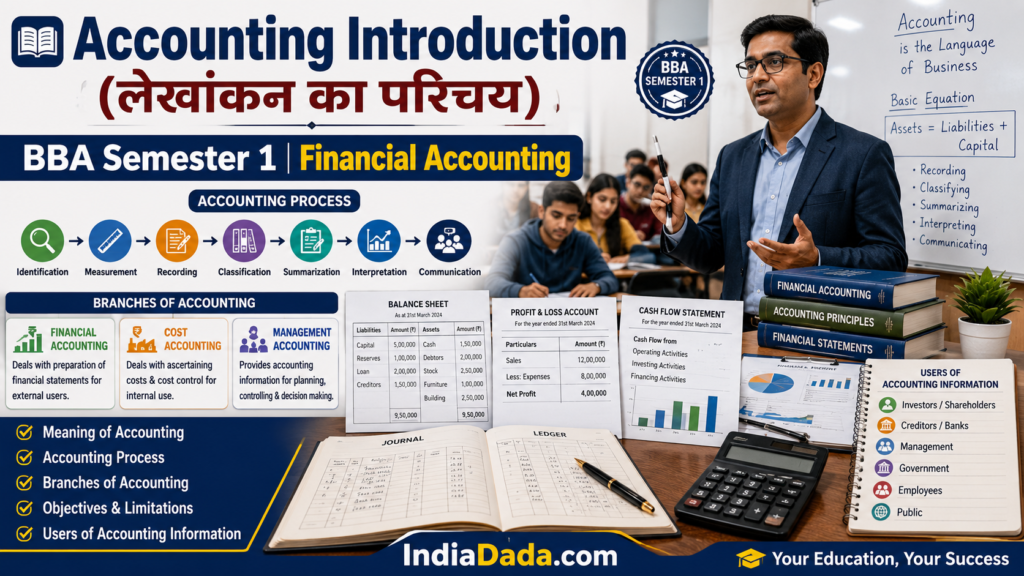
Introduction to Accounting (लेखांकन का परिचय)
मान लीजिए आप एक दुकान चलाते हैं। पूरे दिन में आपने ₹50,000 की बिक्री की, ₹20,000 का सामान खरीदा, कर्मचारियों को वेतन दिया और बिजली का बिल भी जमा किया। अब महीने के अंत में यदि आपसे पूछा जाए कि आपको लाभ हुआ या हानि, तो क्या आप केवल याददाश्त के आधार पर सही उत्तर दे पाएंगे?
यही समस्या हल करने के लिए Accounting (लेखांकन) का जन्म हुआ। Accounting वह प्रणाली है जिसके माध्यम से किसी व्यवसाय के सभी वित्तीय लेन-देन (Financial Transactions) को व्यवस्थित रूप से दर्ज, वर्गीकृत, संक्षिप्त तथा विश्लेषित किया जाता है।
Accounting की सरल परिभाषा
“Accounting is the language of business.”
अर्थात Accounting व्यवसाय की भाषा है, जिसके माध्यम से किसी संस्था की आर्थिक स्थिति को समझा और समझाया जाता है।
Teacher Example (शिक्षक की तरह समझें)
जैसे हम एक-दूसरे से बातचीत करने के लिए हिन्दी या अंग्रेज़ी भाषा का उपयोग करते हैं, उसी प्रकार Business अपनी आर्थिक जानकारी साझा करने के लिए Accounting की भाषा का उपयोग करता है।
- कितनी बिक्री हुई ?
- कितना लाभ हुआ ?
- कितना खर्च हुआ ?
- कितनी संपत्ति (Assets) है ?
- कितना ऋण (Liabilities) है ?
इन सभी प्रश्नों के उत्तर Accounting प्रदान करती है।
Accounting क्या करती है?
Accounting केवल हिसाब-किताब लिखने तक सीमित नहीं है। यह एक पूर्ण प्रक्रिया (Process) है जिसमें निम्न कार्य शामिल होते हैं:
Why Accounting is Important?
आज के आधुनिक व्यापारिक वातावरण में Accounting प्रत्येक व्यवसाय की आवश्यकता बन चुकी है। इसके बिना किसी संस्था की वास्तविक आर्थिक स्थिति जानना लगभग असंभव है।
- व्यापार का लाभ या हानि ज्ञात होती है।
- व्यवसाय की वित्तीय स्थिति का पता चलता है।
- कर (Tax) निर्धारण में सहायता मिलती है।
- निवेशकों एवं बैंकों को जानकारी मिलती है।
- भविष्य की योजनाएँ बनाने में मदद मिलती है।
Meaning of Accounting (लेखांकन का अर्थ)
Accounting को समझने का सबसे आसान तरीका – जैसे एक शिक्षक कक्षा में समझाते हैं।
Accounting क्या है?
जब कोई व्यवसाय (Business) शुरू होता है, तो प्रतिदिन अनेक प्रकार के लेन-देन (Transactions) होते हैं। जैसे सामान खरीदना, बेचना, वेतन देना, बिजली का बिल भरना, बैंक से ऋण लेना आदि।
इन सभी वित्तीय गतिविधियों का व्यवस्थित रिकॉर्ड रखने की प्रक्रिया को Accounting (लेखांकन) कहा जाता है।
Accounting केवल हिसाब लिखने का कार्य नहीं है, बल्कि यह व्यवसाय की आर्थिक स्थिति को समझने और समझाने का एक वैज्ञानिक तरीका है।
Definition 1: Accounting is the Language of Business
“Accounting is the Language of Business.”
जिस प्रकार हम अपने विचार व्यक्त करने के लिए हिन्दी, अंग्रेजी या अन्य भाषाओं का प्रयोग करते हैं, उसी प्रकार व्यवसाय अपनी आर्थिक जानकारी व्यक्त करने के लिए Accounting का उपयोग करता है।
Classroom Example
यदि किसी कंपनी के मालिक को जानना हो कि कंपनी को इस वर्ष कितना लाभ हुआ, तो वह Accounting Reports को देखकर यह जानकारी प्राप्त कर सकता है।
इसलिए Accounting को Business Communication की भाषा कहा जाता है।
Definition 2: Modern Meaning of Accounting
Accounting is a systematic process of identifying, measuring, recording, classifying, summarizing, interpreting and communicating financial information.
सरल शब्दों में, Accounting एक ऐसी प्रक्रिया है जिसमें व्यवसाय की वित्तीय जानकारी को पहचानना, मापना, रिकॉर्ड करना, वर्गीकृत करना, सारांश बनाना, विश्लेषण करना और संबंधित लोगों तक पहुँचाना शामिल होता है।
Teacher's Explanation (शिक्षक की तरह समझें)
मान लीजिए आपने एक मोबाइल शॉप शुरू की।
- ₹50,000 के मोबाइल खरीदे।
- ₹70,000 के मोबाइल बेचे।
- ₹5,000 दुकान का किराया दिया।
- ₹2,000 बिजली का बिल जमा किया।
अब यदि महीने के अंत में पूछा जाए कि आपको कितना लाभ हुआ, तो बिना रिकॉर्ड के यह बताना मुश्किल होगा।
Accounting यही कार्य आसान बनाती है।
Accounting सभी लेन-देन को व्यवस्थित रूप से रिकॉर्ड करती है और अंत में बताती है कि व्यवसाय लाभ में है या हानि में।
Important Points for BBA Exams
- Accounting is known as the Language of Business.
- It records only Financial Transactions.
- It helps in decision making.
- It provides useful information to management.
- It shows Profit, Loss and Financial Position.
Exam Tip
यदि परीक्षा में Accounting की परिभाषा पूछी जाए, तो "Accounting is the Language of Business" तथा "Systematic Process Definition" दोनों लिखने पर उत्तर अधिक प्रभावशाली बनता है।
Accounting Process (लेखांकन प्रक्रिया)
Accounting केवल रिकॉर्ड लिखने तक सीमित नहीं है। यह एक क्रमबद्ध (Systematic) प्रक्रिया है जिसमें कई चरण शामिल होते हैं। प्रत्येक चरण व्यवसाय की वित्तीय जानकारी को उपयोगी बनाने में महत्वपूर्ण भूमिका निभाता है।
Teacher's Classroom Explanation
मान लीजिए आपने एक नया Business शुरू किया है। प्रतिदिन खरीद, बिक्री, भुगतान और प्राप्ति जैसे अनेक लेन-देन होते हैं।
यदि इन सभी Transactions को बिना किसी क्रम के लिखा जाए तो बाद में Profit, Loss या Financial Position जानना लगभग असंभव हो जाएगा।
इसलिए Accounting एक निश्चित Process को Follow करती है।
Identification
सबसे पहले उन Transactions की पहचान की जाती है जो Financial Nature के हों।
Measurement
पहचान किए गए Transactions को Money Terms (₹) में मापा जाता है।
Recording
Transactions को Journal Book में पहली बार दर्ज किया जाता है।
Classification
समान प्रकृति के Transactions को Ledger Accounts में वर्गीकृत किया जाता है।
Summarization
Trial Balance, Trading Account, P&L Account और Balance Sheet तैयार की जाती है।
Analysis & Interpretation
तैयार Reports का विश्लेषण करके Profit, Loss तथा Financial Position समझी जाती है।
Communication
अंतिम रिपोर्ट Investors, Owners, Banks तथा Management तक पहुँचाई जाती है।
Real Business Example
| Transaction | Accounting Process |
|---|---|
| ₹50,000 का माल खरीदा | Identify + Measure |
| Journal Entry की गई | Recording |
| Purchase Account में पोस्ट किया | Classification |
| Trial Balance बनाया | Summarization |
| Profit निकाला | Analysis |
| Management को रिपोर्ट दी | Communication |
Exam Important Point
Accounting Process के 7 Steps को हमेशा इसी क्रम में याद रखें:
Identification → Measurement → Recording → Classification → Summarization → Analysis → Communication
Memory Trick (याद रखने की ट्रिक)
"पहचानो – मापो – लिखो – वर्गीकृत करो – सार बनाओ – विश्लेषण करो – जानकारी पहुँचाओ"
यह लाइन पूरे Accounting Process को कुछ ही सेकंड में याद रखने में मदद करती है।
Branches of Accounting (लेखांकन की शाखाएँ)
Accounting एक बहुत व्यापक विषय है। व्यवसाय की बढ़ती आवश्यकताओं के कारण Accounting को विभिन्न शाखाओं (Branches) में विभाजित किया गया है ताकि अलग-अलग उद्देश्यों को प्रभावी रूप से पूरा किया जा सके।
Teacher's Classroom Explanation
Students, अक्सर Exam में पूछा जाता है कि Accounting की Branches कितनी हैं?
Accounting की मुख्यतः तीन शाखाएँ होती हैं — Financial Accounting, Cost Accounting और Management Accounting.
प्रत्येक शाखा का उद्देश्य अलग-अलग होता है और सभी मिलकर Business Decision Making को मजबूत बनाती हैं।
Financial Accounting
Financial Accounting, Accounting की सबसे पुरानी और सबसे महत्वपूर्ण शाखा है।
इसका मुख्य उद्देश्य Financial Transactions को Record करना, Classify करना, Summarize करना तथा Financial Statements तैयार करना है।
Main Functions:
- Journal Entries करना
- Ledger बनाना
- Trial Balance तैयार करना
- Profit & Loss Account बनाना
- Balance Sheet तैयार करना
Cost Accounting
Cost Accounting का मुख्य उद्देश्य किसी Product, Service, Process या Activity की लागत (Cost) ज्ञात करना है।
यह शाखा Management को Cost Control तथा Cost Reduction में सहायता करती है।
Main Functions:
- Cost Determination
- Cost Control
- Cost Reduction
- Budget Preparation
- Efficiency Analysis
Management Accounting
Management Accounting आधुनिक Accounting की सबसे महत्वपूर्ण शाखाओं में से एक है।
यह Financial Accounting और Cost Accounting से प्राप्त जानकारी का उपयोग करके Management को निर्णय लेने में सहायता करती है।
Main Functions:
- Planning
- Decision Making
- Forecasting
- Performance Evaluation
- Business Control
Comparison of Accounting Branches
| Basis | Financial Accounting | Cost Accounting | Management Accounting |
|---|---|---|---|
| Main Objective | Profit & Loss Calculation | Cost Calculation | Decision Making |
| Users | External Users | Internal Management | Top Management |
| Focus Area | Financial Transactions | Cost Information | Strategic Planning |
| Reports | Financial Statements | Cost Reports | Management Reports |
Easy Memory Trick
F → C → M
- F = Financial Accounting → Profit
- C = Cost Accounting → Cost
- M = Management Accounting → Management Decisions
BBA Semester Exam Point of View
Exam में अक्सर पूछा जाता है:
- Explain Branches of Accounting.
- Differentiate Financial and Cost Accounting.
- Role of Management Accounting in Decision Making.
- Objectives of Cost Accounting.
इसलिए Financial Accounting, Cost Accounting और Management Accounting की Definitions तथा Differences अवश्य तैयार रखें।
Objectives of Accounting (लेखांकन के उद्देश्य)
Accounting केवल लेन-देन को लिखने का कार्य नहीं है, बल्कि यह व्यवसाय को सही दिशा देने वाला एक महत्वपूर्ण प्रबंधन उपकरण (Management Tool) भी है।
Teacher's Classroom Explanation
Students, अक्सर Exam में प्रश्न पूछा जाता है — "What are the Objectives of Accounting?"
Accounting का मुख्य उद्देश्य केवल Records तैयार करना नहीं है, बल्कि Business की Financial Position, Profitability और Future Decisions के लिए उपयोगी जानकारी प्रदान करना भी है।
आइए Accounting के सभी महत्वपूर्ण उद्देश्यों को विस्तार से समझते हैं।
Maintaining Systematic Records
(व्यवस्थित रिकॉर्ड बनाए रखना)
किसी भी व्यवसाय में प्रतिदिन अनेक Financial Transactions होते हैं। यदि इन्हें व्यवस्थित रूप से रिकॉर्ड नहीं किया जाए तो भविष्य में जानकारी प्राप्त करना कठिन हो जाएगा।
Accounting इन सभी लेन-देन का व्यवस्थित रिकॉर्ड तैयार करती है।
Determination of Profit or Loss
(लाभ या हानि का निर्धारण)
किसी भी Business का सबसे महत्वपूर्ण उद्देश्य Profit कमाना होता है।
Accounting यह बताती है कि व्यवसाय को किसी निश्चित अवधि में लाभ (Profit) हुआ है या हानि (Loss)।
इसके लिए Profit & Loss Account तैयार किया जाता है।
Determining Financial Position
(वित्तीय स्थिति ज्ञात करना)
केवल Profit जानना पर्याप्त नहीं है। व्यवसाय की वास्तविक आर्थिक स्थिति जानना भी आवश्यक होता है।
Accounting Balance Sheet की सहायता से यह बताती है कि Business के पास कितनी Assets और Liabilities हैं।
Providing Information to Users
(उपयोगकर्ताओं को जानकारी प्रदान करना)
Accounting विभिन्न Stakeholders को आवश्यक जानकारी प्रदान करती है।
- Owners
- Managers
- Investors
- Creditors
- Banks
- Government
यह जानकारी निर्णय लेने में सहायता करती है।
Facilitating Decision Making
(निर्णय लेने में सहायता करना)
Management को Business से संबंधित अनेक निर्णय लेने होते हैं।
Accounting आवश्यक Financial Information उपलब्ध कराकर Decision Making को आसान बनाती है।
Facilitating Planning and Control
(योजना एवं नियंत्रण में सहायता)
Accounting Management को Planning और Controlling में सहायता प्रदान करती है।
बजट तैयार करना, लागत नियंत्रण करना और भविष्य की रणनीति बनाना Accounting Information के बिना संभव नहीं है।
Quick Revision Table
| Objective | Main Purpose |
|---|---|
| Systematic Records | सभी लेन-देन का रिकॉर्ड रखना |
| Profit Determination | लाभ या हानि ज्ञात करना |
| Financial Position | Assets एवं Liabilities जानना |
| User Information | Stakeholders को जानकारी देना |
| Decision Making | Management को निर्णय में सहायता |
| Planning & Control | भविष्य की योजना एवं नियंत्रण |
Memory Trick for Exam
SPFUDP
- S = Systematic Records
- P = Profit Determination
- F = Financial Position
- U = User Information
- D = Decision Making
- P = Planning & Control
BBA Semester Exam Focus
- Explain Objectives of Accounting.
- How does Accounting help in Decision Making?
- Explain Financial Position Objective.
- Role of Accounting in Planning and Control.
- Difference between Profit Determination and Financial Position.
Limitations of Accounting & Users of Accounting Information
अब तक हमने Accounting का Meaning, Process, Branches और Objectives समझ लिया है। अब हम Accounting की सीमाएँ (Limitations) और Accounting Information के Users को समझेंगे।
Teacher's Classroom Explanation
Students, Exam में अक्सर पूछा जाता है — "What are the Limitations of Accounting?" और "Who are the Users of Accounting Information?"
यह Topic Short Notes, 3 Marks, 5 Marks और Long Answer सभी में महत्वपूर्ण है।
Limitations of Accounting (लेखांकन की सीमाएँ)
Accounting Business की बहुत उपयोगी Information प्रदान करती है, लेकिन Accounting की कुछ सीमाएँ भी होती हैं।
- Not Fully Exact: Accounting पूरी तरह सटीक नहीं होती क्योंकि कई स्थानों पर Estimation का उपयोग किया जाता है।
- Ignores Qualitative Factors: ईमानदार कर्मचारी, ब्रांड वैल्यू, ग्राहक संतुष्टि जैसी चीजों को Accounting में रिकॉर्ड नहीं किया जा सकता।
- Historical Information: Accounting अधिकतर पुराने डेटा पर आधारित होती है।
- Price Level Changes Ignored: Inflation और Purchasing Power में बदलाव को Accounting पूरी तरह नहीं दर्शाती।
- Possibility of Window Dressing: Financial Statements को कभी-कभी बेहतर दिखाने के लिए Manipulate किया जा सकता है।
Users of Accounting Information
Accounting Information केवल Accountant के लिए नहीं होती। Business से जुड़े कई लोग इसका उपयोग करते हैं।
1. Internal Users (आंतरिक उपयोगकर्ता)
- Owners (स्वामी)
- Management (प्रबंधन)
- Employees (कर्मचारी)
2. External Users (बाहरी उपयोगकर्ता)
- Investors
- Banks & Financial Institutions
- Creditors
- Government
- Customers
- General Public
Internal vs External Users
| Basis | Internal Users | External Users |
|---|---|---|
| Relationship | Business के अंदर | Business के बाहर |
| Examples | Owners, Managers, Employees | Investors, Banks, Government |
| Main Purpose | Decision Making | Investment & Credit Decisions |
Complete Chapter Quick Revision
- Accounting is the Language of Business.
- Accounting is a Systematic Process.
- Accounting Process has 7 Steps.
- Identification → Measurement → Recording → Classification → Summarization → Interpretation → Communication.
- Main Branches: Financial, Cost & Management Accounting.
- Main Objectives: Records, Profit, Financial Position, Decision Making.
- Accounting has certain Limitations.
- Many Internal and External Users depend on Accounting Information.
Frequently Asked Questions (FAQ)
Q1. What is Accounting?
Accounting is the systematic process of identifying, measuring, recording, classifying, summarizing, interpreting and communicating financial information.
Q2. Why is Accounting called the Language of Business?
Because Accounting communicates financial information among different users of business.
Q3. How many steps are there in Accounting Process?
There are seven steps: Identification, Measurement, Recording, Classification, Summarization, Interpretation and Communication.
Q4. What are the Branches of Accounting?
Financial Accounting, Cost Accounting and Management Accounting.
Q5. What is the main objective of Accounting?
To maintain records, determine profit or loss, ascertain financial position and help in decision making.
Q6. What is Financial Accounting?
Financial Accounting records business transactions and prepares financial statements.
Q7. What is Cost Accounting?
Cost Accounting determines and controls the cost of products and services.
Q8. What is Management Accounting?
Management Accounting provides information for managerial decision making.
Q9. What are the limitations of Accounting?
Accounting ignores qualitative factors, depends on estimates and may be affected by window dressing.
Q10. Who are the Users of Accounting Information?
Owners, Managers, Employees, Investors, Banks, Creditors and Government.
BBA Semester Important Questions
- Define Accounting.
- Explain Accounting Process.
- Discuss Branches of Accounting.
- What are the Objectives of Accounting?
- Explain Limitations of Accounting.
- Who are the Users of Accounting Information?
- Differentiate Financial, Cost and Management Accounting.
- Why is Accounting called the Language of Business?
Conclusion
Accounting आधुनिक व्यवसाय की रीढ़ (Backbone) है। यह केवल लेन-देन रिकॉर्ड करने की प्रक्रिया नहीं है बल्कि Business Planning, Financial Control और Decision Making का आधार भी है।
एक मजबूत Accounting System किसी भी संगठन को Profitability, Financial Stability और Long-Term Growth प्राप्त करने में सहायता करता है।
यदि Accounting के Basic Concepts मजबूत हैं, तो आगे Financial Accounting, Cost Accounting, Corporate Accounting और Management Accounting जैसे विषयों को समझना बहुत आसान हो जाता है।
Continue Learning With IndiaDada
UPSC, SSC CGL, UPTET, Current Affairs, Government Jobs, School Education, Higher Education, Notes, PDF, MCQ, PYQ, Mock Tests और Exam Preparation की सम्पूर्ण सामग्री अब एक ही प्लेटफॉर्म पर।
Daily Current Affairs
Daily Current Affairs Notes, PDF & Analysis
🎯Current Affairs MCQ
Daily Quiz, Practice Sets & Mock Questions
🇮🇳UPSC Preparation
Prelims, CSAT, Mains Notes & PYQs
📑SSC CGL
Notes, Previous Papers & Mock Tests
🧠UPTET Preparation
Latest Notes, MCQ & Practice Sets
💼Government Jobs
Latest Sarkari Naukri & Recruitment Updates
🔥 Important Study Resources
🌐 Important Official Resources
🎯 Popular Exam Categories
🚀 Stay Connected With IndiaDada.com
Daily Current Affairs, UPSC, SSC CGL, UPTET, Government Jobs, Previous Year Papers, Notes, MCQ, Mock Tests तथा Latest Exam Updates प्राप्त करने के लिए IndiaDada.com के साथ जुड़े रहें।
Visit IndiaDada.com