
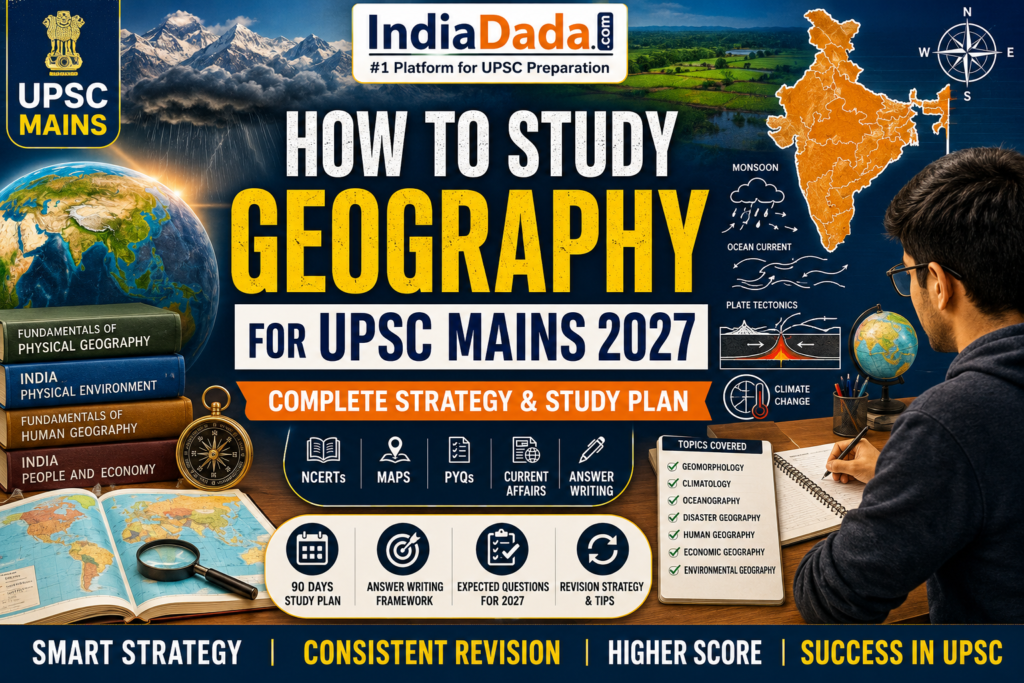
How to Study Geography for UPSC Mains 2027: Complete Strategy, Sources & Answer Writing Approach
UPSC Civil Services Examination में Geography ऐसा विषय है जो हर वर्ष General Studies Paper-1 में लगभग 85 से 100 अंकों का योगदान देता है। यही कारण है कि Geography को GS-1 का सबसे महत्वपूर्ण और सबसे अधिक स्कोरिंग सेक्शन माना जाता है।
अधिकांश अभ्यर्थी Geography को केवल NCERT पढ़कर तैयार करने की कोशिश करते हैं, लेकिन Mains Examination में केवल तथ्य (Facts) या Concept याद होना पर्याप्त नहीं होता। UPSC यह देखता है कि अभ्यर्थी किसी भौगोलिक घटना (Geographical Phenomenon) को कारण, प्रभाव, उदाहरण, वर्तमान घटनाओं और समाधान के साथ कितनी प्रभावी तरीके से प्रस्तुत कर सकता है।
यही वजह है कि कई उम्मीदवार Preliminary Examination में Geography के प्रश्न आसानी से हल कर लेते हैं, लेकिन Mains में अपेक्षित अंक प्राप्त नहीं कर पाते। इसका सबसे बड़ा कारण Answer Writing Skills, Diagram Usage, Mapping Techniques तथा PYQ Based Preparation की कमी होती है।
यदि पिछले वर्षों के प्रश्नपत्रों का विश्लेषण किया जाए तो स्पष्ट होता है कि UPSC बार-बार कुछ निश्चित क्षेत्रों से प्रश्न पूछता है, जैसे—
- Geomorphology (भू-आकृति विज्ञान)
- Climatology (जलवायु विज्ञान)
- Oceanography (महासागरीय विज्ञान)
- Disaster Geography
- Human Geography
- Economic Geography
- Climate Change & Environmental Geography
- Resource Distribution & Industrial Location
इस विस्तृत मार्गदर्शिका में हम Geography Mains Preparation की सम्पूर्ण रणनीति समझेंगे। हम यह जानेंगे कि किन टॉपिक्स से सबसे अधिक प्रश्न पूछे जाते हैं, कौन-कौन से स्रोत सबसे उपयोगी हैं, Answer Writing में Diagram और Maps का प्रयोग कैसे किया जाए तथा 90 दिनों में Geography को Mains Ready कैसे बनाया जाए।
Why Most Aspirants Struggle in Geography Mains?
हर वर्ष हजारों अभ्यर्थी Geography को आसान विषय समझकर तैयारी शुरू करते हैं। NCERT पढ़ लेते हैं, कुछ नोट्स बना लेते हैं और उन्हें लगता है कि Geography का सिलेबस पूरा हो गया है। लेकिन जब UPSC Mains का प्रश्नपत्र सामने आता है तो अधिकांश उम्मीदवार यह महसूस करते हैं कि उन्हें उत्तर लिखने में कठिनाई हो रही है।
वास्तविक समस्या Geography के Concepts में नहीं, बल्कि Concepts को Mains Answer में बदलने की क्षमता में होती है। यही कारण है कि समान ज्ञान होने के बावजूद कुछ अभ्यर्थी 40-50 अंक प्राप्त करते हैं जबकि अन्य 80+ अंक तक पहुँच जाते हैं।
1. Geography को केवल Prelims Subject समझना
अधिकांश छात्र Geography को केवल तथ्यात्मक विषय मानते हैं और Objective Questions के दृष्टिकोण से पढ़ते हैं। जबकि Mains में UPSC Analysis, Interlinkages, Current Affairs Integration और Multi-Dimensional Answers की अपेक्षा करता है।
2. PYQ Analysis को Ignore करना
बहुत से उम्मीदवार सीधे किताबें पढ़ना शुरू कर देते हैं लेकिन पिछले वर्षों के प्रश्नों का विश्लेषण नहीं करते। परिणामस्वरूप उन्हें यह पता ही नहीं चलता कि UPSC वास्तव में क्या पूछ रहा है।
सच्चाई यह है कि Earthquakes, Cyclones, Climate Change, Ocean Currents, Monsoon, Resources, Industries और Disaster Geography जैसे विषयों से बार-बार प्रश्न पूछे जाते हैं।
3. Diagram और Maps का उपयोग न करना
Geography ऐसा विषय है जिसमें Diagram, Flowchart, Maps और Labelling सीधे आपके अंक बढ़ा सकते हैं। फिर भी अधिकांश उत्तर केवल Paragraph में लिखे जाते हैं।
UPSC Examiner हमेशा Visual Presentation वाले उत्तर को अधिक प्रभावी मानता है क्योंकि इससे समझ और प्रस्तुति दोनों स्पष्ट होती हैं।
4. Current Affairs से Geography को Link न करना
आज की Geography Static नहीं है। Climate Change, Glacier Melting, Heat Waves, Marine Heat Waves, El-Nino, La-Nina, Cyclones, Droughts और Floods लगातार Current Affairs से जुड़े हुए हैं।
यदि उत्तर में Contemporary Examples नहीं होंगे तो उत्तर अधूरा माना जा सकता है।
5. Human Geography और Economic Geography को Ignore करना
अधिकांश उम्मीदवार केवल Physical Geography पर ध्यान देते हैं जबकि UPSC Human Geography, Resource Distribution, Population, Migration, Urbanisation और Industrial Location जैसे विषयों से भी नियमित प्रश्न पूछता है।
6. Structureless Answer Writing
कई उम्मीदवारों को विषय आता है लेकिन उत्तर बिखरा हुआ होता है। Introduction, Body, Diagram, Examples, Case Studies और Conclusion की स्पष्ट संरचना नहीं होती।
ऐसे उत्तर ज्ञान होने के बावजूद औसत अंक प्राप्त करते हैं।
7. Source Overload की समस्या
कुछ छात्र 8-10 अलग-अलग Books, PDFs और Coaching Notes पढ़ने लगते हैं। परिणामस्वरूप Revision नहीं हो पाता।
UPSC Geography के लिए 11th और 12th NCERT, Atlas, Current Affairs और सीमित Standard Sources पर्याप्त होते हैं।
Reality Check
UPSC Geography में समस्या Knowledge की कमी नहीं होती। समस्या होती है—
- Question Demand को न समझना
- Answer Structure का अभाव
- Diagram और Maps न बनाना
- Current Affairs Integration न करना
- PYQ आधारित तैयारी न करना
जो अभ्यर्थी इन पाँच समस्याओं को ठीक कर लेते हैं, वे Geography में उल्लेखनीय सुधार कर सकते हैं।
UPSC Geography Syllabus Decoding: UPSC वास्तव में Geography से क्या पूछता है?
UPSC Geography की तैयारी शुरू करने से पहले सबसे महत्वपूर्ण कार्य है Syllabus को सही तरीके से समझना। अधिकांश उम्मीदवार Geography को एक विशाल विषय मानकर पढ़ना शुरू कर देते हैं, लेकिन UPSC का Geography Syllabus वास्तव में कुछ सीमित और निश्चित Themes के आसपास ही घूमता है।
यदि Syllabus को ध्यान से पढ़ा जाए तो Geography को मुख्य रूप से तीन बड़े भागों में विभाजित किया जा सकता है—
1. Physical Geography (सबसे अधिक महत्वपूर्ण)
UPSC Geography का सबसे बड़ा भाग Physical Geography है। प्रत्येक वर्ष अधिकांश प्रश्न इसी क्षेत्र से पूछे जाते हैं।
- Interior of Earth
- Earthquake & Seismic Waves
- Volcanoes
- Continental Drift Theory
- Plate Tectonic Theory
- Mountain Building
- Landforms
- Atmosphere
- Monsoon System
- Cyclones
- Ocean Currents
- Coral Reefs
- Climate Change Impacts
2. Human Geography
यह क्षेत्र अक्सर छात्रों द्वारा कम महत्व दिया जाता है लेकिन UPSC नियमित रूप से Population, Migration, Urbanisation और Settlement से प्रश्न पूछता है।
- Population Distribution
- Demographic Transition
- Migration
- Refugee Issues
- Urbanisation
- Smart Cities
- Settlement Geography
3. Economic Geography
Economic Geography सीधे UPSC Syllabus में शामिल है और Industry तथा Resources आधारित प्रश्न लगातार पूछे जाते हैं।
- Natural Resources Distribution
- Coal Distribution
- Petroleum Resources
- Iron Ore Regions
- Industrial Location Factors
- Primary Sector Industries
- Secondary Sector Industries
- Tertiary Sector Development
4. Environmental Geography
Climate Change के बाद Environmental Geography का महत्व तेजी से बढ़ा है। पिछले वर्षों में कई प्रश्न सीधे Environmental Issues और Geographical Changes से जुड़े हुए दिखाई देते हैं।
- Global Warming
- Glacier Melting
- Sea Level Rise
- Desertification
- Biodiversity Loss
- Marine Heat Waves
- Extreme Weather Events
Expected Weightage Analysis
| Topic | Expected Importance |
|---|---|
| Physical Geography | ★★★★★ |
| Climatology | ★★★★★ |
| Oceanography | ★★★★☆ |
| Disaster Geography | ★★★★★ |
| Human Geography | ★★★★☆ |
| Economic Geography | ★★★★☆ |
| Environmental Geography | ★★★★★ |
What UPSC Examiner Actually Wants?
UPSC केवल Definitions नहीं पूछता। UPSC यह देखता है कि उम्मीदवार किसी Geographical Topic को Cause → Process → Impact → Solution Framework में समझा सकता है या नहीं।
उदाहरण के लिए—
- Earthquake → Causes + Impacts + Mitigation
- Cyclone → Formation + Climate Change Linkage + Disaster Management
- Monsoon → Mechanism + Variability + Economic Impact
- Glacier Melting → Causes + Consequences + Adaptation Measures
Syllabus को Chapters की तरह नहीं, बल्कि Themes की तरह पढ़िए। यदि आपने Physical Geography, Human Geography, Economic Geography और Environmental Geography के Core Themes को समझ लिया, तो Geography के 80% से अधिक प्रश्न स्वतः कवर हो जाते हैं।
Geography PYQ Trend Analysis (2013–2025): UPSC बार-बार किन Topics से Questions पूछता है?
UPSC Mains Geography की तैयारी का सबसे शक्तिशाली तरीका Previous Year Questions (PYQs) का विश्लेषण है। यदि पिछले 10–12 वर्षों के प्रश्नों को ध्यानपूर्वक देखा जाए तो स्पष्ट होता है कि UPSC हर वर्ष नए शब्दों में लगभग उन्हीं Core Themes से प्रश्न पूछता है।
यही कारण है कि सफल अभ्यर्थी Geography को Chapters के रूप में नहीं बल्कि Question Themes के रूप में तैयार करते हैं।
UPSC Geography का सबसे बड़ा Secret
UPSC Questions बदलता है, लेकिन Topics बहुत कम बदलता है।
Topic-wise Question Frequency Analysis
| Topic | Frequency | Importance |
|---|---|---|
| Earthquakes & Plate Tectonics | ★★★★★ | Very High |
| Cyclones | ★★★★★ | Very High |
| Monsoon System | ★★★★★ | Very High |
| Climate Change | ★★★★★ | Very High |
| Landslides | ★★★★☆ | High |
| Ocean Currents | ★★★★☆ | High |
| Resource Distribution | ★★★★☆ | High |
| Industrial Location | ★★★★☆ | High |
| Population & Migration | ★★★☆☆ | Moderate |
| Urbanisation | ★★★☆☆ | Moderate |
Theme 1: Earthquake, Volcano & Plate Tectonics
UPSC बार-बार पृथ्वी की आंतरिक संरचना, भूकंपीय तरंगों, प्लेट विवर्तनिकी सिद्धांत तथा पर्वत निर्माण से जुड़े प्रश्न पूछता है।
- Earth Interior
- Seismic Waves
- Continental Drift
- Plate Tectonics
- Mountain Building
- Volcanic Activity
Theme 2: Cyclones & Atmospheric Systems
Cyclones UPSC के सबसे Favourite Topics में से एक हैं। केवल Formation ही नहीं बल्कि Climate Change, Disaster Management और Economic Impact भी पूछा जाता है।
- Tropical Cyclones
- Temperate Cyclones
- Jet Streams
- Monsoon Mechanism
- El-Nino & La-Nina
- Marine Heat Waves
Theme 3: Climate Change Based Geography
पिछले कुछ वर्षों में Climate Change Geography का सबसे तेजी से बढ़ता हुआ क्षेत्र बन चुका है।
- Glacier Retreat
- Sea Level Rise
- Extreme Weather Events
- Heat Waves
- Biodiversity Loss
- Arctic & Antarctic Changes
Theme 4: Disaster Geography
UPSC Geography को Disaster Management के साथ Interlink करके प्रश्न पूछता है।
- Landslides
- Earthquakes
- Tsunami
- Cyclones
- Cloudburst
- Floods & Droughts
Theme 5: Human & Economic Geography
कई अभ्यर्थी इस क्षेत्र को छोड़ देते हैं जबकि UPSC लगातार Resource Distribution और Industrial Location से प्रश्न पूछता है।
- Population Distribution
- Migration
- Urbanisation
- Natural Resources
- Industrial Location
- Regional Development
UPSC Geography 2027 Prediction Matrix
यदि PYQ Trends, Climate Events और Current Affairs को मिलाकर विश्लेषण किया जाए तो 2027 के लिए निम्न Topics अत्यंत महत्वपूर्ण दिखाई देते हैं—
- Climate Change & Extreme Weather
- Indian Monsoon Variability
- Marine Heat Waves
- Indian Ocean Dipole
- Glacier Melting
- Plate Tectonics
- Earthquake Zones of India
- Landslides in Himalayas
- Urban Flooding
- Industrial Corridors & Resource Geography
How UPSC Thinks While Setting Geography Questions?
UPSC कभी भी सीधे NCERT के Heading से प्रश्न नहीं पूछता।
UPSC Concept + Current Affairs + Application को मिलाकर प्रश्न बनाता है।
उदाहरण:
- Monsoon → Agriculture + Economy + Climate Change
- Cyclone → Formation + Disaster Management
- Earthquake → Plate Tectonics + Risk Reduction
- Glacier Melting → Climate Change + Water Security
- Urbanisation → Migration + Infrastructure + Sustainability
यदि किसी Topic से 10 वर्षों में 3 या उससे अधिक बार प्रश्न पूछे गए हैं, तो UPSC उसे भविष्य में पुनः पूछ सकता है। Geography Preparation हमेशा PYQ-Driven होनी चाहिए, Book-Driven नहीं।
Geography में सबसे ज्यादा Questions कहाँ से आते हैं? (Topic-wise Source Mapping)
UPSC Geography की तैयारी करते समय अधिकांश अभ्यर्थी सबसे बड़ी गलती यह करते हैं कि वे पूरे सिलेबस को समान महत्व देने लगते हैं। जबकि वास्तविकता यह है कि Geography के कुछ Chapters ऐसे हैं जो अकेले ही GS-1 Geography के 60-80% Questions को प्रभावित करते हैं।
यदि आप Smart Preparation करना चाहते हैं तो आपको पहले High Return Topics पर फोकस करना चाहिए। यही Topics बार-बार PYQs में दिखाई देते हैं और Current Affairs से भी सीधे जुड़े रहते हैं।
UPSC Geography Smart Strategy
सभी Chapters बराबर महत्वपूर्ण नहीं होते। UPSC बार-बार कुछ Core Themes के आसपास ही प्रश्न पूछता है।
NCERT Chapter vs UPSC Question Probability
| Topic | Source | Question Probability |
|---|---|---|
| Interior of Earth | Class 11 NCERT | ★★★★★ |
| Earthquakes | Class 11 NCERT | ★★★★★ |
| Plate Tectonics | Class 11 NCERT | ★★★★★ |
| Continental Drift | Class 11 NCERT | ★★★★★ |
| Landforms | Class 11 NCERT | ★★★★★ |
| Atmosphere | Class 11 NCERT | ★★★★★ |
| Monsoon | Class 11 NCERT | ★★★★★ |
| Cyclones | Class 11 NCERT | ★★★★★ |
| Ocean Currents | Class 11 NCERT | ★★★★☆ |
| Population | Class 12 NCERT | ★★★★☆ |
| Migration | Class 12 NCERT | ★★★★☆ |
| Resources | Class 12 NCERT | ★★★★★ |
| Industries | Class 12 NCERT | ★★★★★ |
| Transport & Communication | Class 12 NCERT | ★★★☆☆ |
Priority Level 1 (Must Cover Topics)
यदि आपके पास समय कम है तो सबसे पहले इन Topics को Master कीजिए।
- Interior of Earth
- Earthquakes & Seismic Waves
- Volcanoes
- Continental Drift Theory
- Plate Tectonic Theory
- Mountain Building
- Monsoon
- Cyclones
- Climate Change
- Ocean Currents
इन Topics से लगभग हर वर्ष प्रत्यक्ष या अप्रत्यक्ष प्रश्न पूछे जाते हैं।
Priority Level 2 (High Scoring Topics)
- Population Geography
- Migration
- Urbanisation
- Settlement Geography
- Human Development
- Resource Distribution
- Industrial Location Theory
UPSC अक्सर Human Geography को Economic Geography के साथ जोड़कर प्रश्न पूछता है।
Priority Level 3 (Current Affairs Linked Topics)
- Marine Heat Waves
- Glacier Melting
- Sea Level Rise
- Desertification
- El-Nino & La-Nina
- Indian Ocean Dipole
- Arctic Amplification
- Urban Flooding
ये Topics Climate Change आधारित Questions में अत्यंत महत्वपूर्ण हैं।
Chapter Mapping Strategy
Class 11 NCERT Physical Geography
यह पुस्तक UPSC Geography की Foundation है। Earth, Atmosphere, Oceans और Landforms से जुड़े अधिकांश Concepts यहीं से आते हैं।
Class 12 NCERT Human Geography
Population, Migration, Settlements, Human Development और Resources से संबंधित सभी महत्वपूर्ण Topics इसी पुस्तक से तैयार होते हैं।
Class 12 NCERT India People and Economy
Resources, Agriculture, Industries, Transport, Regional Development और Economic Geography के लिए यह सबसे महत्वपूर्ण Source है।
Most Repeated UPSC Geography Question Areas
- Why do Earthquakes occur?
- Role of Plate Tectonics in Mountain Formation
- Cyclone Formation and Impact
- Indian Monsoon Mechanism
- Climate Change and Extreme Events
- Resource Distribution Patterns
- Industrial Location Factors
- Population Migration Issues
- Urbanisation Challenges
- Disaster Geography
यदि कोई अभ्यर्थी केवल Class 11 Physical Geography और Class 12 Human Geography + India People and Economy NCERT को गहराई से पढ़ ले तथा PYQs का विश्लेषण कर ले, तो Geography GS-1 के अधिकांश प्रश्नों का आधार तैयार हो जाता है।
Physical Geography Strategy: UPSC Mains के 40-50% Marks यहीं से आते हैं
यदि UPSC Geography को एक विशाल वृक्ष माना जाए तो Physical Geography उसकी जड़ (Foundation) है। पिछले कई वर्षों के प्रश्नपत्रों का विश्लेषण बताता है कि GS Paper-1 में Geography के अधिकांश प्रश्न प्रत्यक्ष या अप्रत्यक्ष रूप से Physical Geography से जुड़े होते हैं।
यही कारण है कि किसी भी गंभीर अभ्यर्थी को सबसे पहले Physical Geography को Master करना चाहिए। Earthquake, Volcano, Cyclone, Monsoon, Mountain Building, Ocean Currents और Climate Change जैसे Topics की नींव Physical Geography में ही मौजूद होती है।
Why Physical Geography is So Important?
- GS-1 Geography का सबसे बड़ा भाग
- Disaster Management का आधार
- Climate Change समझने की Foundation
- Current Affairs से सबसे अधिक Linkage
- Maps और Diagrams के लिए सबसे उपयुक्त क्षेत्र
- Direct + Indirect Questions दोनों यहीं से आते हैं
1. Interior of Earth (पृथ्वी की आंतरिक संरचना)
यह Physical Geography का पहला और सबसे महत्वपूर्ण अध्याय है। लगभग सभी Geophysical Processes यहीं से शुरू होती हैं।
- Crust
- Mantle
- Core
- Density Variations
- Temperature Gradient
- Composition of Earth Layers
UPSC अक्सर इस Topic को Seismic Waves तथा Earthquake से जोड़कर प्रश्न पूछता है।
2. Seismic Waves (भूकंपीय तरंगें)
Seismic Waves Geography Mains के Favourite Topics में से एक हैं।
- P-Waves
- S-Waves
- Surface Waves
- Shadow Zone
- Earth Interior Discovery
यहीं से UPSC Earth Interior और Earthquake दोनों को जोड़कर Analytical Questions पूछता है।
3. Earthquakes (भूकंप)
Earthquake केवल एक Geography Topic नहीं बल्कि Geography + Disaster Management का Combined Theme है।
- Causes
- Types
- Seismic Zones of India
- Impacts
- Risk Reduction
- Earthquake Resistant Infrastructure
4. Volcanoes (ज्वालामुखी)
Volcanoes को हमेशा Plate Tectonics के साथ पढ़ें।
- Volcanic Eruptions
- Magma vs Lava
- Volcanic Landforms
- Pacific Ring of Fire
- Volcanic Hazards
5. Continental Drift Theory
Alfred Wegener का Continental Drift Theory UPSC का Classic Topic है।
- Pangaea
- Panthalassa
- Laurasia
- Gondwanaland
- Evidence of Drift
- Limitations
6. Plate Tectonic Theory
Physical Geography का सबसे महत्वपूर्ण Concept Plate Tectonics है।
- Divergent Boundary
- Convergent Boundary
- Transform Boundary
- Subduction Zone
- Volcano Formation
- Earthquake Generation
- Mountain Building
यदि Plate Tectonics अच्छे से समझ ली जाए तो Earthquake, Volcano, Mountain Formation और Island Arcs जैसे कई Topics स्वतः कवर हो जाते हैं।
7. Mountain Building (पर्वत निर्माण)
UPSC अक्सर पूछता है कि पर्वतों का निर्माण किन प्रक्रियाओं से होता है।
- Fold Mountains
- Block Mountains
- Residual Mountains
- Orogenic Processes
- Himalayan Formation
8. Landforms (स्थलाकृतियाँ)
Geomorphology का अंतिम और अत्यंत महत्वपूर्ण भाग Landforms है।
- River Landforms
- Glacial Landforms
- Desert Landforms
- Karst Topography
- Coastal Landforms
Physical Geography Answer Writing Formula
यह Structure UPSC Examiner को एक व्यवस्थित, Analytical और High-Scoring Answer प्रदान करता है।
Diagram Strategy
Physical Geography में Diagram सीधे Marks बढ़ाते हैं।
- Earth Interior Diagram
- Seismic Wave Diagram
- Volcano Structure
- Plate Boundary Diagram
- Mountain Formation Diagram
- River Landform Sketches
UPSC में Diagram हमेशा Artistic नहीं बल्कि Informative होना चाहिए।
यदि कोई अभ्यर्थी Earth Interior → Seismic Waves → Earthquake → Volcano → Continental Drift → Plate Tectonics → Mountain Building → Landforms की Chain को अच्छी तरह समझ लेता है, तो Physical Geography का बड़ा हिस्सा कवर हो जाता है और GS-1 Geography में मजबूत आधार तैयार हो जाता है।
Geomorphology Master Plan: Earth Interior, Earthquake, Volcano, Plate Tectonics और Mountain Building से UPSC Questions कैसे आते हैं?
यदि UPSC Geography को एक इमारत माना जाए तो Geomorphology उसकी नींव (Foundation) है। पिछले कई वर्षों के प्रश्नों का विश्लेषण बताता है कि Earth Interior, Seismic Waves, Earthquakes, Volcanoes, Continental Drift Theory और Plate Tectonic Theory से जुड़े प्रश्न बार-बार पूछे जाते हैं।
सबसे महत्वपूर्ण बात यह है कि UPSC इन Topics को अलग-अलग Chapters के रूप में नहीं पूछता। अधिकांश Questions एक Concept को दूसरे Concept से जोड़कर पूछे जाते हैं।
UPSC का सबसे Favourite Chain Concept
यदि यह पूरी Chain समझ आ गई तो Geomorphology के अधिकांश Questions आसानी से Attempt किए जा सकते हैं।
Chapter 1: Interior of Earth
यह पूरा Geomorphology Section यहीं से शुरू होता है।
Must Read Areas
- Crust (Continental & Oceanic)
- Mantle
- Outer Core
- Inner Core
- Density Variation
- Temperature Gradient
- Composition of Earth Layers
UPSC Angle
UPSC सीधे Layers नहीं पूछता बल्कि Seismic Waves और Earthquake के माध्यम से Earth Interior को जोड़कर प्रश्न पूछता है।
Chapter 2: Seismic Waves
Seismic Waves Geomorphology का सबसे Scoring Concept है।
| Wave | Characteristics |
|---|---|
| P Wave | Fastest, Solid + Liquid |
| S Wave | Only Solid Medium |
| Surface Wave | Most Destructive |
Expected Questions
- How do seismic waves help in understanding Earth's interior?
- Differentiate P and S Waves.
- Explain Seismic Shadow Zones.
Chapter 3: Earthquakes
Earthquake Geography और Disaster Management का Combined Topic है।
Must Cover
- Focus & Epicentre
- Tectonic Earthquakes
- Volcanic Earthquakes
- Seismic Zones of India
- Earthquake Hazards
- Mitigation Measures
Definition → Causes → Distribution → Impacts → India Example → Mitigation → Conclusion
Chapter 4: Volcanoes
Volcanoes को कभी अकेले मत पढ़िए। इन्हें हमेशा Plate Tectonics के साथ पढ़ना चाहिए।
Important Areas
- Magma vs Lava
- Types of Volcanoes
- Volcanic Eruptions
- Ring of Fire
- Volcanic Landforms
- Hazards and Benefits
PYQ Pattern
UPSC Volcanoes को अक्सर Plate Boundaries तथा Earth Movements के साथ जोड़कर पूछता है।
Chapter 5: Continental Drift Theory
Alfred Wegener की Theory आज भी UPSC की Favourite Theories में से एक है।
Key Concepts
- Pangaea
- Panthalassa
- Laurasia
- Gondwanaland
- Drift Evidence
- Limitations
Most Expected Question
Why was Continental Drift Theory replaced by Plate Tectonic Theory?
Chapter 6: Plate Tectonic Theory
यदि Geography का कोई एक Topic पूरे GS-1 Geography को जोड़ता है तो वह Plate Tectonic Theory है।
Topics Covered Through Plate Tectonics
- Earthquakes
- Volcanoes
- Mountain Formation
- Island Arcs
- Ocean Trenches
- Mid Oceanic Ridges
Chapter 7: Mountain Building
Mountain Building सीधे Plate Tectonics से जुड़ा हुआ Topic है।
Must Cover
- Fold Mountains
- Block Mountains
- Residual Mountains
- Orogenic Movements
- Formation of Himalayas
- Young Fold Mountains
Most Expected Question
Explain the role of Plate Tectonics in the formation of Himalayas.
Most Important Diagrams for UPSC Mains
इन 6 Diagrams को Practice करने से Geomorphology के अधिकांश Answers में Visual Advantage प्राप्त किया जा सकता है।
UPSC Secret Strategy
Geomorphology को Chapters में मत पढ़िए।
UPSC Earth Interior नहीं पूछता, UPSC Earth Interior + Seismic Waves पूछता है।
UPSC Volcano नहीं पूछता, UPSC Volcano + Plate Tectonics पूछता है।
UPSC Mountain Building नहीं पूछता, UPSC Mountain Building + Plate Tectonics पूछता है।
यही Interlinkage Approach आपको Geography Mains में High Score दिला सकती है।
Climatology Master Strategy: Atmosphere, Monsoon, Cyclones, El-Nino, La-Nina और Climate Change को UPSC Mains के लिए कैसे पढ़ें?
यदि Geomorphology UPSC Geography की Foundation है, तो Climatology उसका सबसे Scoring Section है। पिछले एक दशक के प्रश्नपत्रों का विश्लेषण बताता है कि Monsoon, Cyclones, Jet Streams, El-Nino, La-Nina, Climate Change और Extreme Weather Events से हर वर्ष प्रत्यक्ष या अप्रत्यक्ष प्रश्न पूछे जाते हैं।
UPSC अब केवल Climate के Basic Concepts नहीं पूछता, बल्कि Climate Change, Agriculture, Economy, Disaster Management और Global Warming के साथ उनका संबंध भी पूछता है।
Why Climatology is UPSC's Favourite?
- Current Affairs से सीधा संबंध
- Climate Change से जुड़ा हुआ
- Disaster Management से Link
- Agriculture पर प्रभाव
- Indian Economy पर प्रभाव
- International Agreements से Connection
Complete Climatology Roadmap
1. Atmosphere (वायुमंडल)
Climatology का पहला अध्याय Atmosphere है। UPSC अक्सर Atmospheric Structure को Weather और Climate Processes से जोड़कर पूछता है।
Must Cover Topics
- Layers of Atmosphere
- Troposphere
- Stratosphere
- Mesosphere
- Thermosphere
- Ozone Layer
2. Pressure Belts & Planetary Winds
Monsoon, Cyclones और Global Climate Systems को समझने के लिए Pressure Belts सबसे महत्वपूर्ण Concept है।
- Equatorial Low Pressure Belt
- Sub-Tropical High Pressure Belt
- Polar High Pressure Belt
- Trade Winds
- Westerlies
- Polar Easterlies
3. Jet Streams
UPSC बार-बार Jet Streams और Indian Monsoon के बीच संबंध पूछता है।
Most Expected Questions
- Role of Jet Streams in Indian Monsoon
- Subtropical Westerly Jet
- Tropical Easterly Jet
- Climate Variability and Jet Streams
4. Indian Monsoon
Indian Monsoon Geography का सबसे महत्वपूर्ण Topic माना जाता है।
Must Cover Areas
- Mechanism of Monsoon
- Onset of Monsoon
- Withdrawal of Monsoon
- Burst of Monsoon
- Break in Monsoon
- Monsoon Variability
- Monsoon and Agriculture
Introduction→ Mechanism→ Factors Affecting→ Economic Impact→ Climate Change Linkage→ Conclusion
5. Tropical Cyclones
Cyclones UPSC Geography के सबसे Repeated Topics में से एक हैं।
Must Read
- Conditions for Formation
- Cyclone Structure
- Eye of Cyclone
- Bay of Bengal Cyclones
- Arabian Sea Cyclones
- Cyclone Risk Zones
- Disaster Preparedness
6. El-Nino & La-Nina (ENSO)
ENSO वर्तमान UPSC Geography का Hot Topic है।
El-Nino
- Pacific Ocean Warming
- Weak Monsoon
- Drought Risk
- Agriculture Impact
La-Nina
- Pacific Ocean Cooling
- Strong Monsoon
- Flood Risk
- Extreme Rainfall
7. Climate Change
UPSC Geography का नया Core Area Climate Change बन चुका है।
Most Important Areas
- Global Warming
- Greenhouse Effect
- Heat Waves
- Marine Heat Waves
- Sea Level Rise
- Glacier Retreat
- Extreme Weather Events
- Climate Adaptation
Most Important Diagrams for UPSC Mains
UPSC Geography 2027 Most Expected Questions
- Discuss the impact of Climate Change on Indian Monsoon.
- Explain the role of Jet Streams in Monsoon Variability.
- How does El-Nino affect India's Agriculture and Water Security?
- Why are Cyclones becoming more intense in the Arabian Sea?
- Discuss the causes and consequences of Marine Heat Waves.
- Evaluate the impact of Extreme Weather Events on Sustainable Development.
UPSC Secret for Climatology
UPSC अब "What is Monsoon?" जैसे प्रश्न नहीं पूछता।
UPSC पूछता है:
- Monsoon + Climate Change
- Cyclone + Disaster Management
- ENSO + Agriculture
- Heat Waves + Economy
- Jet Streams + Monsoon Variability
यही Integrated Approach Geography Mains में High Score का आधार बनती है।
Oceanography Master Strategy: Ocean Currents, Coral Reefs, ENSO, Indian Ocean Dipole और Marine Heat Waves को UPSC Mains के लिए कैसे पढ़ें?
Oceanography UPSC Geography का ऐसा क्षेत्र है जिसे कई अभ्यर्थी कम महत्व देते हैं, जबकि पिछले वर्षों में Ocean Currents, Coral Reefs, El-Nino, La-Nina, Indian Ocean Dipole (IOD), Marine Heat Waves और Blue Economy से लगातार प्रश्न पूछे गए हैं।
Climate Change के बढ़ते प्रभाव के कारण Oceanography का महत्व पहले से कहीं अधिक बढ़ गया है। वर्तमान में Oceanography केवल Physical Geography का विषय नहीं रह गया है बल्कि Climate Change, Disaster Management, Environment और International Relations से भी जुड़ चुका है।
Why Oceanography is Important for UPSC?
- Monsoon को प्रभावित करता है
- Climate Change से सीधा संबंध
- Marine Resources का आधार
- Cyclones को प्रभावित करता है
- Blue Economy का Foundation
- Current Affairs से लगातार जुड़ा हुआ
Complete Oceanography Roadmap
1. Ocean Floor Relief Features
UPSC सीधे Ocean Floor के Features पूछ सकता है या इन्हें Plate Tectonics के साथ जोड़ सकता है।
- Continental Shelf
- Continental Slope
- Abyssal Plains
- Mid Oceanic Ridge
- Ocean Trenches
- Seamounts & Guyots
2. Ocean Currents (महासागरीय धाराएँ)
Ocean Currents UPSC Geography के सबसे महत्वपूर्ण Oceanography Topics में से एक हैं।
Warm Currents
- Gulf Stream
- Kuroshio Current
- Brazil Current
- Agulhas Current
Cold Currents
- Labrador Current
- California Current
- Peru Current
- Canary Current
UPSC Focus Areas
- Climate Influence
- Fishing Grounds
- Fog Formation
- Marine Biodiversity
3. Coral Reefs
Coral Reefs Environment और Geography दोनों के लिए अत्यंत महत्वपूर्ण Topic हैं।
- Fringing Reefs
- Barrier Reefs
- Atolls
- Coral Bleaching
- Great Barrier Reef
- Lakshadweep Reefs
Climate Change and Coral Reef Degradation: Causes, Consequences and Conservation Measures.
4. ENSO (El-Nino Southern Oscillation)
ENSO Indian Monsoon और Global Climate दोनों को प्रभावित करता है।
| El-Nino | La-Nina |
|---|---|
| Pacific Warming | Pacific Cooling |
| Weak Monsoon | Strong Monsoon |
| Drought Risk | Flood Risk |
| Lower Agriculture Output | Excess Rainfall |
5. Indian Ocean Dipole (IOD)
Indian Ocean Dipole UPSC का Current Affairs Favourite Topic बन चुका है।
Important Areas
- Positive IOD
- Negative IOD
- Impact on Monsoon
- Agriculture Impact
- Climate Variability
UPSC अक्सर IOD को ENSO और Indian Monsoon के साथ जोड़कर प्रश्न पूछता है।
6. Marine Heat Waves
Marine Heat Waves वर्तमान समय का सबसे Trending Geography Topic है।
- Ocean Temperature Rise
- Coral Bleaching
- Cyclone Intensification
- Marine Ecosystem Damage
- Fishery Sector Impact
7. Blue Economy & Ocean Resources
Blue Economy Geography और Economy का Integrated Topic है।
- Marine Fisheries
- Offshore Energy
- Deep Sea Mining
- Marine Trade Routes
- Coastal Economy
- Sustainable Ocean Governance
Most Important Oceanography Diagrams
Oceanography Answer Writing Framework
UPSC Geography 2027 Most Expected Oceanography Questions
- Discuss the impact of Marine Heat Waves on Indian Ocean ecosystems.
- How do Ocean Currents influence Climate and Fisheries?
- Explain the relationship between ENSO and Indian Monsoon.
- Discuss the significance of Indian Ocean Dipole in Monsoon Variability.
- Examine the causes and consequences of Coral Bleaching.
- Evaluate the role of Blue Economy in India's growth strategy.
UPSC Secret for Oceanography
UPSC अब केवल Ocean Currents नहीं पूछता।
- Ocean Currents + Climate Change
- ENSO + Agriculture
- IOD + Monsoon
- Marine Heat Waves + Coral Bleaching
- Blue Economy + Sustainable Development
यही Integrated Thinking Oceanography को UPSC Mains में High Scoring बनाती है।
Disaster Geography Master Strategy: Earthquake, Tsunami, Landslide, Flood, Drought, Cyclone और Cloudburst को UPSC Mains के लिए कैसे पढ़ें?
UPSC Mains में Disaster Geography एक ऐसा क्षेत्र है जहाँ Geography और Disaster Management एक-दूसरे से मिल जाते हैं। यही कारण है कि GS-1 Geography और GS-3 Disaster Management के बीच मजबूत Interlinkages देखने को मिलते हैं।
पिछले वर्षों के प्रश्नों का विश्लेषण बताता है कि UPSC केवल Disaster की परिभाषा नहीं पूछता बल्कि उसके Causes, Spatial Distribution, Vulnerability, Socio-Economic Impact और Mitigation Strategy पर आधारित Analytical Questions पूछता है।
Why Disaster Geography is a High Scoring Area?
- GS-1 और GS-3 दोनों में उपयोगी
- Current Affairs से सीधा संबंध
- भारत-केंद्रित प्रश्नों की संभावना
- Case Studies का उपयोग आसान
- Maps और Diagrams जोड़ने का अवसर
- Answer में Multi-Dimensional Analysis संभव
Complete Disaster Geography Roadmap
1. Earthquake Disaster
Earthquake Geography और Disaster Management का सबसे महत्वपूर्ण Combined Topic है।
Must Cover Areas
- Causes of Earthquakes
- Plate Boundaries
- Seismic Zones of India
- Earthquake Vulnerability
- Infrastructure Damage
- Disaster Preparedness
Important Case Studies
- Bhuj Earthquake (2001)
- Nepal Earthquake (2015)
- Turkey-Syria Earthquake
2. Tsunami
Tsunami UPSC का Classic Geography Topic है जो अक्सर Earthquake और Plate Tectonics के साथ जोड़ा जाता है।
- Subduction Zone Earthquakes
- Tsunami Generation Mechanism
- Indian Ocean Tsunami 2004
- Coastal Vulnerability
- Early Warning Systems
3. Landslides
हिमालयी क्षेत्र में Landslides UPSC का सबसे Favourite Disaster Geography Topic माना जाता है।
Most Important Areas
- Natural Causes
- Anthropogenic Causes
- Road Construction Impact
- Deforestation
- Slope Instability
- Mitigation Measures
Joshimath Land Subsidence, Kedarnath Region, Himachal Pradesh Landslides
4. Floods
Floods भारत की सबसे सामान्य प्राकृतिक आपदाओं में से एक हैं।
- River Floods
- Flash Floods
- Urban Flooding
- Dam Release Floods
- Climate Change Linkage
- Flood Management Strategies
Important Examples
- Kerala Floods
- Assam Floods
- Chennai Urban Flooding
- Bengaluru Urban Flooding
5. Droughts
UPSC Drought को Climate Change, Agriculture और Water Security के साथ जोड़कर पूछता है।
- Meteorological Drought
- Hydrological Drought
- Agricultural Drought
- Socio-Economic Drought
- Food Security Impact
- Water Conservation Strategies
6. Cyclones
Cyclones Geography और Disaster Management दोनों का High Probability Topic है।
- Formation Conditions
- Bay of Bengal Cyclones
- Arabian Sea Cyclones
- Storm Surge
- Disaster Preparedness
- Coastal Resilience
7. Cloudburst
Cloudburst वर्तमान UPSC Geography का Emerging Topic है।
- Cloudburst Mechanism
- Himalayan Vulnerability
- Flash Flood Generation
- Climate Change Linkage
- Mitigation Strategies
UPSC Disaster Geography Answer Template
यह Structure लगभग सभी Disaster Geography Questions पर लागू किया जा सकता है।
Most Important Disaster Geography Diagrams
India-Specific High Value Areas
- Himalayan Disaster Vulnerability
- Western Ghats Landslides
- Ganga-Brahmaputra Floodplain
- Coastal Cyclone Risk Zones
- Urban Flooding in Metropolitan Cities
- Drought-Prone Regions of India
UPSC Geography 2027 Most Expected Disaster Questions
- Why are Himalayan regions highly vulnerable to landslides?
- Discuss the impact of Climate Change on extreme weather events.
- Examine the causes of increasing urban floods in India.
- How can India strengthen its disaster resilience against cyclones?
- Discuss the causes and consequences of cloudbursts in Himalayan regions.
- Evaluate India's preparedness against major earthquakes.
UPSC Secret for Disaster Geography
UPSC अब केवल "What is Disaster?" नहीं पूछता।
- Earthquake + Infrastructure
- Flood + Urbanisation
- Cyclone + Climate Change
- Landslide + Human Activities
- Drought + Water Security
- Cloudburst + Himalayan Ecology
जितना बेहतर आप Geography को Disaster Management से जोड़ेंगे, उतने ही अधिक Marks प्राप्त करने की संभावना होगी।
Human Geography Master Strategy: Population, Migration, Urbanisation, Settlements, Demographic Transition और Refugee Crisis को UPSC Mains के लिए कैसे पढ़ें?
अधिकांश अभ्यर्थी Geography की तैयारी करते समय Physical Geography पर पूरा ध्यान देते हैं और Human Geography को अपेक्षाकृत कम महत्व देते हैं। यही सबसे बड़ी गलती होती है।
UPSC Mains में Population, Migration, Urbanisation, Human Development, Settlements, Refugee Crisis और Regional Development जैसे विषय लगातार पूछे जाते हैं। विशेष रूप से जब Geography को Economy, Society, Environment और Governance से जोड़ा जाता है, तब Human Geography अत्यंत महत्वपूर्ण हो जाती है।
Why Human Geography Matters in UPSC?
- Geography + Society का Integration
- Population & Development Questions
- Urbanisation Issues
- Migration & Refugee Problems
- Human Development Indicators
- Sustainable Cities & Smart Cities
Complete Human Geography Roadmap
1. Population Geography
Population Geography UPSC Human Geography का सबसे महत्वपूर्ण अध्याय है।
Must Cover Areas
- Population Distribution
- Population Density
- Population Growth
- Population Explosion
- Age Structure
- Dependency Ratio
- Population Dividend
Population Dividend, Ageing Population, Population Distribution Pattern in India.
2. Demographic Transition Theory
यह UPSC का Classical Human Geography Topic है।
High Birth Rate + High Death Rate
High Birth Rate + Falling Death Rate
Declining Birth Rate
Low Birth Rate + Low Death Rate
भारत वर्तमान में Demographic Transition के उन्नत चरणों की ओर बढ़ रहा है, इसलिए यह Topic अत्यंत महत्वपूर्ण है।
3. Migration Geography
Migration UPSC का Favourite Human Geography Topic है क्योंकि इसका संबंध Economy, Urbanisation और Social Change से है।
Types of Migration
- Internal Migration
- External Migration
- Rural to Urban Migration
- Seasonal Migration
- Forced Migration
- Economic Migration
India Examples
- Bihar → Delhi Migration
- UP → Maharashtra Migration
- Construction Sector Labour Mobility
4. Human Settlements
Settlement Geography सीधे Urbanisation और Development से जुड़ा हुआ Topic है।
- Rural Settlements
- Urban Settlements
- Clustered Settlements
- Dispersed Settlements
- Linear Settlements
- Nucleated Settlements
5. Urbanisation
Urbanisation UPSC Human Geography का सबसे अधिक पूछे जाने वाला Topic है।
Must Cover Areas
- Urban Growth
- Megacities
- Smart Cities
- Urban Infrastructure
- Urban Flooding
- Waste Management
- Sustainable Urban Planning
Causes→ Urban Growth→ Challenges→ Government Initiatives→ Sustainable Solutions→ Way Forward
6. Human Development
UPSC Human Geography को Human Development के साथ जोड़कर पूछता है।
- Human Development Index (HDI)
- Education Indicators
- Health Indicators
- Gender Development
- Regional Inequality
- Sustainable Development Goals
7. Refugee Crisis & Forced Migration
Global Refugee Issues वर्तमान समय का अत्यंत महत्वपूर्ण Geography Topic बन चुका है।
- Climate Refugees
- Political Refugees
- Conflict-Induced Migration
- Border Migration Issues
- International Humanitarian Challenges
Most Important Human Geography Diagrams
Human Geography Answer Framework
India Specific High Value Areas
- Demographic Dividend
- Urban Flooding
- Migration after COVID-19
- Smart Cities Mission
- Regional Development Imbalance
- Metropolitan Growth Challenges
UPSC Geography 2027 Most Expected Human Geography Questions
- Discuss the opportunities and challenges of India's demographic dividend.
- Examine the causes and consequences of rapid urbanisation in India.
- How does migration contribute to regional development?
- Evaluate the challenges faced by Indian megacities.
- Discuss the relationship between urbanisation and climate resilience.
- Explain the significance of Human Development Indicators in regional planning.
UPSC Secret for Human Geography
UPSC अब Population की Definition नहीं पूछता।
- Population + Development
- Migration + Economy
- Urbanisation + Sustainability
- HDI + Regional Inequality
- Refugees + Global Challenges
याद रखिए, Human Geography हमेशा Geography को Society, Economy और Governance से जोड़ती है। यही UPSC का वास्तविक Approach है।
Economic Geography Master Strategy: Resources, Agriculture, Industries, Industrial Location Theory, Transport, Trade & Logistics
Economic Geography UPSC Geography का सबसे कम समझा जाने वाला लेकिन अत्यंत महत्वपूर्ण भाग है। अधिकांश अभ्यर्थी Physical Geography पर पूरा ध्यान देते हैं और Economic Geography को केवल तथ्यात्मक विषय समझकर छोड़ देते हैं।
वास्तविकता यह है कि UPSC GS-1 में Resource Distribution, Industrial Location, Agriculture, Logistics Corridors, Transport Networks, Blue Economy, Mineral Resources और Regional Economic Development जैसे विषयों से नियमित रूप से प्रश्न पूछता है।
Why Economic Geography Matters?
- GS-1 Geography का Core Part
- Economy से Direct Linkage
- Resource Distribution Questions
- Industrial Location Theory
- Infrastructure Development
- Current Affairs Based Questions
Complete Economic Geography Roadmap
1. Resource Geography
UPSC लगातार Natural Resource Distribution पर प्रश्न पूछता है।
Must Cover Areas
- Renewable Resources
- Non-Renewable Resources
- Water Resources
- Forest Resources
- Mineral Resources
- Energy Resources
भारत एवं विश्व में Resources के Spatial Distribution को Map के माध्यम से समझना चाहिए।
2. Agriculture Geography
Agriculture Geography को Climate, Soil और Monsoon के साथ जोड़कर पढ़ना चाहिए।
- Agricultural Regions
- Cropping Patterns
- Food Security
- Irrigation Systems
- Climate Change Impact
- Sustainable Agriculture
High Value Topics
- Millets Mission
- Natural Farming
- Precision Agriculture
- Climate Smart Agriculture
3. Mineral & Energy Resources
UPSC अक्सर Resource Distribution और Strategic Importance दोनों को जोड़कर प्रश्न पूछता है।
Minerals
- Iron Ore
- Bauxite
- Manganese
- Copper
- Lithium
Energy Resources
- Coal
- Petroleum
- Natural Gas
- Solar Energy
- Green Hydrogen
4. Industrial Geography
Industrial Geography UPSC का सबसे महत्वपूर्ण Economic Geography Topic माना जाता है।
- Industrial Regions
- Manufacturing Clusters
- Industrial Corridors
- SEZs
- Industrial Development
- Regional Imbalances
5. Industrial Location Theory
UPSC बार-बार पूछता है कि कोई उद्योग किसी विशेष स्थान पर ही क्यों स्थापित होता है।
Location Factors
- Raw Material
- Power Supply
- Labour Availability
- Transportation
- Market Access
- Government Policy
Industry→ Raw Material→ Labour→ Transport→ Market→ Technology→ Example
6. Transport Geography
Transport Geography सीधे Economic Development से जुड़ा हुआ विषय है।
- Road Transport
- Railways
- Inland Waterways
- Air Transport
- Multimodal Logistics
- PM Gati Shakti
7. Trade & Logistics
भारत की बढ़ती अर्थव्यवस्था के कारण Logistics आधारित Geography Topics का महत्व बढ़ रहा है।
- Trade Routes
- Ports
- Logistics Corridors
- Export Hubs
- Supply Chains
- Global Value Chains
8. Economic Corridors & Regional Development
Current Affairs और Geography का यह सबसे महत्वपूर्ण Integration Area है।
- Delhi-Mumbai Industrial Corridor
- Eastern Dedicated Freight Corridor
- Western Dedicated Freight Corridor
- Bharatmala Project
- Sagarmala Programme
- Economic Clusters
Most Important Economic Geography Diagrams
Economic Geography Answer Writing Framework
India Specific High Value Areas
- Critical Minerals Mission
- Green Hydrogen Mission
- PM Gati Shakti
- Industrial Corridors
- Logistics Performance
- Renewable Energy Geography
- Blue Economy
UPSC Geography 2027 Most Expected Economic Geography Questions
- Discuss the factors responsible for industrial location in India.
- Examine the role of transport infrastructure in regional development.
- Evaluate the significance of critical minerals for India's growth.
- Discuss the geographical basis of renewable energy development.
- How can logistics reforms enhance India's competitiveness?
- Analyse the role of industrial corridors in balanced regional development.
UPSC Secret for Economic Geography
UPSC केवल "Where are resources located?" नहीं पूछता।
- Resources + Development
- Industries + Location Factors
- Transport + Economic Growth
- Minerals + Strategic Security
- Corridors + Regional Development
- Blue Economy + Sustainability
Economic Geography को हमेशा Geography + Economy + Current Affairs के Integrated Framework में तैयार करना चाहिए। यही Approach UPSC Mains में High Scores दिलाती है।
Environmental Geography & Climate Change Master Strategy: Global Warming, Biodiversity Loss, Desertification, Glacier Melting, Sea Level Rise & Heat Waves
पिछले एक दशक में UPSC Geography का सबसे तेजी से विकसित होने वाला क्षेत्र Environmental Geography रहा है। Climate Change, Biodiversity Loss, Glacier Retreat, Extreme Weather Events, Marine Heat Waves और Sustainable Development जैसे विषय अब Geography के केंद्र में आ चुके हैं।
आज UPSC केवल Physical Geography नहीं पूछता बल्कि यह जानना चाहता है कि भौगोलिक परिवर्तन मानव समाज, अर्थव्यवस्था, कृषि, जल संसाधनों और पर्यावरण को किस प्रकार प्रभावित कर रहे हैं।
Why Environmental Geography is Critical for UPSC?
- Current Affairs Driven Section
- Climate Change से सीधा संबंध
- GS-1 + GS-3 + Essay में उपयोगी
- International Summits से जुड़ा हुआ
- India Specific Challenges
- Future-Oriented Questions की संभावना
Complete Environmental Geography Roadmap
1. Global Warming
Global Warming Climate Change का मूल कारण है और UPSC के लिए सबसे महत्वपूर्ण Concepts में से एक है।
- Greenhouse Effect
- Greenhouse Gases
- Carbon Emissions
- Anthropogenic Factors
- Industrialisation Impact
- Global Temperature Rise
2. Climate Change
Climate Change Geography का सबसे अधिक पूछे जाने वाला Contemporary Topic है।
Major Impacts
- Rainfall Variability
- Extreme Weather Events
- Food Security Challenges
- Water Stress
- Disaster Frequency Increase
- Climate Migration
3. Heat Waves & Marine Heat Waves
Heat Waves वर्तमान UPSC के Favourite Current Affairs Topics में से हैं।
Heat Waves
- Urban Heat Island Effect
- Human Health Impact
- Agriculture Damage
- Energy Demand Increase
Marine Heat Waves
- Ocean Temperature Rise
- Coral Bleaching
- Fishery Impact
- Cyclone Intensification
4. Glacier Melting
Himalayan Glaciers भारत की Water Security से सीधे जुड़े हुए हैं।
- Retreating Glaciers
- GLOF (Glacial Lake Outburst Flood)
- River Flow Changes
- Water Security Risks
- Himalayan Vulnerability
Discuss the impact of glacier retreat on India's water security and disaster vulnerability.
5. Sea Level Rise
Sea Level Rise Coastal Geography और Climate Change के बीच का महत्वपूर्ण Topic है।
- Coastal Erosion
- Saltwater Intrusion
- Island Vulnerability
- Coastal Infrastructure Risk
- Climate Refugees
6. Desertification
Desertification केवल मरुस्थल के विस्तार का नाम नहीं है बल्कि Land Degradation की व्यापक प्रक्रिया है।
- Land Degradation
- Soil Erosion
- Deforestation
- Unsustainable Agriculture
- Drought Vulnerability
7. Biodiversity Loss
Biodiversity Loss Geography, Environment और Sustainable Development तीनों को जोड़ता है।
- Habitat Loss
- Species Extinction
- Climate Change Impact
- Invasive Species
- Ecosystem Imbalance
8. Sustainable Development Goals (SDGs)
UPSC Environmental Geography को Sustainable Development के साथ जोड़कर देखता है।
- SDG 6 (Clean Water)
- SDG 7 (Clean Energy)
- SDG 11 (Sustainable Cities)
- SDG 13 (Climate Action)
- SDG 14 (Life Below Water)
- SDG 15 (Life on Land)
9. COP Summits & Climate Governance
Climate Governance UPSC के Contemporary Questions में महत्वपूर्ण भूमिका निभाती है।
- UNFCCC
- Paris Agreement
- COP Summits
- Nationally Determined Contributions (NDCs)
- Net Zero Targets
- Climate Finance
Most Important Environmental Geography Diagrams
Environmental Geography Answer Framework
India Specific High Value Areas
- Himalayan Climate Vulnerability
- Indian Heat Waves
- Coastal Erosion
- GLOF Risks
- Land Degradation in India
- Mission LiFE
- National Green Hydrogen Mission
UPSC Geography 2027 Most Expected Questions
- Discuss the impact of Climate Change on India's water security.
- Examine the causes and consequences of Marine Heat Waves.
- How does glacier retreat affect Himalayan ecosystems?
- Discuss the challenges posed by rising sea levels for coastal India.
- Evaluate the relationship between Climate Change and Biodiversity Loss.
- How can Sustainable Development Goals support climate resilience?
- Discuss the causes and consequences of increasing Heat Waves in India.
UPSC Secret for Environmental Geography
UPSC अब केवल Climate Change की परिभाषा नहीं पूछता।
- Climate Change + Agriculture
- Climate Change + Water Security
- Heat Waves + Urbanisation
- Sea Level Rise + Coastal Economy
- Glacier Melting + Disaster Risk
- Biodiversity + Sustainable Development
Environmental Geography को हमेशा Geography + Environment + Economy + Governance के Integrated Framework में तैयार करना चाहिए। यही UPSC Mains का वास्तविक दृष्टिकोण है।
Mapping Strategy for UPSC Mains: World Map, India Map, Places in News और Diagrammatic Mapping Master Plan
UPSC Mains Geography में Maps और Location-Based Understanding आपकी Answer Writing को एक अलग स्तर पर ले जाती है। बहुत से अभ्यर्थी केवल Theory पढ़ते हैं जबकि Top Rankers अपने उत्तरों में Maps, Sketches और Spatial Representation का उपयोग करते हैं।
Examiner को जब किसी Answer में Map, Location Marking या Diagram दिखाई देता है तो उत्तर अधिक Analytical, Geographical और Presentation-Oriented प्रतीत होता है। यही कारण है कि Mapping UPSC Geography का Hidden Scoring Tool माना जाता है।
Why Mapping is Important for UPSC Mains?
- Answer Presentation बेहतर बनती है
- Geographical Understanding प्रदर्शित होती है
- Spatial Analysis आसान होता है
- Examiner पर सकारात्मक प्रभाव पड़ता है
- 5-10 Marks तक का Overall Improvement संभव
- Current Affairs Integration आसान हो जाता है
Complete Mapping Preparation Roadmap
1. India Mapping Strategy
GS-1 Geography के लिए भारत का Map सबसे अधिक महत्वपूर्ण है।
Must Practice Areas
- Major Rivers
- Mountain Ranges
- Plateaus
- Coastal Plains
- Important Passes
- Major Ports
- Mineral Belts
- Industrial Regions
2. Physical Features of India
UPSC अक्सर Physical Geography को Map-Based Understanding के साथ जोड़ता है।
- Himalayas
- Northern Plains
- Peninsular Plateau
- Western Ghats
- Eastern Ghats
- Thar Desert
- Coastal Plains
- Islands of India
3. Rivers & Water Geography
Water Geography UPSC का Evergreen Topic है।
Most Important Rivers
- Ganga
- Brahmaputra
- Indus
- Godavari
- Krishna
- Narmada
- Tapti
- Mahanadi
- Kaveri
4. Resource Mapping
Economic Geography के अधिकांश Questions Resource Distribution से जुड़े होते हैं।
- Coal Fields
- Iron Ore Regions
- Bauxite Belts
- Mica Regions
- Petroleum Basins
- Natural Gas Fields
- Renewable Energy Corridors
5. World Mapping Strategy
World Geography के Questions में Location Awareness अत्यंत महत्वपूर्ण है।
Must Cover Areas
- Major Oceans
- Important Seas
- Straits
- Canals
- Mountain Systems
- Volcanic Belts
- Earthquake Zones
- Major Climate Regions
6. Important Straits & Chokepoints
Current Affairs और Geography के Integration के लिए यह Topic अत्यंत महत्वपूर्ण है।
- Strait of Malacca
- Strait of Hormuz
- Bab-el-Mandeb
- Bosporus Strait
- Dardanelles Strait
- Suez Canal
- Panama Canal
7. Places in News Mapping
UPSC अक्सर Current Affairs से जुड़े Locations को Geography Questions में Integrate करता है।
Regular Mapping Sources
- The Hindu
- Indian Express
- PIB
- Down To Earth
- World Bank Reports
- UN Reports
50 Most Important Locations for UPSC Geography
Most Useful Maps & Sketches in Geography Answers
Mapping Integration in Answers
हर Geography Answer में Map आवश्यक नहीं है, लेकिन जहाँ Location, Distribution, Resource, Climate, Disaster या River System की चर्चा हो वहाँ छोटा Map अतिरिक्त अंक दिला सकता है।
UPSC Geography 2027 Mapping Focus Areas
- Indian Ocean Region
- Arctic Region
- Red Sea & Suez Canal
- South China Sea
- Himalayan Glaciers
- Earthquake Prone Zones
- Cyclone Vulnerable Coastal Areas
- Critical Mineral Regions
- River Interlinking Areas
- Major Industrial Corridors
UPSC Secret for Mapping
Top Rankers पूरे Maps नहीं बनाते। वे केवल 15-20 सेकंड में Rough Outline Sketch बनाकर Location, River, Resource या Region Mark कर देते हैं।
- Map = Better Presentation
- Map = Better Geography Orientation
- Map = Better Recall
- Map = Better Examiner Impression
यदि आप Geography Answers में 1 छोटा Map या Sketch जोड़ना सीख जाते हैं, तो आपके उत्तर सामान्य Candidates से अलग दिखाई देने लगते हैं।
Geography Answer Writing Master Framework: 10 Marks, 15 Marks और 20 Marks Questions में 120+ Score कैसे Target करें?
UPSC Geography में सफलता केवल Knowledge पर निर्भर नहीं करती बल्कि इस बात पर निर्भर करती है कि आप उस Knowledge को Answer Sheet में कितनी प्रभावी तरीके से प्रस्तुत करते हैं।
कई अभ्यर्थियों को Geography का Concept आता है लेकिन Answer Structure, Diagram Usage, Mapping Integration और Multi-Dimensional Analysis की कमी के कारण Marks कम प्राप्त होते हैं।
याद रखिए — UPSC Knowledge को नहीं, Presentation + Analysis + Structure को Marks देता है।
Why Geography Answer Writing is Different?
- Maps जोड़ सकते हैं
- Diagrams बना सकते हैं
- Flowcharts का उपयोग कर सकते हैं
- Current Affairs जोड़ सकते हैं
- Case Studies जोड़ सकते हैं
- Geographical Analysis दिखा सकते हैं
Universal Geography Answer Framework
10 Marker (150 Words) Strategy
10 Marks Questions में समय बहुत कम होता है। इसलिए उत्तर अत्यंत Structured होना चाहिए।
| Part | Words |
|---|---|
| Introduction | 20-25 |
| Main Body | 90-100 |
| Conclusion | 20-25 |
Ideal Structure
- 2 Lines Introduction
- 4-5 Bullet Points
- 1 Diagram
- 1 Line Conclusion
15 Marker (250 Words) Strategy
यह UPSC Geography का सबसे महत्वपूर्ण Question Type है।
Ideal Structure
- Introduction (30 Words)
- Causes / Features
- Impacts
- Map / Diagram
- Current Affairs Linkage
- Way Forward
- Conclusion
20 Marker (300+ Words) Strategy
यहाँ Examiner Detailed Analysis देखना चाहता है।
Golden Structure
- Definition
- Background
- Causes
- Geographical Impact
- Economic Impact
- Environmental Impact
- Case Study
- Diagram / Map
- Way Forward
- Balanced Conclusion
5 Powerful Introduction Types
How to Write the Main Body?
Main Body UPSC Answer का सबसे महत्वपूर्ण भाग होता है।
Use This Formula
यह Formula लगभग हर Geography Question पर लागू होता है।
When to Use Diagrams?
Simple Diagram = Better Marks
When to Use Maps?
- Resource Distribution
- Industrial Regions
- Earthquake Zones
- Cyclone Prone Areas
- River Systems
- Ocean Currents
- Climate Regions
- Disaster Vulnerability
How to Use Data in Geography Answers?
UPSC Examiner Facts और Authentic Sources को पसंद करता है।
- IPCC Reports
- World Bank Data
- UNDP Reports
- NITI Aayog Reports
- Census Data
- Economic Survey
3 Powerful Geography Conclusion Templates
Template 1: Sustainability Based
"Sustainable and geographically balanced development remains the key to addressing the challenge effectively."
Template 2: Climate Resilience Based
"Building climate-resilient systems will be essential for long-term environmental and economic stability."
Template 3: Inclusive Development Based
"A balanced approach combining development, environmental conservation and social inclusion is the way forward."
Common Mistakes That Reduce Marks
- Paragraph-only Answers
- No Diagram
- No Current Affairs Link
- No Examples
- No Conclusion
- Generic Content
- Poor Structure
- Excessive Theory
Topper Secret Strategy
Top Rankers Geography Answers में सामान्यतः यह Combination उपयोग करते हैं:
यही Structure Answer को Average से Excellent Category में ले जाता है।
Golden Rule of Geography Answer Writing
यदि किसी Answer में Diagram + Map + Current Affairs Example + Structured Analysis शामिल है, तो वही Answer UPSC Geography में High Score प्राप्त करने की सबसे अधिक संभावना रखता है।
NCERT to Advanced Sources Roadmap: Geography के लिए क्या पढ़ें, क्या छोड़ें और 90 Days में Mains Ready कैसे बनें?
UPSC Geography की तैयारी में सबसे बड़ी समस्या Sources की नहीं बल्कि Source Selection की होती है। अधिकांश अभ्यर्थी 10-15 किताबें इकट्ठी कर लेते हैं, लेकिन Revision नहीं कर पाते।
सफल अभ्यर्थी सीमित Sources पढ़ते हैं, उन्हें कई बार Revise करते हैं और PYQs के साथ जोड़ते हैं। Geography में Source Accumulation नहीं बल्कि Source Consolidation सफलता की कुंजी है।
Biggest Mistake of Aspirants
अधिक किताबें पढ़ना = अधिक Marks नहीं।
कम Sources + Multiple Revisions + PYQ Analysis = High Score
Complete Geography Source Flow
Stage 1: NCERT Foundation (Must Read)
UPSC Geography की पूरी Foundation NCERT Books पर आधारित है।
Most Important NCERTs
- Class 11 - Fundamentals of Physical Geography
- Class 11 - India Physical Environment
- Class 12 - Fundamentals of Human Geography
- Class 12 - India People and Economy
Stage 2: GC Leong
GC Leong Geography Concepts को मजबूत करने के लिए सबसे लोकप्रिय स्रोत है।
Important Chapters
- Weather & Climate
- Landforms
- Vegetation
- Deserts
- Grasslands
- Climate Regions
पूरी पुस्तक पढ़ने की आवश्यकता नहीं है। केवल UPSC Relevant Chapters पर्याप्त हैं।
Stage 3: Atlas Preparation
Atlas Geography Preparation का अनिवार्य भाग है।
Recommended Atlas
- Oxford Student Atlas
- Orient BlackSwan Atlas
Daily Mapping Practice
- 10 Minutes India Map
- 10 Minutes World Map
Stage 4: Current Affairs Integration
Current Affairs Geography का Dynamic Portion है।
Best Sources
- The Hindu
- Indian Express
- Down To Earth
- PIB
- ISRO Updates
- IPCC Reports
Stage 5: Previous Year Questions (PYQs)
PYQs Geography Preparation का सबसे महत्वपूर्ण हिस्सा हैं।
Focus Area
- 2013–2025 GS-1 PYQs
- Topic Wise Classification
- Trend Analysis
- Question Framework Understanding
Stage 6: Answer Writing Practice
Knowledge को Marks में बदलने का कार्य Answer Writing करती है।
Target
- Daily 2 Questions
- Weekly 1 Sectional Test
- Monthly Full Length Test
90 Days Geography Master Plan
Days 1–20
Complete NCERT ReadingClass 11 + Class 12 Geography
Days 21–35
GC Leong + Atlas Practice
Days 36–50
Physical Geography RevisionGeomorphology + Climatology
Days 51–65
Human + Economic Geography
Days 66–75
Environment + Climate Change
Days 76–85
PYQ Practice + Mapping
Days 86–90
Final Revision + Mock Tests
What to Avoid?
- 10+ Books पढ़ना
- Random PDFs Collect करना
- PYQs Ignore करना
- Current Affairs Skip करना
- Map Practice छोड़ना
- Revision न करना
Best Geography Source Combination
यदि कोई अभ्यर्थी केवल इस Combination को सही तरीके से Follow करता है, तो GS-1 Geography का अधिकांश भाग प्रभावी रूप से तैयार किया जा सकता है।
Topper Secret
Top Rankers Geography के लिए बहुत अधिक Sources नहीं पढ़ते। वे 4-5 Standard Sources को बार-बार Revise करते हैं और उन्हें Current Affairs तथा PYQs से जोड़ते हैं।
UPSC में Geography का Score Knowledge की Quantity से नहीं बल्कि Revision की Quality से बढ़ता है।
90 Days Geography Revision Strategy: 3 Revisions, PYQ Practice, Test Series & Final 30 Days Master Plan
UPSC Geography में सबसे बड़ी गलती Sources की नहीं बल्कि Revision की होती है। अधिकांश अभ्यर्थी Geography पढ़ लेते हैं लेकिन Mains तक पहुँचते-पहुँचते Concepts, Examples, Diagrams और Current Affairs भूल जाते हैं।
Top Rankers Geography को कम से कम 3 बार Revise करते हैं। यही कारण है कि वे Exam Hall में Questions को तुरंत Recall कर लेते हैं और Structured Answers लिख पाते हैं।
Geography Success Formula
Revision 1: Concept Building (Days 1–30)
इस चरण का उद्देश्य Geography का मजबूत Conceptual Foundation तैयार करना है।
Focus Areas
- NCERT Reading
- Physical Geography
- Human Geography
- Economic Geography
- Environment Geography
- Basic Mapping
Target
पूरा Geography Syllabus कम से कम एक बार Cover हो जाना चाहिए।
Revision 2: PYQ Integration (Days 31–60)
यह सबसे महत्वपूर्ण चरण होता है।
What to Do?
- 2013–2025 PYQs Solve करें
- Topic Wise Classification करें
- Repeated Themes Identify करें
- Important Diagrams तैयार करें
- Current Affairs जोड़ें
हर PYQ के सामने Model Answer Outline बनाइए।
Revision 3: Answer Writing & Consolidation (Days 61–90)
इस चरण में Knowledge को Exam-Oriented Format में बदलना होता है।
- Daily Answer Writing
- Weekly Sectional Tests
- Full Length Geography Revision
- Map Practice
- Diagram Practice
- Current Affairs Update
How to Create a PYQ Notebook?
Top Rankers एक अलग Geography PYQ Notebook बनाते हैं।
| Column | Content |
|---|---|
| Question | Original PYQ |
| Theme | Topic Category |
| Concept | Core Idea |
| Diagram | Required Diagram |
| Current Affairs | Latest Example |
| Answer Framework | Structure |
When Should You Start Test Series?
Month 1
No Full TestsOnly Topic-wise Practice
Month 2
Weekly Sectional Tests
Month 3
Full Length Geography Tests
Ideal Daily Geography Schedule
| Activity | Time |
|---|---|
| Concept Revision | 1 Hour |
| Current Affairs Geography | 30 Minutes |
| Answer Writing | 1 Hour |
| Map Practice | 20 Minutes |
| PYQ Analysis | 30 Minutes |
Final 30 Days Before UPSC Mains
अंतिम 30 दिन Geography Score को निर्णायक रूप से प्रभावित करते हैं।
Week 1
Physical Geography Revision
Week 2
Human + Economic Geography Revision
Week 3
Environment + Climate Change
Week 4
PYQs + Tests + Maps + Diagrams
Must Revise Before Exam
- Indian Monsoon
- Cyclones
- ENSO & IOD
- Plate Tectonics
- Earthquakes
- Climate Change
- Glacier Melting
- Urbanisation
- Migration
- Resource Distribution
- Industrial Location
- Disaster Geography
Topper Secret Revision Method
Top Rankers Geography को Notes → PYQs → Answer Writing → Revision Cycle में पढ़ते हैं।
Golden Rule for Geography Revision
यदि आपने Geography को 3 बार Revise किया, 200+ PYQs Analyze किए, 100+ Answers लिखे और Maps + Diagrams की Practice की, तो GS-1 Geography में उच्च अंक प्राप्त करने की संभावना अत्यधिक बढ़ जाती है।
Most Important PYQ Themes & Expected Questions for UPSC Mains 2027
UPSC Questions को कभी भी रटना नहीं चाहिए। UPSC Themes को समझना चाहिए। पिछले वर्षों के Geography Questions का विश्लेषण बताता है कि UPSC बार-बार उन्हीं Core Themes को नए Context और Current Affairs के साथ पूछता है।
यदि आप इन High Probability Themes को अच्छी तरह तैयार कर लेते हैं तो Geography के बड़े हिस्से को कवर कर सकते हैं।
Important Note
नीचे दिए गए Questions Prediction नहीं बल्कि PYQ Trends + Current Affairs + UPSC Pattern Analysis पर आधारित High Probability Themes हैं।
Theme 1: Climate Change & Extreme Weather
- Discuss the impact of Climate Change on Indian Monsoon.
- How are Heat Waves affecting India's economy and public health?
- Examine the relationship between Climate Change and Extreme Weather Events.
- Discuss the geographical implications of Marine Heat Waves.
- How can climate-resilient infrastructure reduce disaster vulnerability?
Theme 2: Himalayas & Disaster Geography
- Why are Himalayan regions increasingly vulnerable to landslides?
- Discuss the causes of Glacial Lake Outburst Floods (GLOFs).
- Evaluate the environmental impact of infrastructure development in the Himalayas.
- How does Climate Change affect Himalayan ecosystems?
Theme 3: Monsoon & Atmospheric Systems
- Explain the role of Jet Streams in Indian Monsoon.
- Discuss the causes of Monsoon Variability in India.
- How does El-Nino influence India's rainfall pattern?
- Evaluate the significance of Indian Ocean Dipole in Monsoon forecasting.
Theme 4: Oceanography
- How do Ocean Currents influence Climate and Fisheries?
- Discuss the causes and consequences of Coral Bleaching.
- Evaluate the significance of Blue Economy for India.
- Examine the impact of Marine Heat Waves on Ocean Ecosystems.
Theme 5: Population & Urbanisation
- Discuss the opportunities and challenges of India's Demographic Dividend.
- Examine the causes and consequences of rapid Urbanisation.
- How does Migration influence regional development?
- Evaluate the challenges faced by Indian Megacities.
Theme 6: Resources & Industrial Geography
- Discuss the geographical factors affecting Industrial Location.
- Evaluate the importance of Critical Minerals for India.
- How do Industrial Corridors contribute to regional development?
- Discuss the role of Logistics Infrastructure in Economic Growth.
Theme 7: Geomorphology
- Explain the significance of Plate Tectonic Theory in understanding Earth Processes.
- How do Seismic Waves help in understanding Earth's interior?
- Discuss the formation of Fold Mountains.
- Evaluate the role of Plate Boundaries in Earthquake Generation.
Theme 8: Environmental Geography
- Discuss the causes and consequences of Desertification.
- How does Biodiversity Loss affect Sustainable Development?
- Examine the impact of Sea Level Rise on Coastal India.
- Evaluate India's Climate Adaptation Strategies.
2027 High Probability Question Matrix
| Topic | Probability |
|---|---|
| Climate Change | ★★★★★ |
| Monsoon | ★★★★★ |
| Cyclones | ★★★★★ |
| Marine Heat Waves | ★★★★★ |
| Glacier Melting | ★★★★★ |
| Urbanisation | ★★★★☆ |
| Industrial Corridors | ★★★★☆ |
| Plate Tectonics | ★★★★☆ |
| Coral Reefs | ★★★★☆ |
| Blue Economy | ★★★★☆ |
Golden Strategy for Expected Questions
इन Questions के उत्तर याद मत कीजिए। इनके Themes, Diagrams, Examples, Current Affairs Linkages और Answer Framework तैयार कीजिए। UPSC Question बदल सकता है लेकिन Theme अक्सर वही रहती है।
Common Mistakes That Reduce Marks in UPSC Geography Mains (And How to Avoid Them)
UPSC Geography में अधिकांश अभ्यर्थी Knowledge की कमी से नहीं बल्कि गलत Strategy के कारण Marks खो देते हैं। कई बार Candidate को Topic अच्छी तरह आता है, लेकिन Presentation, Structure, Examples, Diagrams और Analysis की कमी के कारण उत्तर औसत बन जाता है।
यदि आप नीचे दी गई गलतियों से बच जाते हैं, तो Geography में 15–25 Marks तक का सुधार संभव है।
The Reality of UPSC Geography
UPSC Geography में केवल "क्या जानते हैं" महत्वपूर्ण नहीं है।
UPSC यह भी देखता है कि "कैसे प्रस्तुत करते हैं"।
Mistake #1: Geography को केवल NCERT तक सीमित रखना
NCERT Foundation देती है, लेकिन Mains Answer Writing के लिए Current Affairs, PYQs और Analysis भी आवश्यक हैं।
Mistake #2: PYQs Ignore करना
कई Aspirants Geography पढ़ते रहते हैं लेकिन पिछले वर्षों के प्रश्न नहीं देखते।
Mistake #3: Diagram न बनाना
Geography ऐसा Subject है जिसमें Diagram सीधे Marks बढ़ाते हैं।
Mistake #4: Maps का उपयोग न करना
Resource Distribution, Rivers, Climate Regions, Industrial Areas और Disaster Zones वाले Answers में Maps न जोड़ना एक बड़ी गलती है।
Mistake #5: Current Affairs से Geography को न जोड़ना
आज Geography का अधिकांश हिस्सा Climate Change और Current Affairs से जुड़ा हुआ है।
Mistake #6: केवल Theory लिखना
लंबे Paragraph Examiner को प्रभावित नहीं करते।
Mistake #7: Generic Introduction लिखना
कई Answers "Geography is an important subject..." जैसी सामान्य Lines से शुरू होते हैं।
Mistake #8: Conclusion छोड़ देना
अनेक उम्मीदवार समय के अभाव में Conclusion नहीं लिखते।
Mistake #9: Human Geography को Ignore करना
कई Candidates केवल Physical Geography पढ़ते हैं।
Mistake #10: Economic Geography को कम महत्व देना
Resources, Industries और Industrial Location से हर वर्ष प्रश्न पूछे जाते हैं।
Mistake #11: Climate Change को केवल Environment मानना
Climate Change अब Geography का Core Area बन चुका है।
Mistake #12: Too Many Sources
10–15 Books पढ़ना Revision को कमजोर बना देता है।
Mistake #13: Data और Reports का उपयोग न करना
UPSC Examiner Authentic Sources को पसंद करता है।
Mistake #14: Answer Structure न होना
Knowledge होने के बावजूद Marks कम मिलते हैं क्योंकि उत्तर बिखरा हुआ होता है।
Mistake #15: Revision को हल्के में लेना
Geography में Score Revision पर निर्भर करता है।
Estimated Mark Loss Matrix
| Mistake | Potential Loss |
|---|---|
| No Diagram | 3–5 Marks |
| No Maps | 2–4 Marks |
| No Current Affairs | 4–6 Marks |
| Poor Structure | 5–8 Marks |
| No Conclusion | 2–3 Marks |
| No Revision | 10+ Marks |
What Top Rankers Do Differently?
यही Combination Geography Answers को Average से Exceptional Category में ले जाता है।
Final Takeaway
UPSC Geography में सफलता किसी Secret Book में नहीं छिपी है। Success का Formula है — सही Sources, PYQ Analysis, Regular Revision, Maps, Diagrams और Structured Answer Writing।
यदि आप इन 15 गलतियों से बच जाते हैं, तो Geography GS-1 आपका सबसे Scoring Section बन सकता है।
How to Study Geography for UPSC Mains 2027: Final Conclusion & Complete Success Blueprint
UPSC Geography केवल एक Subject नहीं है बल्कि Physical Processes, Human Development, Economic Activities, Climate Systems, Environment, Resources और Disaster Management को समझने का एक Integrated Framework है।
अधिकांश अभ्यर्थी Geography को अलग-अलग Chapters के रूप में पढ़ते हैं जबकि UPSC Geography को Interconnected System के रूप में देखता है। यही कारण है कि Exam में सीधे Definitions कम और Analytical Questions अधिक पूछे जाते हैं।
What UPSC Really Wants?
UPSC यह नहीं देखता कि आपने कितनी Books पढ़ी हैं।
UPSC यह देखता है कि आप किसी Geographical Issue को कितनी गहराई से समझते हैं, उससे जुड़े Factors को पहचानते हैं और Multi-Dimensional Analysis प्रस्तुत कर सकते हैं या नहीं।
The Geography Success Pyramid
Complete Geography Master Formula
यदि आप इस Framework को अनुशासित तरीके से Follow करते हैं तो GS-1 Geography का लगभग पूरा हिस्सा व्यवस्थित रूप से तैयार किया जा सकता है।
Most Important Topics to Revise Again & Again
The 3 Revision Rule
Revision 1
Concept Building
Revision 2
PYQ Integration
Revision 3
Answer Writing & Consolidation
याद रखिए — Geography में पहली Reading आपको Topic से परिचित कराती है, दूसरी Reading Understanding देती है और तीसरी Reading Exam-Oriented Mastery प्रदान करती है।
What Top Rankers Actually Do?
- Limited Sources Follow करते हैं
- PYQs को Topic Wise Analyze करते हैं
- Current Affairs जोड़ते हैं
- Maps का नियमित अभ्यास करते हैं
- Diagrams तैयार रखते हैं
- 100+ Geography Answers लिखते हैं
- 3–4 Revisions करते हैं
Ultimate Geography Blueprint for 120+ Marks
Final Message for UPSC Aspirants
Geography को कभी भी रटने वाला Subject मत समझिए। यह Observation, Analysis और Interlinkages का Subject है।
जब आप Monsoon को Agriculture से, Climate Change को Water Security से, Ocean Currents को Fisheries से, Urbanisation को Sustainability से और Plate Tectonics को Earthquakes से जोड़कर समझना शुरू कर देते हैं, तब Geography वास्तव में UPSC Mains के लिए तैयार होती है।
अंततः Geography में सफलता किसी Shortcut से नहीं बल्कि Conceptual Clarity, Consistent Revision, Smart Answer Writing और Continuous Practice से प्राप्त होती है।
Study Smart. Revise Regularly. Write Effectively. Score Consistently.
Frequently Asked Questions (FAQs) – How to Study Geography for UPSC Mains 2027
नीचे दिए गए FAQs UPSC Aspirants द्वारा सबसे अधिक पूछे जाने वाले प्रश्नों पर आधारित हैं। ये Questions Beginners, Intermediate और Advanced Level Candidates सभी के लिए उपयोगी हैं।
1. UPSC Mains Geography के लिए सबसे महत्वपूर्ण Topics कौन से हैं?
Indian Monsoon, Climate Change, Plate Tectonics, Earthquakes, Ocean Currents, ENSO, Urbanisation, Migration, Resource Distribution, Industrial Location और Disaster Geography सबसे महत्वपूर्ण Topics हैं।
2. Geography के लिए कौन सी NCERT Books पढ़नी चाहिए?
Class 11 Fundamentals of Physical Geography, India Physical Environment, Class 12 Fundamentals of Human Geography और India People and Economy सबसे महत्वपूर्ण NCERTs हैं।
3. क्या Geography के लिए GC Leong आवश्यक है?
हाँ, GC Leong Physical Geography और Climate Regions को बेहतर समझने के लिए अत्यंत उपयोगी स्रोत माना जाता है।
4. Geography में Maps कितने महत्वपूर्ण हैं?
Maps Answer Presentation को बेहतर बनाते हैं और Geography Answers को अधिक Analytical एवं Scoring बनाते हैं।
5. Geography के लिए कौन सा Atlas सबसे अच्छा है?
Oxford Student Atlas और Orient BlackSwan Atlas UPSC Aspirants के बीच सबसे लोकप्रिय हैं।
6. Geography Current Affairs कहाँ से पढ़ें?
The Hindu, Indian Express, Down To Earth, PIB, ISRO Updates, IPCC Reports और Government Reports सर्वोत्तम स्रोत हैं।
7. Geography में Diagrams कितने जरूरी हैं?
Earthquake, Volcano, Cyclone, Monsoon, Ocean Currents और Population Topics में Diagrams सीधे Answer Quality बढ़ाते हैं।
8. UPSC Geography के लिए कितनी बार Revision करनी चाहिए?
कम से कम 3 Complete Revisions करना आदर्श माना जाता है।
9. Geography के PYQs कितने महत्वपूर्ण हैं?
PYQs UPSC के Question Pattern, Repeated Themes और Expected Areas को समझने का सबसे विश्वसनीय तरीका हैं।
10. Geography में Answer Writing कब शुरू करनी चाहिए?
NCERT Foundation Complete होने के तुरंत बाद Answer Writing शुरू कर देनी चाहिए।
11. Human Geography को कैसे पढ़ें?
Population, Migration, Urbanisation, Settlements और Human Development को Current Affairs और Government Reports के साथ पढ़ें।
12. Economic Geography में क्या सबसे महत्वपूर्ण है?
Resources, Agriculture, Industrial Location, Transport Networks, Industrial Corridors और Logistics Geography।
13. Climate Change Geography का हिस्सा है या Environment का?
Climate Change Geography और Environment दोनों का Integrated Topic है और UPSC इसे Multi-Dimensional Perspective से पूछता है।
14. Geography में Current Affairs कैसे Integrate करें?
हर Topic के साथ Latest Reports, Case Studies और Contemporary Examples जोड़ें।
15. Geography के लिए कितने Sources पर्याप्त हैं?
NCERT + GC Leong + Atlas + Current Affairs + PYQs का Combination अधिकांश Aspirants के लिए पर्याप्त होता है।
16. क्या Geography के लिए Coaching जरूरी है?
नहीं, सही Sources, PYQs, Revision और Answer Writing के माध्यम से Self Study से भी Geography में अच्छे Marks प्राप्त किए जा सकते हैं।
17. Geography में सबसे ज्यादा Questions कहाँ से आते हैं?
Climatology, Environment, Disaster Geography, Human Geography और Economic Geography से लगातार Questions पूछे जाते हैं।
18. Geography Answers में Data कैसे जोड़ें?
IPCC, World Bank, Census, NITI Aayog, UNDP और Economic Survey के आंकड़ों का उपयोग करें।
19. Geography Preparation के दौरान सबसे बड़ी गलती क्या है?
बहुत अधिक Sources पढ़ना और Revision न करना सबसे बड़ी गलती मानी जाती है।
20. UPSC Mains Geography में 120+ Score कैसे प्राप्त करें?
Concept Clarity, PYQ Analysis, Current Affairs Integration, Maps, Diagrams, Answer Writing और Multiple Revisions का संयोजन 120+ Score के लिए सबसे प्रभावी Strategy माना जाता है।
FAQ Summary
यदि आप Geography को Conceptually समझते हैं, Current Affairs से जोड़ते हैं, नियमित Maps एवं Diagrams Practice करते हैं और PYQs का विश्लेषण करते हैं, तो Geography UPSC GS-1 का सबसे Scoring Section बन सकता है।
Master Geography for UPSC Mains 2027 with Smart Strategy, Consistent Revision & Answer Writing
UPSC Geography केवल एक विषय नहीं बल्कि GS-1 का सबसे Scoring और Analytical Section है। यदि आप Concept Clarity, Current Affairs Integration, Maps, Diagrams, PYQ Analysis और Answer Writing पर ध्यान देते हैं तो Geography आपके Overall Mains Score को काफी बढ़ा सकती है।
इस Complete Geography Roadmap में हमने Foundation से लेकर Advanced Level तक हर महत्वपूर्ण Topic को Cover किया है ताकि आप 2027 UPSC Mains के लिए एक Structured और Exam-Oriented तैयारी कर सकें।
IndiaDada Official Resources
UPSC Geography Notes
Topic-wise Detailed Notes, Diagrams, Maps and PYQ Analysis.
Daily Current Affairs
Geography, Environment, Economy and International Relations Updates.
MCQ Practice Sets
Prelims Oriented Topic-wise Practice Questions with Explanations.
Mains Answer Writing
Model Answers, Structure Frameworks and Topper Strategies.
Maps & Atlas Practice
India Map, World Map and Places in News Preparation.
UPSC PYQ Analysis
Previous Year Questions with Trend Analysis and Future Predictions.
Final Success Checklist for Geography
- ✔ Complete NCERT Geography
- ✔ GC Leong Revision
- ✔ Daily Atlas Practice
- ✔ Current Affairs Integration
- ✔ 2013–2025 PYQ Analysis
- ✔ Geography Notes Consolidation
- ✔ 100+ Answer Writing Practice
- ✔ Maps & Diagram Revision
- ✔ 3 Complete Revisions
- ✔ Full Length Mock Tests
Start Your UPSC Geography Journey Today
यदि आप Geography को Smart तरीके से पढ़ते हैं, PYQs को समझते हैं, Current Affairs को जोड़ते हैं और नियमित Answer Writing करते हैं, तो Geography GS-1 का सबसे भरोसेमंद Scoring Section बन सकता है।
Learn Smart • Revise Consistently • Write Effectively • Crack UPSC Confidently
About IndiaDada
IndiaDada UPSC, Competitive Exams, Current Affairs, Study Materials, PYQ Analysis, Mock Tests और Career Guidance से जुड़ा एक Educational Platform है, जिसका उद्देश्य Aspirants को Authentic, Structured और Exam-Oriented Content उपलब्ध कराना है।
Continue Learning With IndiaDada
UPSC, SSC CGL, UPTET, Current Affairs, Government Jobs, School Education, Higher Education, Notes, PDF, MCQ, PYQ, Mock Tests और Exam Preparation की सम्पूर्ण सामग्री अब एक ही प्लेटफॉर्म पर।
Daily Current Affairs
Daily Current Affairs Notes, PDF & Analysis
🎯Current Affairs MCQ
Daily Quiz, Practice Sets & Mock Questions
🇮🇳UPSC Preparation
Prelims, CSAT, Mains Notes & PYQs
📑SSC CGL
Notes, Previous Papers & Mock Tests
🧠UPTET Preparation
Latest Notes, MCQ & Practice Sets
💼Government Jobs
Latest Sarkari Naukri & Recruitment Updates
🔥 Important Study Resources
🌐 Important Official Resources
🎯 Popular Exam Categories
🚀 Stay Connected With IndiaDada.com
Daily Current Affairs, UPSC, SSC CGL, UPTET, Government Jobs, Previous Year Papers, Notes, MCQ, Mock Tests तथा Latest Exam Updates प्राप्त करने के लिए IndiaDada.com के साथ जुड़े रहें।
Visit IndiaDada.com