
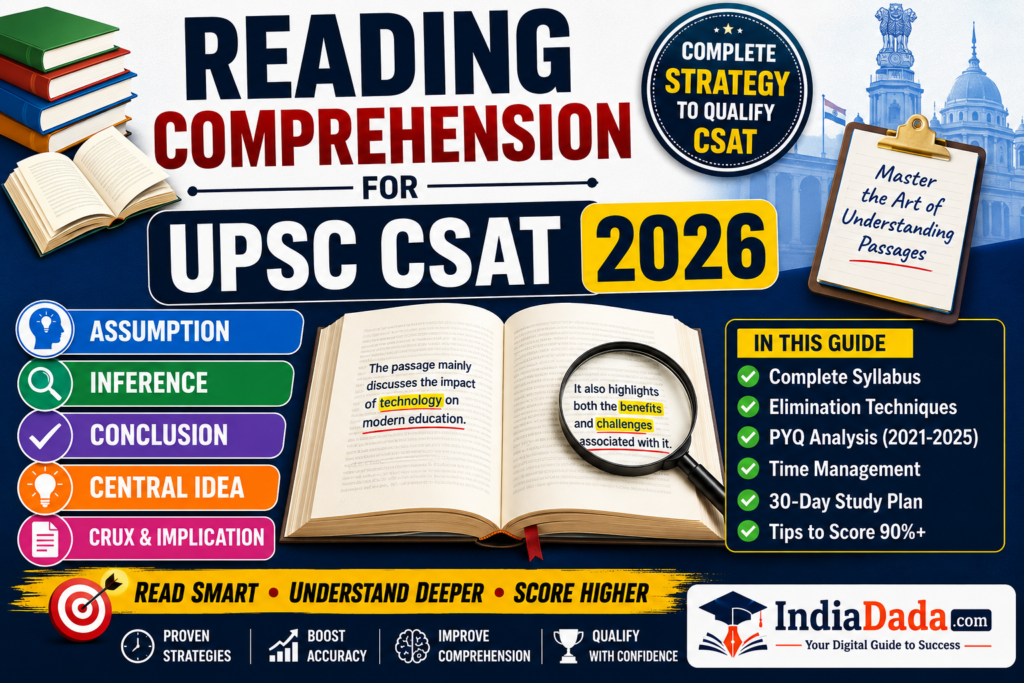
Reading Comprehension for UPSC CSAT 2026
Complete Syllabus, Strategy & Qualification Roadmap
📖 What is Reading Comprehension?
Reading Comprehension UPSC CSAT का सबसे महत्वपूर्ण भाग माना जाता है। यह केवल पढ़ने की क्षमता (Reading Ability) की जांच नहीं करता बल्कि आपकी समझ (Understanding), विश्लेषण (Analysis), तार्किक सोच (Logical Thinking) तथा निर्णय क्षमता (Decision Making) को भी परखता है।
पिछले वर्षों के विश्लेषण के अनुसार UPSC CSAT में लगभग 25 से 30 प्रश्न Reading Comprehension से पूछे जाते रहे हैं। इसलिए यह Section अकेले CSAT Qualification में निर्णायक भूमिका निभा सकता है।
📚 Reading Comprehension in UPSC CSAT
UPSC Official Syllabus में Comprehension को Civil Services Aptitude Test (CSAT) का Core Component माना गया है।
इस Section का उद्देश्य यह देखना होता है कि अभ्यर्थी किसी दिए गए Passage को पढ़कर उसके Central Idea, Assumption, Conclusion तथा Author's Viewpoint को सही ढंग से समझ पाता है या नहीं।
📋 Complete Reading Comprehension Syllabus
📌 Central Idea
Passage का मुख्य विचार
📌 Crux of Passage
Passage का सार
📌 Inference
Evidence आधारित निष्कर्ष
📌 Assumption
Hidden Belief या धारणा
📌 Conclusion
Passage से निकला परिणाम
📌 Logical Message
सबसे तार्किक संदेश
📌 Author's Opinion
लेखक का दृष्टिकोण
📌 Practical Implication
व्यावहारिक निष्कर्ष
🔥 Why Reading Comprehension is Important?
कई वर्षों के CSAT Analysis से यह स्पष्ट हुआ है कि केवल Reading Comprehension के माध्यम से ही Qualification Score का बड़ा हिस्सा प्राप्त किया जा सकता है।
- सबसे अधिक Questions
- कम Formula Dependence
- Language Based Scoring Area
- Logical Thinking Development
- Decision Making Ability Test
🚀 Beginner Preparation Roadmap
यदि आप Reading Comprehension में Beginner हैं तो शुरुआत Passage Reading से नहीं बल्कि Keywords Understanding से करें।
सबसे पहले Assumption, Inference, Conclusion, Central Idea तथा Crux जैसे Concepts को समझें। उसके बाद Previous Year Passages का अभ्यास करें।
Keywords → Short Passages → PYQs → Mock Tests → Full-Length CSAT Practice
How UPSC Creates Reading Comprehension Questions?
Understanding UPSC Language, Traps & Question Pattern
🎯 Why Students Find Reading Comprehension Difficult?
अधिकांश विद्यार्थी Passage पढ़ लेते हैं लेकिन UPSC क्या पूछ रहा है, यह नहीं समझ पाते। समस्या Passage में नहीं बल्कि Question Language में होती है।
UPSC सीधे प्रश्न नहीं पूछता। वह Assumption, Inference, Central Idea, Logical Message, Implication, Conclusion जैसे Keywords के माध्यम से आपकी समझ की परीक्षा लेता है।
📚 UPSC Reading Comprehension Question Types
UPSC लगभग हर वर्ष कुछ निश्चित प्रकार के प्रश्न पूछता है।
| Keyword | What UPSC Wants? |
|---|---|
| Central Idea | Passage का मुख्य विचार |
| Crux | Passage का सार |
| Inference | Evidence आधारित निष्कर्ष |
| Assumption | Hidden Belief |
| Conclusion | Final Outcome |
| Implication | Indirect Meaning |
| Message | Author का उद्देश्य |
🧠 The Biggest UPSC Trap
UPSC अक्सर ऐसे Options देता है जो देखने में सही लगते हैं लेकिन Passage में उनका कोई Evidence नहीं होता।
यदि Option आपकी General Knowledge के अनुसार सही है लेकिन Passage में उसका समर्थन नहीं है, तो UPSC उसे गलत मान सकता है।
Passage > Your Knowledge
📖 Author vs Reader Problem
Reading Comprehension में सबसे बड़ी चुनौती Author और Reader के बीच का अंतर होता है।
Reader अपने अनुभव, शिक्षा और General Knowledge के आधार पर Passage को समझता है जबकि UPSC चाहता है कि आप केवल Author की दृष्टि से सोचें।
🔍 How UPSC Designs Wrong Options?
- Partially Correct Statements
- Extreme Statements
- Emotion Based Statements
- Outside Knowledge Based Statements
- Factually Correct but Passage Irrelevant Statements
- Over-Generalized Statements
इन्हीं कारणों से कई बार विद्यार्थी सही उत्तर जानते हुए भी गलत विकल्प चुन लेते हैं।
📦 The Famous "In The Box Rule"
Reading Comprehension का सबसे महत्वपूर्ण Rule है:
Passage के बाहर नहीं सोचना है।
Passage में जो कहा गया है केवल उसी के आधार पर उत्तर देना है।
यदि Passage में Plastic Recycling की बात की गई है तो Economy, GDP या Environment के बारे में अपनी तरफ से नहीं जोड़ना है जब तक Passage स्वयं न कहे।
🚀 Ideal Reading Process
- Question पहले पढ़ें
- Keywords पहचानें
- Passage पढ़ें
- Important Lines Mark करें
- Options Compare करें
- Outside Knowledge हटाएँ
- Best Supported Answer चुनें
🔥 Most Important Keywords Every Aspirant Must Know
- Assumption
- Inference
- Conclusion
- Central Idea
- Crux
- Implication
- Author's View
- Logical Message
- Pragmatic Meaning
- Best Explanation
इन Keywords की सही समझ Reading Comprehension में सफलता की पहली सीढ़ी है।
Assumption, Inference, Conclusion, Central Idea & Implication
The Most Important Concepts of UPSC CSAT Reading Comprehension
🎯 Why This Chapter is Important?
UPSC Reading Comprehension में अधिकांश विद्यार्थी Passage पढ़ लेते हैं लेकिन Question की Demand नहीं समझ पाते। UPSC सीधे नहीं पूछता कि Passage में क्या लिखा है, बल्कि वह पूछता है कि Author क्या मानकर चल रहा है, क्या निष्कर्ष निकलता है, क्या संकेत दिया गया है और Passage का मुख्य विचार क्या है।
यही कारण है कि Assumption, Inference, Conclusion, Central Idea और Implication UPSC CSAT के सबसे महत्वपूर्ण Keywords माने जाते हैं।
🧠 Assumption (पूर्वधारणा)
Assumption वह बात होती है जिसे Author सीधे नहीं लिखता लेकिन मानकर चलता है कि Reader उसे समझ जाएगा।
इसे Hidden Belief, Unstated Premise या पूर्वधारणा भी कहा जाता है।
"Government should increase investment in schools to improve education quality."
इस Statement की Assumption क्या है?
👉 Education Quality अभी पर्याप्त नहीं है।
Author ने यह नहीं कहा कि Education Quality खराब है, लेकिन वह इसी आधार पर अपनी बात रख रहा है।
🔍 Inference (निष्कर्षात्मक अनुमान)
Inference वह बात होती है जो Passage में दिए गए Facts और Evidence के आधार पर निकाली जाती है।
Inference हमेशा Passage द्वारा Supported होना चाहिए।
"Last year rainfall was significantly below normal and agricultural production declined."
Inference:
👉 Rainfall और Agricultural Production में संबंध हो सकता है।
यह Conclusion नहीं बल्कि Evidence Based Inference है।
🏆 Conclusion (निष्कर्ष)
Conclusion वह Final Result होता है जो Passage के सभी Arguments, Facts और Evidence को देखकर निकाला जाता है।
UPSC कई बार Conclusion और Inference को मिलाकर Options देता है।
"Air Pollution is increasing rapidly in urban areas. It is causing health problems and reducing life expectancy."
Conclusion:
👉 Air Pollution एक गंभीर सार्वजनिक स्वास्थ्य समस्या है।
Conclusion Passage के Overall Message को दर्शाता है।
📖 Central Idea (मुख्य विचार)
Central Idea पूरे Passage का Main Theme होता है।
UPSC में सबसे अधिक पूछे जाने वाले Questions में से एक Central Idea Question होता है।
यदि Passage Climate Change पर है और उसमें Agriculture, Water Crisis तथा Economy की चर्चा है तो Central Idea Climate Change होगा, Agriculture नहीं।
📚 Crux of Passage (सारांश)
Crux का अर्थ होता है Passage का सबसे संक्षिप्त और सटीक सार।
Central Idea और Crux में अंतर यह है कि Central Idea Topic बताता है जबकि Crux Passage का सार बताता है।
Central Idea = Importance of Women's Education
Crux = Women's Education improves social and economic development.
📌 Implication (निहितार्थ)
Implication वह बात होती है जो Passage में सीधे नहीं कही गई होती लेकिन संकेत के रूप में मौजूद होती है।
"Many villages still lack access to clean drinking water."
Implication:
👉 Water Infrastructure Development की आवश्यकता है।
Implication अक्सर UPSC के कठिन Questions में पूछा जाता है।
⚖️ Difference Between Assumption, Inference & Conclusion
| Concept | Meaning | Source |
|---|---|---|
| Assumption | Hidden Belief | Author's Mind |
| Inference | Evidence Based Guess | Passage Facts |
| Conclusion | Final Result | Entire Passage |
| Central Idea | Main Theme | Whole Passage |
| Crux | Short Summary | Whole Passage |
| Implication | Indirect Meaning | Hidden Message |
🚀 UPSC Master Strategy
- Passage पढ़ते समय Author की सोच पहचानें।
- अपनी General Knowledge को बीच में न लाएँ।
- Extreme Options को पहले हटाएँ।
- Evidence Based Answer चुनें।
- Whole Passage Approach अपनाएँ।
- Central Idea और Crux को अलग-अलग समझें।
UPSC Reading Comprehension Elimination Techniques
Learn How Toppers Eliminate Wrong Options
🎯 Why Elimination is More Important Than Finding the Answer?
UPSC Reading Comprehension में कई बार सही उत्तर सीधे दिखाई नहीं देता। वास्तविक परीक्षा में Topper अक्सर सही Answer खोजने की बजाय गलत विकल्पों को हटाते हैं।
यदि 4 विकल्पों में से 2 गलत हटा दिए जाएं तो Guessing Probability 25% से बढ़कर 50% हो जाती है।
📦 Technique 1: In-The-Box Rule
यह UPSC CSAT Reading Comprehension का सबसे शक्तिशाली Rule माना जाता है।
Passage में जो कहा गया है उसी के आधार पर उत्तर दें।
Passage के बाहर की जानकारी का उपयोग न करें।
UPSC अक्सर ऐसे विकल्प देता है जो वास्तविक जीवन में सही होते हैं लेकिन Passage में उनका कोई उल्लेख नहीं होता।
✅ Only Passage Logic
⚠️ Technique 2: Extreme Word Trap
UPSC अक्सर Extreme Words का उपयोग करके गलत विकल्प बनाता है।
यदि Passage Balanced Language में लिखा गया है तो Extreme Option सामान्यतः गलत होता है।
| Extreme Words | Risk Level |
|---|---|
| Always | Very High |
| Never | Very High |
| Only | High |
| Entirely | High |
| Completely | High |
| All | High |
🧩 Technique 3: Half True Trap
यह UPSC का सबसे खतरनाक Trap माना जाता है।
Option का पहला भाग Passage से लिया जाता है लेकिन दूसरा भाग Author ने कभी नहीं कहा होता।
Passage: "Technology improves productivity."
Option: "Technology improves productivity and eliminates unemployment."
पहला भाग सही है लेकिन दूसरा भाग Passage में नहीं है।
इसलिए पूरा Option गलत हो जाएगा।
🌍 Technique 4: Outside Knowledge Trap
UPSC चाहता है कि आप Passage के आधार पर सोचें, Wikipedia के आधार पर नहीं।
कई बार Option Factually Correct होता है लेकिन Passage से Supported नहीं होता।
UPSC Answer = Best Supported Option
याद रखें: Passage हमेशा आपकी General Knowledge से बड़ा होता है।
👤 Technique 5: Author vs Reader Trap
Reading Comprehension में आपका उत्तर महत्वपूर्ण नहीं है।
महत्वपूर्ण यह है कि Author क्या कहना चाहता है।
✅ What Does The Author Think?
UPSC कई बार ऐसे विकल्प देता है जो Reader को पसंद आते हैं लेकिन Author की Position नहीं दर्शाते।
🔍 Option Analysis Framework
हर Option को इन 5 Filters से जांचें:
- क्या Passage इसे Support करता है?
- क्या इसमें Extreme Words हैं?
- क्या यह Half-True है?
- क्या इसमें Outside Knowledge जोड़ी गई है?
- क्या यह Author की Position दर्शाता है?
🏆 UPSC Topper Strategy
- Passage पहले नहीं, Question पहले पढ़ें।
- Keyword पहचानें।
- Evidence खोजें।
- Extreme Option हटाएँ।
- Outside Knowledge हटाएँ।
- Best Supported Answer चुनें।
Schema Theory, Reader vs Author Mindset & UPSC Psychological Traps
The Most Advanced Reading Comprehension Concepts
🧠 Why Smart Students Fail in Reading Comprehension?
कई बार ऐसा देखा गया है कि GS Paper में अच्छा प्रदर्शन करने वाले विद्यार्थी भी Reading Comprehension में गलतियां कर देते हैं। इसका कारण Knowledge की कमी नहीं बल्कि Reading Psychology होती है।
UPSC केवल आपकी जानकारी (Knowledge) नहीं जांचता बल्कि यह भी देखता है कि आप Passage को बिना Bias के समझ सकते हैं या नहीं।
📚 What is Schema Theory?
Schema Theory कहती है कि हर व्यक्ति किसी भी जानकारी को अपने पुराने अनुभव (Past Experience), Knowledge और Beliefs के आधार पर समझता है।
जब आप कोई Passage पढ़ते हैं तो आपका दिमाग पहले से मौजूद Knowledge का उपयोग करके Meaning बनाने की कोशिश करता है।
"Apple"
किसी को Fruit याद आएगा।
किसी को Technology Company याद आएगी।
किसी को Newton का Gravity Theory याद आएगा।
यानी एक ही शब्द अलग-अलग लोगों के लिए अलग Meaning बना सकता है।
🎯 UPSC और Schema Theory का संबंध
UPSC अक्सर ऐसे Passages देता है जिनमें Candidate अपनी General Knowledge जोड़ने लगता है।
यहीं सबसे बड़ी गलती होती है।
❌ What You Already Know
❌ What You Believe
❌ What Society Thinks
✅ What The Passage Says
👤 Reader vs Author Mindset
Reading Comprehension में दो व्यक्ति होते हैं:
- Author (लेखक)
- Reader (पाठक)
समस्या तब शुरू होती है जब Reader Author की जगह खुद सोचने लगता है।
| Reader Thinking | Author Thinking |
|---|---|
| मैं क्या सोचता हूँ? | लेखक क्या कहना चाहता है? |
| मेरी राय क्या है? | Passage की राय क्या है? |
| मेरी जानकारी क्या है? | Passage क्या कह रहा है? |
⚡ Confirmation Bias
Confirmation Bias का अर्थ है कि व्यक्ति वही बातें स्वीकार करता है जो उसकी पहले से बनी हुई धारणा को सही साबित करें।
यदि किसी विषय पर आपकी Strong Opinion है तो Reading Comprehension में आप Passage को Neutral तरीके से नहीं पढ़ पाएंगे।
यदि किसी Topic पर आपकी Strong Political Opinion है तो Passage पढ़ते समय आप Neutral नहीं रह पाएंगे।
🔍 Common Cognitive Errors in CSAT
- Overthinking
- Assumption जोड़ना
- Outside Knowledge जोड़ना
- Emotional Interpretation
- Extreme Option चुन लेना
- Author की जगह खुद सोचना
- Half True Option पर भरोसा करना
- Question Keyword Ignore करना
🚫 Most Common Mistakes in Reading Comprehension
UPSC CSAT में बार-बार देखी जाने वाली गलतियाँ:
- Passage को जल्दी-जल्दी पढ़ना
- Question पहले न पढ़ना
- Keywords Ignore करना
- Conclusion और Inference में भ्रम
- Central Idea की जगह Example चुन लेना
- Crux की जगह Detail चुन लेना
- Outside Knowledge का उपयोग करना
📖 Pre-Reading, During Reading & Post-Reading Framework
Top Performers Reading Comprehension को 3 Stages में Solve करते हैं:
1️⃣ Pre-Reading
- Question Type पहचानें
- Keyword देखें
- Topic समझें
2️⃣ During Reading
- Author Tone पहचानें
- Main Argument खोजें
- Examples और Main Idea अलग करें
3️⃣ Post-Reading
- Options Eliminate करें
- Evidence Check करें
- Best Supported Option चुनें
🏆 UPSC Mental Model for RC
Passage > Author > Evidence > Logic > Answer
NOT
Knowledge > Opinion > Guess > Answer
यदि आप इस Mental Model को Follow करते हैं तो Reading Comprehension की Accuracy बहुत तेजी से बढ़ सकती है।
UPSC CSAT Reading Comprehension Strategy
Qualification Formula, PYQ Analysis & Time Management
🎯 Understanding the CSAT Qualification Formula
UPSC CSAT Paper कुल 200 Marks का होता है। Qualifying Marks 33% यानी लगभग 66.67 Marks होते हैं। प्रत्येक प्रश्न 2.5 Marks का होता है।
इसका अर्थ है कि CSAT Qualify करने के लिए लगभग 27 Questions सही करने आवश्यक होते हैं।
27 Correct Questions × 2.5 Marks
= 67.5 Marks
= CSAT Qualified
यही कारण है कि Reading Comprehension को CSAT का सबसे महत्वपूर्ण भाग माना जाता है क्योंकि कई वर्षों में लगभग 25-30 Questions केवल Comprehension से पूछे गए हैं।
📚 Reading Comprehension Can Qualify You Alone
पिछले वर्षों के Trend से यह स्पष्ट हुआ है कि यदि Candidate Reading Comprehension में मजबूत है तो वह केवल RC के आधार पर Qualification Score के बहुत करीब पहुंच सकता है।
इसीलिए अनुभवी Mentors CSAT की तैयारी Reading Comprehension से शुरू करने की सलाह देते हैं।
Attempt RC First
Target 20-25 Correct RC Answers
Cover Remaining Marks from Maths & Reasoning
⚡ Passage First or Question First?
यह Reading Comprehension की सबसे महत्वपूर्ण Debate है।
Method 1: Passage First
- पूरे Passage का Context समझ आता है
- Flow बना रहता है
- Time अधिक लगता है
Method 2: Question First
- Keyword पहले पता चल जाते हैं
- Focused Reading होती है
- Time बचता है
Question → Keyword → Passage → Options
⏰ Time Management Strategy
CSAT में सबसे बड़ी समस्या Knowledge नहीं बल्कि Time Pressure होती है।
| Section | Recommended Time |
|---|---|
| Reading Comprehension | 45-55 Minutes |
| Reasoning | 25-30 Minutes |
| Mathematics | 30-40 Minutes |
📊 PYQ Trend Analysis (2021-2025)
| Year | Approx RC Questions |
|---|---|
| 2021 | 25+ |
| 2022 | 25+ |
| 2023 | 27+ |
| 2024 | 27+ |
| 2025 Trend | 25-30 Expected |
Trend स्पष्ट रूप से दिखाता है कि Reading Comprehension UPSC CSAT का सबसे बड़ा और सबसे स्थिर Section है।
🚀 Exam Hall Strategy
- Easy RC Passages पहले करें।
- Difficult Philosophical Passages बाद में करें।
- Keywords Underline करें।
- Extreme Options हटाएँ।
- Evidence Based Answer चुनें।
- Time Limit Maintain करें।
Easy Questions First
Difficult Questions Later
🔥 Mock Test Strategy
Reading Comprehension केवल पढ़ने से Improve नहीं होती, बल्कि Timed Practice से Improve होती है।
- Daily 3-5 Passages
- Weekly Full CSAT Mock
- Error Analysis Notebook
- Wrong Options Analysis
- Keyword Practice
Daily Reading+Daily RC Practice+Weekly Mock Test=High Accuracy
🏆 90% Qualification Strategy
यदि आपका लक्ष्य केवल CSAT Qualify करना है तो Reading Comprehension सबसे सुरक्षित रास्ता है।
Target रखें कि RC से कम से कम 20-25 Questions सही हों। इससे Qualification Marks का बड़ा हिस्सा सुरक्षित हो जाएगा।
20-25 Correct RC Questions+5-10 Reasoning Questions+5-10 Maths Questions
= Safe CSAT Qualification
Reading Comprehension Final Strategy, FAQ & Conclusion
Complete UPSC CSAT RC Preparation Roadmap
📅 30-Day Reading Comprehension Study Plan
यदि आप Reading Comprehension में Beginner हैं तो नीचे दिया गया 30-Day Plan आपकी Accuracy और Speed दोनों बढ़ाने में मदद करेगा।
| Days | Focus Area |
|---|---|
| Day 1-5 | Assumption, Inference, Conclusion Concepts |
| Day 6-10 | Central Idea, Crux & Implication Questions |
| Day 11-15 | Elimination Techniques Practice |
| Day 16-20 | PYQ Reading Comprehension Sets |
| Day 21-25 | Timed Practice & Mock RC Tests |
| Day 26-30 | Full Length CSAT Mock Tests |
3-5 Passages
20-30 Questions
30 Minutes Reading Practice
📚 Best Resources for Reading Comprehension
- UPSC Previous Year CSAT Papers
- Official UPSC Question Papers
- The Hindu Editorials
- Indian Express Explained
- Yojana & Kurukshetra Articles
- Daily Opinion Articles
- Quality Mock Tests
Reading Comprehension सुधारने का सबसे अच्छा तरीका नियमित Reading Habit विकसित करना है।
🚀 Daily Practice Framework
Top Performers Reading Comprehension को Skill की तरह Practice करते हैं।
- Passage पढ़ें
- Main Idea लिखें
- Author Tone पहचानें
- Assumption खोजें
- Inference निकालें
- Options Eliminate करें
- Error Analysis करें
यही UPSC RC Improvement Cycle है।
❓ Frequently Asked Questions (FAQ)
सामान्यतः 25-30 प्रश्न Reading Comprehension से पूछे जाते हैं।
कई मामलों में Reading Comprehension Qualification Score का बड़ा हिस्सा Cover कर सकती है, लेकिन Maths और Reasoning भी तैयार रखना चाहिए।
Assumption, Inference, Conclusion, Central Idea और Author's View।
Passage के बाहर की जानकारी (Outside Knowledge) जोड़ना।
लगातार अभ्यास के साथ 30-45 दिनों में अच्छा Improvement देखा जा सकता है।
🏆 Final Conclusion
Reading Comprehension UPSC CSAT का सबसे महत्वपूर्ण और सबसे अधिक Scoring Section है। यह केवल भाषा की परीक्षा नहीं बल्कि आपकी Analytical Ability, Logical Thinking, Evidence-Based Reasoning और Decision Making Skills की भी परीक्षा है।
यदि आप Assumption, Inference, Conclusion, Central Idea, Crux, Implication, Elimination Techniques और Author Perspective को अच्छी तरह समझ लेते हैं तो RC आपके लिए सबसे मजबूत Section बन सकता है।
Right Mindset+Author Perspective+Elimination Techniques+PYQ Practice+Mock Tests
= CSAT Qualification
🔍 SEO Keywords
Reading Comprehension for UPSC CSAT 2026, UPSC CSAT Reading Comprehension Notes, RC Strategy for UPSC, CSAT Comprehension Preparation, Assumption Inference Conclusion UPSC, UPSC CSAT English Comprehension, Reading Comprehension PYQ Analysis, UPSC CSAT Qualification Strategy, Author Perspective in Reading Comprehension
🏷️ Hashtags
#UPSC #CSAT #ReadingComprehension #UPSCPreparation #CSAT2026 #UPSCNotes #IASPreparation #UPSCPrelims #IndiaDada #CivilServices
🌐 IndiaDada.com Special Note
IndiaDada.com पर UPSC CSAT के लिए Reading Comprehension, Logical Reasoning, Data Interpretation, Quantitative Aptitude, Daily Mock Tests, Current Affairs, Previous Year Questions तथा Free Study Material उपलब्ध कराया जाता है।
नियमित अभ्यास, सही Strategy और Consistency के साथ CSAT Qualify करना पूरी तरह संभव है।
Continue Learning With IndiaDada
UPSC, SSC CGL, UPTET, Current Affairs, Govt Jobs, School Education, Higher Education, Notes, PDF, MCQ, PYQ और Mock Test की सम्पूर्ण तैयारी अब एक ही प्लेटफॉर्म पर।
Daily Current Affairs
Latest Daily Current Affairs Notes
🎯Current Affairs MCQ
Daily Quiz & Practice Sets
🇮🇳UPSC Preparation
Prelims, CSAT & Mains Study Material
📑SSC CGL
Notes, PYQ & Mock Test
🧠UPTET
Notes, MCQ & Practice Questions
💼Govt Jobs
Latest Sarkari Naukri Updates
🔥 Important Study Resources
🌐 Important Official Websites
🚀 Stay Connected With IndiaDada.com
Daily Current Affairs, Govt Jobs, UPSC, SSC CGL, UPTET, Notes, MCQ, Mock Tests, Previous Year Papers और Exam Updates प्राप्त करने के लिए IndiaDada.com के साथ जुड़े रहें।
Visit IndiaDada.comContinue Learning With IndiaDada
UPSC, SSC CGL, UPTET, Current Affairs, Government Jobs, School Education, Higher Education, Notes, PDF, MCQ, PYQ, Mock Tests और Exam Preparation की सम्पूर्ण सामग्री अब एक ही प्लेटफॉर्म पर।
Daily Current Affairs
Daily Current Affairs Notes, PDF & Analysis
🎯Current Affairs MCQ
Daily Quiz, Practice Sets & Mock Questions
🇮🇳UPSC Preparation
Prelims, CSAT, Mains Notes & PYQs
📑SSC CGL
Notes, Previous Papers & Mock Tests
🧠UPTET Preparation
Latest Notes, MCQ & Practice Sets
💼Government Jobs
Latest Sarkari Naukri & Recruitment Updates
🔥 Important Study Resources
🌐 Important Official Resources
🎯 Popular Exam Categories
🚀 Stay Connected With IndiaDada.com
Daily Current Affairs, UPSC, SSC CGL, UPTET, Government Jobs, Previous Year Papers, Notes, MCQ, Mock Tests तथा Latest Exam Updates प्राप्त करने के लिए IndiaDada.com के साथ जुड़े रहें।
Visit IndiaDada.comContinue Learning With IndiaDada
UPSC, SSC CGL, UPTET, Current Affairs, Government Jobs, School Education, Higher Education, Notes, PDF, MCQ, PYQ, Mock Tests और Exam Preparation की सम्पूर्ण सामग्री अब एक ही प्लेटफॉर्म पर।
Daily Current Affairs
Daily Current Affairs Notes, PDF & Analysis
🎯Current Affairs MCQ
Daily Quiz, Practice Sets & Mock Questions
🇮🇳UPSC Preparation
Prelims, CSAT, Mains Notes & PYQs
📑SSC CGL
Notes, Previous Papers & Mock Tests
🧠UPTET Preparation
Latest Notes, MCQ & Practice Sets
💼Government Jobs
Latest Sarkari Naukri & Recruitment Updates
🔥 Important Study Resources
🌐 Important Official Resources
🎯 Popular Exam Categories
🚀 Stay Connected With IndiaDada.com
Daily Current Affairs, UPSC, SSC CGL, UPTET, Government Jobs, Previous Year Papers, Notes, MCQ, Mock Tests तथा Latest Exam Updates प्राप्त करने के लिए IndiaDada.com के साथ जुड़े रहें।
Visit IndiaDada.com