
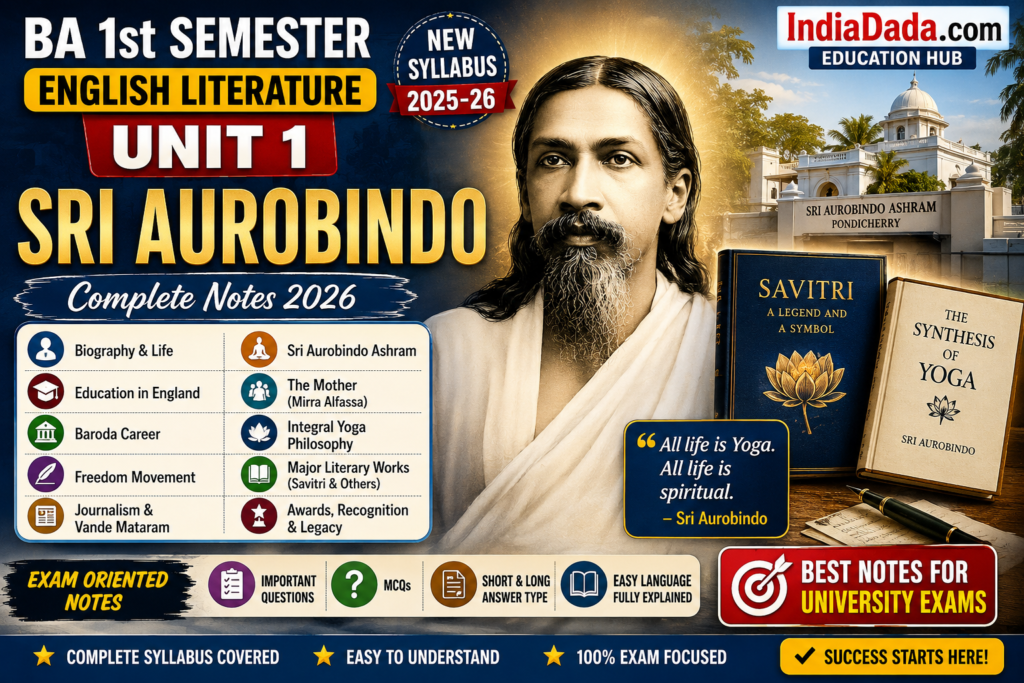
BA 1st Semester English Unit 1: Sri Aurobindo Introduction
श्री अरविंदो आधुनिक भारत के महान दार्शनिक, कवि, योगी और राष्ट्रवादी विचारक थे। भारतीय अंग्रेज़ी साहित्य के विकास में उनका योगदान अत्यंत महत्वपूर्ण माना जाता है। उन्होंने न केवल साहित्य के क्षेत्र में बल्कि आध्यात्मिक और राष्ट्रीय जागरण में भी महत्वपूर्ण भूमिका निभाई।
रवीन्द्रनाथ टैगोर के बाद श्री अरविंदो को भारतीय अंग्रेज़ी साहित्य के सबसे प्रभावशाली लेखकों में गिना जाता है। उनकी रचनाओं में राष्ट्रप्रेम, आध्यात्मिक चेतना, मानव विकास और योग दर्शन की गहरी झलक दिखाई देती है।
✓ आधुनिक भारतीय अंग्रेज़ी साहित्य के प्रमुख लेखक
✓ स्वतंत्रता आंदोलन से जुड़े राष्ट्रवादी चिंतक
✓ श्री अरविंदो आश्रम के संस्थापक
Birth, Family Background and Early Education of Sri Aurobindo
Sri Aurobindo was born on 15 August 1872 in Kolkata (formerly Calcutta), one of the most important cultural and educational centers of British India. His birth coincidentally falls on the same date that later became India's Independence Day, making his life even more symbolic in Indian history.
His father, Dr. Krishna Dhan Ghose, was a well-known civil surgeon who strongly believed in Western education and modern scientific thinking. He wanted his children to receive the best possible education according to European standards. His mother, Swarnalata Devi, was known for her religious nature and cultural values.
From a very young age, Sri Aurobindo displayed extraordinary intelligence and a deep interest in learning. His early schooling began at a Christian Convent School in Darjeeling where he received his foundational education. During these years, he developed strong language skills and a disciplined academic approach.
Recognizing his exceptional potential, his family sent him to England for higher studies. This decision played a crucial role in shaping his intellectual personality and later contributions to literature, philosophy, politics and spirituality.
- Date of Birth: 15 August 1872
- Place of Birth: Kolkata, British India
- Father: Dr. Krishna Dhan Ghose (Civil Surgeon)
- Mother: Swarnalata Devi
- Early Schooling: Christian Convent School, Darjeeling
- Special Trait: Brilliant student with exceptional language abilities
Education in England and Intellectual Development
One of the most significant phases of Sri Aurobindo’s life began when he was sent to England for higher education. His father believed that a modern education in Europe would help him become a successful administrator and intellectual. Therefore, at a very young age, Sri Aurobindo left India and started his educational journey in England.
During his stay in England, he studied at some of the most prestigious institutions and developed an extraordinary command over literature, philosophy and languages. His academic excellence quickly made him one of the brightest Indian students studying abroad during that period.
Mastery Over Multiple Languages
Sri Aurobindo possessed remarkable linguistic talent. While studying in England, he learned several European languages and became proficient in reading and writing them. This multilingual knowledge later helped him produce world-class literary and philosophical works.
- Greek Language
- Latin Language
- French Language
- German Language
- Italian Language
- Spanish Language
His understanding of classical and modern languages enabled him to study ancient civilizations, Western philosophy and world literature in their original forms. This broad intellectual exposure played a major role in shaping his future ideas.
Indian Civil Service Examination
While in England, Sri Aurobindo prepared for the prestigious Indian Civil Service (ICS) Examination. At that time, the ICS was considered one of the toughest and most respected examinations under British rule.
He successfully cleared the written examination with outstanding performance. His achievement demonstrated his exceptional intelligence and academic capability. However, his interests gradually shifted towards nationalism and service to India rather than a career under the British administration.
Return to India
After completing his studies abroad, Sri Aurobindo returned to India in 1893. His return marked the beginning of a new chapter in his life. The experiences gained in Europe combined with his deep connection to Indian culture inspired him to work for the progress and awakening of the nation.
Upon returning, he joined the Baroda State Service. Here he worked in various administrative positions and simultaneously continued his study of Indian philosophy, Sanskrit literature and cultural traditions. These years laid the foundation for his future role as a nationalist leader, philosopher and spiritual thinker.
✓ Sri Aurobindo went to England for higher education.
✓ He mastered several European languages.
✓ He cleared the Indian Civil Service Examination.
✓ He returned to India in 1893.
✓ His return marked the beginning of his contribution to Indian nationalism and literature.
Thus, Sri Aurobindo's education in England was not merely an academic journey. It transformed him into a scholar with global knowledge, deep philosophical insight and a strong vision for India's future.
Sri Aurobindo and the Indian Freedom Movement
After returning to India in 1893, Sri Aurobindo began working in the Baroda State Service. Although he was performing administrative duties, his heart was deeply connected with the condition of India under British rule. He believed that India deserved complete freedom and that every citizen should actively contribute to the nation's progress.
During his years in Baroda, he carefully studied Indian culture, ancient scriptures, history and philosophy. At the same time, he observed the political situation of the country and became increasingly involved in nationalist activities. These experiences transformed him from a government employee into a powerful voice of Indian nationalism.
Career at Baroda State
Sri Aurobindo served in different positions within the Baroda administration for nearly thirteen years. His dedication, knowledge and leadership qualities earned him great respect among colleagues and students.
Later, he became associated with Baroda State College and eventually held the prestigious position of Principal. His role as an educator allowed him to inspire young minds and spread nationalist ideas among students.
- Joined Baroda State Service in 1893.
- Worked for approximately 13 years.
- Served in various administrative positions.
- Became Principal of Baroda State College.
- Inspired students through education and leadership.
Role in the Freedom Struggle
Sri Aurobindo was not only a writer and philosopher but also one of the earliest leaders of India's freedom movement. He strongly opposed British rule and advocated complete independence at a time when many leaders were still demanding limited reforms.
Through his speeches, writings and political activities, he encouraged Indians to develop self-confidence, national pride and the courage to fight for freedom. His ideas inspired countless young revolutionaries across the country.
He believed that political freedom was essential for the spiritual and cultural development of India. Therefore, he dedicated a significant part of his life to the nationalist movement.
Journalism and Nationalist Writing
Sri Aurobindo used journalism as a powerful tool to spread nationalist ideas. He wrote articles that criticized British policies and encouraged Indians to unite for independence.
One of the most important newspapers associated with him was "Vande Mataram". Through this platform, he expressed his political views and inspired people to participate in the struggle against colonial rule.
His writings were bold, intellectual and deeply patriotic. They played a major role in awakening national consciousness among educated Indians.
✓ Encouraged patriotism and national unity.
✓ Criticized British colonial policies.
✓ Motivated young freedom fighters.
✓ Promoted self-respect and self-reliance.
✓ Strengthened the nationalist movement.
Popular National Leader
Because of his powerful speeches and revolutionary ideas, Sri Aurobindo quickly emerged as one of the most respected nationalist leaders of his time. Many young Indians viewed him as a source of inspiration and guidance.
His vision of freedom went beyond politics. He dreamed of an India that would become spiritually awakened, culturally strong and intellectually advanced. This unique combination of nationalism and spirituality made him different from many other political leaders.
✓ Sri Aurobindo actively participated in the Indian freedom movement.
✓ He worked in Baroda State Service for thirteen years.
✓ He became Principal of Baroda State College.
✓ He wrote nationalist articles for "Vande Mataram".
✓ He was one of the most influential nationalist leaders before independence.
Thus, Sri Aurobindo's contribution to the freedom struggle was not limited to politics alone. Through education, journalism, literature and leadership, he inspired an entire generation to dream of a free and powerful India.
Sri Aurobindo Ashram, Spiritual Vision and Literary Contributions
After actively participating in the Indian freedom movement, Sri Aurobindo gradually turned his attention towards spirituality and human evolution. He believed that true progress of humanity could be achieved through spiritual awakening, inner transformation and self-realization.
His spiritual ideas were unique because he combined ancient Indian wisdom with modern philosophical thinking. According to him, human beings possess unlimited potential and can achieve higher levels of consciousness through disciplined spiritual practice.
Foundation of Sri Aurobindo Ashram
One of the most significant achievements of Sri Aurobindo was the establishment of the famous Sri Aurobindo Ashram in Pondicherry (now Puducherry). The Ashram became a center for spiritual learning, meditation and personal development.
People from different parts of India and the world visited the Ashram to learn about yoga, spirituality and self-discovery. The Ashram continues to be an important spiritual institution even today.
- Spiritual growth and self-realization.
- Practice of Integral Yoga.
- Development of higher consciousness.
- Promotion of peace, harmony and inner transformation.
- Creating a spiritually awakened society.
The Mother (Mirra Alfassa)
A very important person associated with Sri Aurobindo's spiritual work was Mirra Alfassa, popularly known as "The Mother". She was a French spiritual collaborator who worked closely with Sri Aurobindo in developing the Ashram and spreading spiritual teachings.
Sri Aurobindo and The Mother shared a common vision of spiritual evolution and human development. Together they guided thousands of followers and established a unique spiritual community.
Mirra Alfassa was known as "The Mother" and played a crucial role in the development of Sri Aurobindo Ashram.
Sri Aurobindo's Philosophy of Integral Yoga
Sri Aurobindo developed a unique spiritual philosophy known as Integral Yoga. Unlike traditional yoga systems that focus mainly on personal liberation, Integral Yoga aims at the transformation of the entire human personality.
According to Sri Aurobindo, spiritual practice should improve not only the mind but also emotions, character, actions and social life. He believed that every aspect of human existence could be transformed through divine consciousness.
Major Literary Works of Sri Aurobindo
Apart from being a philosopher and spiritual leader, Sri Aurobindo was also a brilliant writer. His books, essays and poems cover subjects such as spirituality, philosophy, yoga, culture and human evolution.
| Literary Work | Importance |
|---|---|
| Essays on the Gita | Interpretation of Bhagavad Gita and its spiritual teachings. |
| The Synthesis of Yoga | Comprehensive explanation of Integral Yoga. |
| The Human Cycle | Study of human society and social evolution. |
| Savitri: A Legend and a Symbol | Epic spiritual poem and one of his greatest works. |
| On the Veda | Analysis and interpretation of the Vedic texts. |
Why "Savitri" is Important?
Among all his literary creations, Savitri is considered his masterpiece. It is a long epic poem that combines mythology, spirituality and philosophy. The work reflects Sri Aurobindo's vision of human transformation and divine consciousness.
Many literary critics regard Savitri as one of the greatest achievements in modern Indian English poetry.
- Sri Aurobindo established the Sri Aurobindo Ashram at Pondicherry.
- Mirra Alfassa was known as "The Mother".
- He developed the philosophy of Integral Yoga.
- Savitri is his most famous literary masterpiece.
- The Synthesis of Yoga is one of his most important philosophical books.
Through his Ashram, spiritual philosophy and literary works, Sri Aurobindo left a lasting impact on Indian thought and world spirituality. His writings continue to inspire readers, scholars and spiritual seekers across the globe.
Awards, Recognition, Legacy and Exam Preparation
Sri Aurobindo's contributions extended far beyond literature and spirituality. His influence can be seen in Indian nationalism, philosophy, education, yoga and modern intellectual thought. Because of his extraordinary achievements, he earned recognition both in India and abroad.
His writings inspired generations of readers, freedom fighters, philosophers and spiritual seekers. Even today, scholars around the world study his books to understand the relationship between spirituality, society and human progress.
Recognition and International Reputation
Sri Aurobindo was widely respected as one of the most influential thinkers of modern India. After Rabindranath Tagore, many literary scholars considered him among the most significant figures in Indian English literature.
His literary style, philosophical depth and spiritual insight made him unique among modern Indian writers. He successfully combined Eastern wisdom with Western intellectual traditions.
- Great philosopher and spiritual thinker.
- Leader of the Indian freedom movement.
- Founder of Integral Yoga.
- Outstanding poet and essayist.
- Founder of Sri Aurobindo Ashram.
Nobel Prize Recognition
Sri Aurobindo's literary excellence received international attention. He was nominated for the Nobel Prize in Literature because of his remarkable contributions to poetry, philosophy and spiritual writing.
His works were appreciated for their originality, intellectual depth and universal message. Many critics regarded him as one of the greatest literary voices produced by modern India.
Legacy of Sri Aurobindo
The legacy of Sri Aurobindo continues through his books, teachings, Ashram and philosophical ideas. His vision of human evolution and spiritual transformation remains relevant in the modern world.
Thousands of students, researchers and spiritual practitioners continue to study his writings. His teachings encourage individuals to develop both intellectual excellence and inner spiritual strength.
- Promotion of spiritual evolution.
- Development of Integral Yoga.
- Contribution to Indian English literature.
- Support for Indian nationalism.
- Establishment of a global spiritual movement.
Important Facts for Examination
| Topic | Important Information |
|---|---|
| Birth | 15 August 1872, Kolkata |
| Father | Dr. Krishna Dhan Ghose |
| Mother | Swarnalata Devi |
| Education | England |
| Profession | Poet, Philosopher, Journalist, Freedom Fighter |
| Ashram | Sri Aurobindo Ashram, Pondicherry |
| Spiritual Associate | Mirra Alfassa (The Mother) |
| Famous Work | Savitri |
| Yoga Philosophy | Integral Yoga |
| Death | 5 December 1950 |
Multiple Choice Questions (MCQs)
| Question | Answer |
|---|---|
| Where was Sri Aurobindo born? | Kolkata |
| When was Sri Aurobindo born? | 15 August 1872 |
| Who was known as "The Mother"? | Mirra Alfassa |
| Which Ashram was founded by Sri Aurobindo? | Sri Aurobindo Ashram |
| Which is his most famous epic poem? | Savitri |
| What philosophy did Sri Aurobindo develop? | Integral Yoga |
| Which newspaper was associated with him? | Vande Mataram |
| In which city is Sri Aurobindo Ashram located? | Pondicherry |
| Which examination did he qualify? | Indian Civil Service (ICS) |
| When did Sri Aurobindo die? | 5 December 1950 |
Short Answer Questions
- Who was Sri Aurobindo?
- Write a short note on Sri Aurobindo Ashram.
- Who was Mirra Alfassa?
- Explain Integral Yoga.
- Why is Savitri considered important?
Long Answer Questions
- Discuss the life and achievements of Sri Aurobindo.
- Explain Sri Aurobindo's contribution to Indian English literature.
- Describe the spiritual philosophy of Sri Aurobindo.
- Write an essay on Sri Aurobindo's role in India's freedom movement.
- Evaluate Sri Aurobindo's contribution as a philosopher and poet.
✓ Born in Kolkata on 15 August 1872.
✓ Educated in England.
✓ Freedom fighter and nationalist leader.
✓ Journalist of Vande Mataram.
✓ Founder of Sri Aurobindo Ashram.
✓ Developed Integral Yoga.
✓ Famous work: Savitri.
✓ Associated with Mirra Alfassa (The Mother).
✓ One of the greatest figures in Indian English Literature.
Sri Aurobindo remains a symbol of intellectual brilliance, spiritual wisdom and national pride. His life demonstrates how literature, philosophy and spirituality can work together to transform individuals and society.
Frequently Asked Questions (FAQ)
Who was Sri Aurobindo?
Sri Aurobindo was an Indian philosopher, poet, journalist, freedom fighter and spiritual leader. He is regarded as one of the most influential figures in modern Indian history and Indian English literature.
When and where was Sri Aurobindo born?
Sri Aurobindo was born on 15 August 1872 in Kolkata (Calcutta), British India.
What is Sri Aurobindo famous for?
He is famous for his contributions to Indian nationalism, philosophy, spirituality, literature and the development of Integral Yoga.
What is Integral Yoga?
Integral Yoga is the spiritual philosophy developed by Sri Aurobindo which aims at the complete transformation of human consciousness and personality.
Who was known as “The Mother”?
Mirra Alfassa, the spiritual collaborator of Sri Aurobindo, was known as “The Mother”.
Which is the most famous work of Sri Aurobindo?
"Savitri: A Legend and a Symbol" is considered his greatest literary masterpiece.
Where is Sri Aurobindo Ashram located?
Sri Aurobindo Ashram is located in Pondicherry (Puducherry), India.
What role did Sri Aurobindo play in the freedom movement?
He actively participated in the Indian freedom movement through journalism, political leadership and nationalist writings.
✓ Life and achievements of Sri Aurobindo
✓ Contribution to Indian English Literature
✓ Sri Aurobindo Ashram and The Mother
✓ Integral Yoga Philosophy
✓ Savitri as a literary masterpiece
✓ Sri Aurobindo and Indian Freedom Movement
Conclusion
Sri Aurobindo occupies a unique position in Indian history because he successfully combined literature, philosophy, spirituality and nationalism. His life was dedicated to the intellectual, cultural and spiritual advancement of humanity.
As a poet, he enriched Indian English literature with profound literary works. As a freedom fighter, he inspired countless Indians to dream of independence. As a spiritual leader, he offered a new vision of human evolution through Integral Yoga.
Even today, Sri Aurobindo's writings continue to guide students, scholars and spiritual seekers around the world. His contribution remains timeless and highly relevant in the modern age.
✓ Introduction of Sri Aurobindo
✓ Birth and Family Background
✓ Education in England
✓ ICS Examination and Return to India
✓ Career at Baroda State Service
✓ Freedom Movement Activities
✓ Journalism and Vande Mataram
✓ Sri Aurobindo Ashram
✓ Mirra Alfassa (The Mother)
✓ Integral Yoga Philosophy
✓ Major Literary Works
✓ Savitri and Other Books
✓ Awards and Recognition
✓ MCQs and Exam Questions
Continue Learning With IndiaDada
UPSC, SSC CGL, UPTET, Current Affairs, Government Jobs, School Education, Higher Education, Notes, PDF, MCQ, PYQ, Mock Tests और Exam Preparation की सम्पूर्ण सामग्री अब एक ही प्लेटफॉर्म पर।
Daily Current Affairs
Daily Current Affairs Notes, PDF & Analysis
🎯Current Affairs MCQ
Daily Quiz, Practice Sets & Mock Questions
🇮🇳UPSC Preparation
Prelims, CSAT, Mains Notes & PYQs
📑SSC CGL
Notes, Previous Papers & Mock Tests
🧠UPTET Preparation
Latest Notes, MCQ & Practice Sets
💼Government Jobs
Latest Sarkari Naukri & Recruitment Updates
🔥 Important Study Resources
🌐 Important Official Resources
🎯 Popular Exam Categories
🚀 Stay Connected With IndiaDada.com
Daily Current Affairs, UPSC, SSC CGL, UPTET, Government Jobs, Previous Year Papers, Notes, MCQ, Mock Tests तथा Latest Exam Updates प्राप्त करने के लिए IndiaDada.com के साथ जुड़े रहें।
Visit IndiaDada.com