
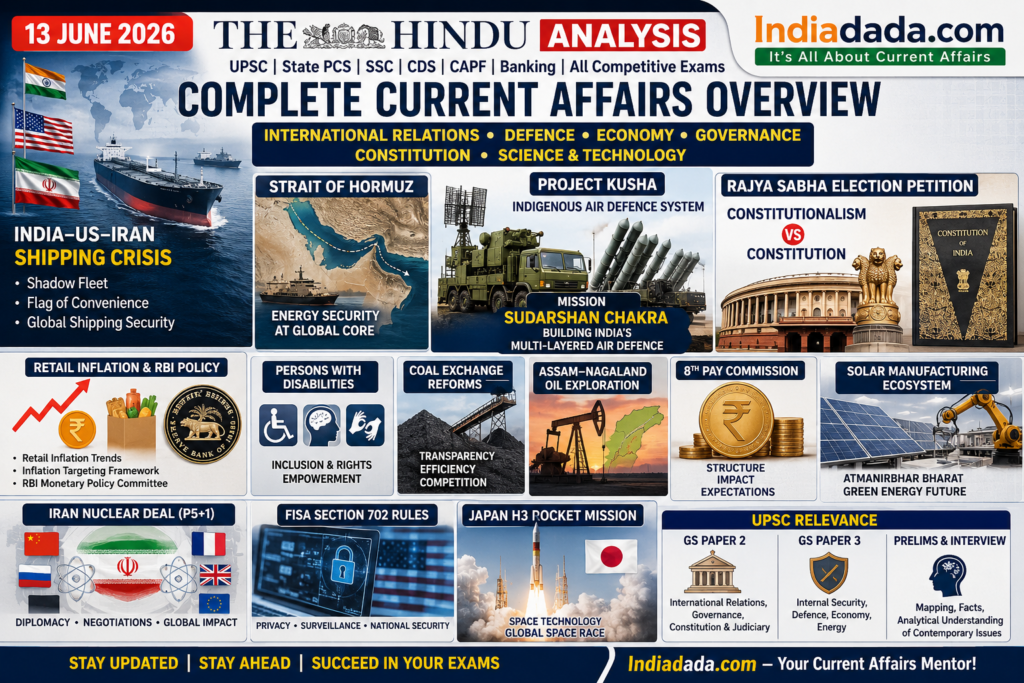
13 June 2026 The Hindu Analysis – UPSC Current Affairs Overview
13 June 2026 का The Hindu Analysis UPSC, State PCS, SSC, CDS, CAPF, Banking तथा अन्य Competitive Exams के लिए अत्यंत महत्वपूर्ण रहा। आज के समाचारों में International Relations, Internal Security, Defence Technology, Economy, Governance, Constitutional Issues तथा Science & Technology से जुड़े अनेक महत्वपूर्ण विषय शामिल रहे।
विशेष रूप से India-US-Iran Maritime Crisis, Strait of Hormuz, Project Kusha, Retail Inflation, Rajya Sabha Election Dispute, Coal Exchange Reforms, 8th Pay Commission तथा Japan H3 Rocket जैसे विषय परीक्षा की दृष्टि से अत्यधिक महत्वपूर्ण हैं।
Why Is Today's Analysis Important?
UPSC अब केवल समाचार आधारित प्रश्न नहीं पूछता बल्कि समाचारों के पीछे छिपे हुए Constitutional, Economic, Strategic तथा Geopolitical Dimensions को समझने की अपेक्षा करता है।
Major Themes Covered Today
- India-US-Iran Strategic Developments
- Global Shipping Security
- Strait of Hormuz & Energy Security
- Project Kusha Air Defence System
- Retail Inflation & RBI Policy Framework
- Rajya Sabha Election Petition
- Coal Exchange Reforms
- 8th Pay Commission Debate
- Solar Manufacturing Ecosystem
- Japan H3 Rocket Mission
UPSC Relevance
GS Paper 2
International Relations, Governance, Constitution & Judiciary.
GS Paper 3
Internal Security, Defence Technology, Economy & Energy.
Prelims
Mapping, Economy, Defence Systems & Current Affairs Facts.
Interview
Analytical Understanding of Contemporary Issues.
Topics Covered in This Complete Analysis
- India-US-Iran Shipping Crisis
- Strait of Hormuz
- Shadow Fleet & Flag of Convenience
- Iran Nuclear Deal (P5+1)
- Project Kusha
- Mission Sudarshan Chakra
- India's Air Defence Architecture
- Rajya Sabha Election Petition
- Constitutionalism vs Constitution
- Retail Inflation & Inflation Targeting
- RBI & Monetary Policy Committee
- Persons with Disabilities
- Coal Exchange
- Assam-Nagaland Oil Exploration
- 8th Pay Commission
- Solar Manufacturing Ecosystem
- FISA Section 702 Rules
- Japan H3 Rocket
Current Affairs become valuable only when they are connected with concepts, governance, policies and constitutional understanding.
India-US-Iran Shipping Crisis, Commercial Vessel Attacks & India's Diplomatic Response
13 June 2026 के The Hindu Analysis में सबसे प्रमुख चर्चा India-US-Iran Shipping Crisis को लेकर रही। हाल के दिनों में ओमान की खाड़ी (Gulf of Oman) और Strait of Hormuz के आसपास कई Commercial Oil Tankers और Cargo Ships पर कार्रवाई की घटनाएं सामने आई हैं।
इन घटनाओं में भारतीय नागरिकों की मृत्यु और भारतीय चालक दल (Indian Crew Members) की मौजूदगी ने भारत के लिए इस विषय को अत्यंत संवेदनशील बना दिया है।
What Exactly Happened?
हाल के सप्ताहों में अमेरिकी नौसेना द्वारा कुछ Commercial Vessels के विरुद्ध कार्रवाई की गई। इन जहाजों पर आरोप लगाया गया कि वे प्रतिबंधित तेल (Sanctioned Oil) के परिवहन से जुड़े नेटवर्क का हिस्सा थे।
Key Developments
- Multiple Commercial Ships Targeted
- Incidents Near Strait of Hormuz
- Indian Crew Members Present
- Concerns Over Maritime Security
- Growing West Asian Tensions
India's Concern
भारत की चिंता मुख्य रूप से दो कारणों से है। पहला, भारतीय नागरिकों की सुरक्षा। दूसरा, भारत की Energy Security क्योंकि भारत अपने तेल आयात का बड़ा हिस्सा पश्चिम एशिया से प्राप्त करता है।
Citizen Safety
भारतीय नाविकों एवं समुद्री कर्मचारियों की सुरक्षा।
Energy Imports
भारत की तेल आपूर्ति प्रभावित हो सकती है।
Trade Security
समुद्री व्यापार मार्गों की सुरक्षा।
Diplomatic Stability
क्षेत्रीय शांति बनाए रखना।
Why Is West Asia Important For India?
- Major Source of Crude Oil Imports
- Large Indian Diaspora Presence
- Strategic Maritime Routes
- Energy Security Interests
- Trade & Investment Relations
Impact on Global Economy
यदि समुद्री मार्गों में अस्थिरता बढ़ती है तो वैश्विक व्यापार, तेल आपूर्ति और Shipping Insurance Costs पर सीधा प्रभाव पड़ता है।
Possible Economic Effects
- Rise in Crude Oil Prices
- Increase in Shipping Costs
- Supply Chain Disruptions
- Global Inflationary Pressure
- Trade Route Diversions
India's Diplomatic Response
भारत ने इस मुद्दे पर राजनयिक स्तर पर चिंता व्यक्त की है। भारत का मुख्य उद्देश्य अपने नागरिकों की सुरक्षा सुनिश्चित करना, समुद्री व्यापार की स्वतंत्रता बनाए रखना तथा क्षेत्रीय स्थिरता को बढ़ावा देना है।
India's Priorities
- Protection of Indian Nationals
- Freedom of Navigation
- Stable Energy Supplies
- Regional Peace
- Rules-Based Maritime Order
UPSC Perspective
यह मुद्दा केवल एक Maritime Incident नहीं है। यह International Relations, Maritime Security, Energy Security और Geopolitics का संयुक्त विषय है।
In today's interconnected world, maritime security is directly linked with economic security and national security.
Way Forward
- Maritime Security Cooperation को मजबूत किया जाए।
- Strategic Petroleum Reserves बढ़ाए जाएं।
- Energy Import Sources का Diversification किया जाए।
- Regional Diplomatic Engagement बढ़ाया जाए।
- Indian Seafarers Protection Mechanisms को मजबूत किया जाए।
Prelims Quick Revision
- Incident linked to Gulf of Oman region.
- Important for Maritime Security.
- Related to Energy Security and Oil Trade.
- Important from International Relations perspective.
Strait of Hormuz – World's Most Strategic Oil Chokepoint
13 June 2026 के Current Affairs में Strait of Hormuz पुनः चर्चा में रहा। West Asia में बढ़ते तनाव और Commercial Shipping Routes पर हुए हमलों ने इस समुद्री मार्ग को वैश्विक स्तर पर एक बार फिर केंद्र में ला दिया है।
UPSC Prelims, GS Paper 2 (International Relations) तथा GS Paper 3 (Energy Security) के लिए Strait of Hormuz अत्यंत महत्वपूर्ण विषय है। Mapping Questions में भी इससे संबंधित प्रश्न बार-बार पूछे जाते हैं।
What is Strait of Hormuz?
Strait of Hormuz एक संकीर्ण समुद्री जलडमरूमध्य (Narrow Maritime Chokepoint) है जो Persian Gulf को Gulf of Oman और आगे Arabian Sea से जोड़ता है।
Location Facts
- Connects Persian Gulf with Gulf of Oman
- Links Gulf Region to Arabian Sea
- Located Between Iran and Oman
- One of World's Most Important Shipping Routes
- Major Global Energy Transit Point
Countries Around Strait of Hormuz
Iran
Northern Coastline Control
Oman
Southern Side of Strait
UAE
Nearby Strategic Position
Saudi Arabia
Major Oil Export Stakeholder
Why Is Strait of Hormuz So Important?
विश्व के तेल व्यापार (Global Oil Trade) का बड़ा हिस्सा इसी मार्ग से होकर गुजरता है। इसलिए इसे अक्सर "World's Most Important Oil Chokepoint" कहा जाता है।
Strategic Importance
- Global Oil Transportation Route
- LNG Export Transit Point
- Critical for Energy Security
- Vital for International Trade
- Major Geopolitical Hotspot
What is a Maritime Chokepoint?
Maritime Chokepoint ऐसे संकीर्ण समुद्री मार्गों को कहा जाता है जिनसे होकर बड़ी मात्रा में अंतरराष्ट्रीय व्यापार और ऊर्जा आपूर्ति गुजरती है। यदि इन मार्गों में बाधा आती है तो वैश्विक अर्थव्यवस्था प्रभावित हो सकती है।
Important Global Chokepoints
- Strait of Hormuz
- Suez Canal
- Bab-el-Mandeb Strait
- Malacca Strait
- Panama Canal
Importance for India
भारत अपनी ऊर्जा आवश्यकताओं का बड़ा हिस्सा आयातित तेल और गैस से पूरा करता है। इन आयातों का महत्वपूर्ण भाग Strait of Hormuz के माध्यम से भारत तक पहुंचता है।
- Energy Security
- Crude Oil Imports
- LNG Supplies
- Maritime Trade Routes
- Indian Diaspora Interests
What Happens If Hormuz Gets Blocked?
- Global Oil Prices May Rise Sharply
- Energy Supply Disruptions
- Inflation Across Countries
- Shipping Insurance Costs Increase
- Global Economic Uncertainty
Hormuz and Geopolitics
Strait of Hormuz केवल एक समुद्री मार्ग नहीं है, बल्कि यह विश्व राजनीति, क्षेत्रीय शक्ति संतुलन और ऊर्जा सुरक्षा का केंद्र भी है। Iran, USA, Saudi Arabia तथा Gulf Countries के बीच होने वाले अधिकांश Strategic Developments इस क्षेत्र को प्रभावित करते हैं।
Whoever controls major energy routes gains significant influence over global trade and geopolitics.
UPSC Mains Perspective
Potential Question
Discuss the strategic significance of the Strait of Hormuz in the context of global energy security and India's national interests.
Prelims Quick Revision
- Located between Iran and Oman.
- Connects Persian Gulf to Gulf of Oman.
- Major Global Oil Transit Route.
- Important Maritime Chokepoint.
- Critical for India's Energy Security.
Shadow Fleet & Flag of Convenience – Hidden Networks of Global Oil Trade
13 June 2026 के The Hindu Analysis में Shipping Crisis के दौरान "Shadow Fleet" और "Flag of Convenience" शब्द विशेष रूप से चर्चा में रहे। UPSC Prelims तथा International Relations के लिए ये दोनों Concepts अत्यंत महत्वपूर्ण हैं क्योंकि इनका संबंध Global Oil Trade, Economic Sanctions तथा Maritime Governance से है।
What is Shadow Fleet?
Shadow Fleet उन Oil Tankers और Cargo Ships के समूह को कहा जाता है जो अंतरराष्ट्रीय प्रतिबंधों (Sanctions) से बचकर तेल या अन्य वस्तुओं का परिवहन करते हैं। ये जहाज अक्सर अपनी वास्तविक पहचान, स्वामित्व या मार्ग को छिपाने का प्रयास करते हैं।
Features of Shadow Fleet
- Operates Outside Normal Transparency Standards
- Often Linked with Sanctioned Trade
- Uses Complex Ownership Structures
- Frequently Changes Registration
- Difficult to Track in Real Time
Why Do Shadow Fleets Exist?
जब किसी देश पर आर्थिक प्रतिबंध लगाए जाते हैं, तब उसके लिए अंतरराष्ट्रीय बाजार में तेल या अन्य वस्तुएं बेचना कठिन हो जाता है। ऐसे में कुछ कंपनियां और जहाज वैकल्पिक नेटवर्क के माध्यम से व्यापार जारी रखते हैं।
Sanctions Evasion
आर्थिक प्रतिबंधों से बचने का प्रयास।
Oil Transportation
प्रतिबंधित तेल का परिवहन।
Hidden Ownership
वास्तविक मालिकों की पहचान छिपाना।
Profit Incentive
व्यापारिक लाभ बनाए रखना।
What is Flag of Convenience (FOC)?
Flag of Convenience का अर्थ है कि कोई जहाज उस देश में पंजीकृत (Register) हो जहां उसके मालिक वास्तव में रहते नहीं हैं। जहाज मालिक अक्सर ऐसे देशों में Registration करवाते हैं जहां नियम सरल, टैक्स कम और संचालन लागत कम हो।
Why Ships Use Flag of Convenience?
- Lower Taxes
- Flexible Regulations
- Reduced Operating Costs
- Simplified Registration Process
- Commercial Advantages
Examples of Popular Flag of Convenience States
- Panama
- Liberia
- Marshall Islands
- Bahamas
- Malta
Why Is This Issue Important?
Shadow Fleet और Flag of Convenience के कारण अंतरराष्ट्रीय समुद्री सुरक्षा, पर्यावरण संरक्षण तथा प्रतिबंधों के प्रभावी क्रियान्वयन में चुनौतियां उत्पन्न होती हैं।
Major Concerns
- Weak Transparency
- Maritime Safety Risks
- Environmental Concerns
- Sanctions Enforcement Challenges
- Difficulty in Regulatory Oversight
Environmental Risks
कई Shadow Fleet Tankers पुराने होते हैं और उनके Maintenance Standards पर्याप्त नहीं होते। इससे Oil Spill तथा Marine Pollution का खतरा बढ़ सकता है।
- Oil Spill Risks
- Marine Ecosystem Damage
- Poor Safety Standards
- Limited Regulatory Monitoring
- Accident Vulnerability
Link With Current Affairs
West Asia, Iran Sanctions, Russia Oil Trade तथा Global Shipping Routes से जुड़े हालिया विवादों में Shadow Fleet का उल्लेख लगातार देखने को मिलता है।
Modern geopolitics is increasingly influenced not only by nations but also by global trade networks operating beyond traditional transparency frameworks.
UPSC Mains Perspective
Potential Question
What is a Shadow Fleet? Discuss its implications for global maritime governance and energy security.
Prelims Quick Revision
- Shadow Fleet is often linked with sanctioned trade.
- Flag of Convenience means registration in another country.
- Panama and Liberia are major FOC states.
- Important for Maritime Security and Global Trade.
- Frequently linked with oil transportation networks.
Iran Nuclear Deal (P5+1), Economic Sanctions & West Asian Geopolitics
13 June 2026 के The Hindu Analysis में Iran Nuclear Programme, P5+1 Negotiations तथा Iran-USA Tensions पुनः चर्चा में रहे। यह विषय UPSC GS Paper 2 (International Relations), GS Paper 3 (Security) तथा Prelims के लिए अत्यंत महत्वपूर्ण है।
Iran का Nuclear Programme केवल एक वैज्ञानिक या ऊर्जा संबंधी विषय नहीं है, बल्कि यह Global Security, Diplomacy, Economic Sanctions और West Asian Power Politics से भी जुड़ा हुआ है।
What Is Iran Nuclear Programme?
Iran का दावा है कि उसका Nuclear Programme शांतिपूर्ण उद्देश्यों (Peaceful Purposes) जैसे बिजली उत्पादन और वैज्ञानिक अनुसंधान के लिए है। हालांकि कई देशों ने इस कार्यक्रम को लेकर सुरक्षा संबंधी चिंताएं व्यक्त की हैं।
Key Objectives Claimed By Iran
- Nuclear Energy Production
- Scientific Research
- Medical Applications
- Technological Advancement
- Energy Security
What Is P5+1?
P5+1 उन छह देशों का समूह है जिन्होंने Iran के साथ Nuclear Negotiations में भाग लिया।
United States
Permanent UNSC Member
United Kingdom
Permanent UNSC Member
France
Permanent UNSC Member
Russia
Permanent UNSC Member
China
Permanent UNSC Member
Germany
Additional Negotiating Partner
What Was JCPOA?
JCPOA (Joint Comprehensive Plan of Action) 2015 में Iran और P5+1 देशों के बीच हुआ एक ऐतिहासिक समझौता था। इसका उद्देश्य Iran के Nuclear Activities पर सीमाएं लगाना तथा बदले में आर्थिक प्रतिबंधों में राहत प्रदान करना था।
Main Features of JCPOA
- Limits on Uranium Enrichment
- International Monitoring
- IAEA Inspections
- Sanctions Relief
- Nuclear Transparency Measures
Why Were Sanctions Imposed?
कई देशों को आशंका थी कि Nuclear Technology का उपयोग सैन्य उद्देश्यों के लिए किया जा सकता है। इसी कारण Iran पर विभिन्न आर्थिक प्रतिबंध लगाए गए।
Major Types of Sanctions
- Oil Export Restrictions
- Financial Sanctions
- Banking Restrictions
- Technology Transfer Controls
- Trade Limitations
Impact on Global Oil Markets
Iran विश्व के महत्वपूर्ण तेल उत्पादक देशों में से एक है। इसलिए Iran पर लगाए गए प्रतिबंधों का सीधा प्रभाव Global Energy Markets पर पड़ता है।
- Oil Price Volatility
- Supply Chain Risks
- Energy Security Concerns
- Shipping Route Sensitivity
- Regional Instability
Why Is This Important For India?
Energy Imports
भारत की तेल आवश्यकताओं पर प्रभाव।
Strategic Interests
West Asia में भारत के हित।
Trade Relations
क्षेत्रीय व्यापारिक संपर्क।
Chabahar Connectivity
भारत की रणनीतिक परियोजना।
Role of IAEA
International Atomic Energy Agency (IAEA) Nuclear Activities की निगरानी करती है तथा Nuclear Safeguards के पालन को सुनिश्चित करती है।
Frequently Asked Prelims Facts
- IAEA Headquarters – Vienna, Austria
- Related to Peaceful Nuclear Use
- Conducts Nuclear Inspections
- Promotes Nuclear Safety
Nuclear diplomacy is not merely about technology; it is about trust, verification and global security.
UPSC Mains Perspective
Potential Question
Discuss the significance of the Iran Nuclear Deal (JCPOA) in maintaining stability in West Asia and global energy markets.
Prelims Quick Revision
- P5+1 = USA, UK, France, Russia, China + Germany.
- JCPOA signed in 2015.
- IAEA monitors nuclear activities.
- Iran is an important oil-producing nation.
- Important for Energy Security and IR.
Project Kusha – India's Indigenous Long Range Air Defence System
13 June 2026 के The Hindu Analysis में Project Kusha विशेष चर्चा में रहा। यह भारत द्वारा विकसित किया जा रहा एक अत्याधुनिक Long Range Air Defence System है, जिसका उद्देश्य दुश्मन के Aircraft, Cruise Missiles, Ballistic Missiles और अन्य हवाई खतरों से देश की सुरक्षा करना है।
Project Kusha को अक्सर भारत के स्वदेशी Air Defence Shield के रूप में देखा जाता है। यह परियोजना Defence Research and Development Organisation (DRDO) के नेतृत्व में विकसित की जा रही है।
What is Project Kusha?
Project Kusha एक Indigenous Long Range Surface-to-Air Missile System (LR-SAM) है जिसे भारत की Air Defence Capabilities को मजबूत करने के लिए विकसित किया जा रहा है।
Key Features
- Indigenously Developed System
- Long Range Air Defence Capability
- Multi-Layered Protection
- Advanced Radar Integration
- Missile Interception Capability
Why Does India Need Project Kusha?
वर्तमान समय में आधुनिक युद्ध केवल भूमि, जल और वायु तक सीमित नहीं है। मिसाइल हमले, ड्रोन हमले और लंबी दूरी के Precision Strikes राष्ट्रीय सुरक्षा के लिए नई चुनौतियां बन चुके हैं।
Missile Threats
Ballistic और Cruise Missiles से सुरक्षा।
Drone Warfare
UAV एवं Drone Attacks का मुकाबला।
Air Space Security
भारतीय वायु क्षेत्र की रक्षा।
Strategic Deterrence
दुश्मन के विरुद्ध निवारक क्षमता।
How Does an Air Defence System Work?
Air Defence Systems विभिन्न Sensors, Radars, Command Centres तथा Interceptor Missiles का उपयोग करते हैं। इनका उद्देश्य दुश्मन के हवाई खतरों की पहचान कर उन्हें लक्ष्य तक पहुंचने से पहले नष्ट करना होता है।
Basic Components
- Surveillance Radar
- Tracking Radar
- Command & Control Centre
- Interceptor Missiles
- Communication Network
Project Kusha vs S-400
Project Kusha की तुलना अक्सर Russia के S-400 Air Defence System से की जाती है। हालांकि Project Kusha पूरी तरह भारतीय आवश्यकताओं के अनुसार विकसित किया जा रहा है।
Comparison Snapshot
| Feature | Project Kusha | S-400 |
|---|---|---|
| Origin | India | Russia |
| Development | DRDO | Almaz-Antey |
| Purpose | Air Defence | Air Defence |
| Strategic Value | Atmanirbhar Bharat | Imported Capability |
Importance for Atmanirbhar Bharat
Strategic Benefits
- Reduced Import Dependence
- Strengthened Defence Manufacturing
- Technology Development
- Job Creation
- Enhanced Strategic Autonomy
Role of DRDO
Defence Research and Development Organisation (DRDO) भारत की प्रमुख रक्षा अनुसंधान संस्था है। यह मिसाइल, रडार, इलेक्ट्रॉनिक्स, नौसैनिक प्रणालियों तथा रक्षा तकनीकों के विकास में महत्वपूर्ण भूमिका निभाती है।
- Agni Missile Series
- Prithvi Missile Series
- Akash Missile System
- BrahMos Collaboration
- Project Kusha
Strategic Importance
Project Kusha भारत की Integrated Air Defence Network को मजबूत करेगा और भविष्य के Multi-Domain Warfare Environment में महत्वपूर्ण भूमिका निभाएगा।
A strong air defence network is the first shield of national security in modern warfare.
UPSC Mains Perspective
Potential Question
Discuss the significance of Project Kusha in strengthening India's indigenous defence capabilities and air defence architecture.
Prelims Quick Revision
- Project Kusha is an Indigenous Air Defence System.
- Developed under DRDO.
- Related to Long Range Air Defence.
- Supports Atmanirbhar Bharat in Defence.
- Important for Internal Security and Defence Technology.
Mission Sudarshan Chakra & India's Multi-Layered Air Defence Architecture
13 June 2026 के The Hindu Analysis में Mission Sudarshan Chakra विशेष रूप से चर्चा में रहा। यह भारतीय वायु सेना (IAF) द्वारा आयोजित एक महत्वपूर्ण Air Defence Exercise है जिसका उद्देश्य भारत की Multi-Layered Air Defence Capability का परीक्षण और सुदृढ़ीकरण करना है।
वर्तमान समय में Drone Attacks, Cruise Missiles, Ballistic Missiles, Fighter Aircraft तथा Electronic Warfare जैसी चुनौतियों के कारण Integrated Air Defence Network का महत्व लगातार बढ़ रहा है।
What is Mission Sudarshan Chakra?
Mission Sudarshan Chakra भारतीय वायु सेना द्वारा आयोजित एक बड़े पैमाने का Air Defence Exercise है जिसमें विभिन्न Air Defence Assets, Radar Systems, Missile Systems तथा Fighter Aircraft को एकीकृत रूप से संचालित किया जाता है।
Key Objectives
- Air Defence Readiness Assessment
- Real-Time Threat Detection
- Integrated Response Mechanism
- Operational Coordination
- Combat Preparedness Evaluation
What is Multi-Layered Air Defence?
Multi-Layered Air Defence का अर्थ है कि किसी देश के पास विभिन्न दूरी और ऊंचाई पर आने वाले हवाई खतरों को रोकने के लिए कई स्तरों वाली सुरक्षा व्यवस्था हो।
Layers of Air Defence
- Long Range Defence Layer
- Medium Range Defence Layer
- Short Range Defence Layer
- Point Defence Systems
- Electronic Warfare Support
Why Is Air Defence Important?
Protection of Cities
महत्वपूर्ण शहरों की सुरक्षा।
Military Bases
सैन्य प्रतिष्ठानों की रक्षा।
Critical Infrastructure
Nuclear Plants, Ports और Airports की सुरक्षा।
National Security
रणनीतिक परिसंपत्तियों की सुरक्षा।
Major Components of India's Air Defence Network
| System | Role |
|---|---|
| S-400 | Long Range Air Defence |
| Project Kusha | Indigenous Long Range Defence |
| Akash Missile | Medium Range Defence |
| Spyder System | Quick Reaction Defence |
| Radar Network | Detection & Tracking |
Role of Radar Systems
किसी भी Air Defence Architecture का सबसे महत्वपूर्ण हिस्सा Radar Network होता है। Radar Systems दुश्मन के Aircraft, Missiles और Drones का पता लगाकर Command Centres को सूचना प्रदान करते हैं।
Functions of Radar
- Early Warning
- Target Detection
- Tracking Capability
- Threat Classification
- Missile Guidance Support
Emerging Threats in Modern Warfare
- Drone Swarms
- Hypersonic Missiles
- Cruise Missiles
- Electronic Warfare
- Cyber Attacks on Defence Networks
How Does Mission Sudarshan Chakra Help?
इस प्रकार के अभ्यास वास्तविक युद्ध परिस्थितियों की तैयारी में सहायता करते हैं। इससे विभिन्न सैन्य प्रणालियों के बीच समन्वय, प्रतिक्रिया समय और Operational Effectiveness का परीक्षण किया जाता है।
- Joint Operations Readiness
- Network-Centric Warfare Capability
- Integrated Threat Response
- Strategic Preparedness
- Enhanced Combat Efficiency
In modern warfare, the ability to detect and neutralize threats before impact is as important as offensive capability.
UPSC Mains Perspective
Potential Question
Discuss the importance of multi-layered air defence architecture in ensuring India's national security.
Prelims Quick Revision
- Mission Sudarshan Chakra is an Air Defence Exercise.
- Conducted by the Indian Air Force.
- Related to Integrated Air Defence Systems.
- Important for Internal Security & Defence Technology.
- Frequently linked with S-400, Akash and Project Kusha.
India's Air Defence Architecture, IACCS & Integrated Security Network
13 June 2026 के Current Affairs में Project Kusha और Mission Sudarshan Chakra के साथ-साथ भारत की Integrated Air Defence Architecture भी चर्चा में रही। आधुनिक युद्ध के बदलते स्वरूप को देखते हुए भारत एक Multi-Layered, Network-Centric और Technology Driven Air Defence System विकसित कर रहा है।
UPSC GS Paper 3 (Internal Security), Defence Technology तथा Science & Technology के लिए यह विषय अत्यंत महत्वपूर्ण है।
What is Air Defence Architecture?
Air Defence Architecture उन सभी Radar Systems, Missile Systems, Communication Networks, Command Centres तथा Fighter Aircraft का संयुक्त ढांचा है जो किसी देश के Air Space की सुरक्षा सुनिश्चित करता है।
Main Components
- Early Warning Radars
- Missile Defence Systems
- Fighter Aircraft
- Command & Control Centres
- Integrated Communication Network
What is IACCS?
IACCS (Integrated Air Command and Control System) भारतीय वायु सेना द्वारा विकसित एक अत्याधुनिक नेटवर्क आधारित प्रणाली है, जो देशभर के Air Defence Assets को एकीकृत करती है।
Functions of IACCS
- Real-Time Air Surveillance
- Threat Detection
- Data Integration
- Command & Control
- Coordinated Response Mechanism
How Does IACCS Work?
IACCS विभिन्न Radar Stations, Air Bases, Missile Units तथा Surveillance Platforms से प्राप्त जानकारी को एक Centralized Network में एकत्रित करता है। इससे Threat Assessment और Response Time दोनों बेहतर होते हैं।
Detection
Radar द्वारा लक्ष्य की पहचान।
Tracking
लक्ष्य की गतिविधि पर निगरानी।
Analysis
खतरे का मूल्यांकन।
Response
उपयुक्त रक्षा कार्रवाई।
India's Major Air Defence Assets
| System | Primary Role |
|---|---|
| S-400 | Long Range Air Defence |
| Project Kusha | Indigenous Long Range Shield |
| Akash Missile | Medium Range Defence |
| Spyder | Short Range Defence |
| IACCS | Integrated Command Network |
Why Is Integration Important?
आधुनिक युद्ध में केवल हथियार पर्याप्त नहीं होते। विभिन्न प्रणालियों के बीच Real-Time Coordination और Information Sharing अत्यंत आवश्यक है।
Benefits of Integration
- Faster Decision Making
- Improved Threat Assessment
- Reduced Response Time
- Enhanced Situational Awareness
- Efficient Resource Utilization
Emerging Technologies in Air Defence
- Artificial Intelligence (AI)
- Machine Learning
- Hypersonic Tracking Systems
- Drone Countermeasures
- Space-Based Surveillance
Challenges Before India
- Drone Swarm Attacks
- Hypersonic Missile Threats
- Cyber Warfare
- Electronic Jamming
- Multi-Domain Warfare Challenges
Future Outlook
भारत आने वाले वर्षों में Air Defence Systems, Space-Based Sensors, AI Enabled Defence Platforms तथा Indigenous Defence Technologies पर अधिक निवेश कर रहा है।
Future wars will be won not only by superior weapons but by superior integration of information and technology.
UPSC Mains Perspective
Potential Question
Examine the role of Integrated Air Command and Control System (IACCS) in strengthening India's air defence preparedness.
Prelims Quick Revision
- IACCS = Integrated Air Command and Control System.
- Operated by the Indian Air Force.
- Provides Real-Time Air Surveillance.
- Links Multiple Air Defence Assets.
- Important for Network-Centric Warfare.
Rajya Sabha Election Petition, Election Law & Judicial Review in India
13 June 2026 के The Hindu Analysis में Rajya Sabha Election Petition से जुड़ा एक महत्वपूर्ण मामला चर्चा में रहा। इसने Election Law, Judicial Review, Democratic Representation तथा Constitutional Governance से जुड़े अनेक महत्वपूर्ण प्रश्नों को पुनः सामने ला दिया।
UPSC GS Paper 2 (Polity & Governance), Constitution, Judiciary तथा Election Commission से संबंधित Topics के लिए यह विषय अत्यंत महत्वपूर्ण है।
What is an Election Petition?
Election Petition एक कानूनी प्रक्रिया है जिसके माध्यम से किसी चुनाव के परिणाम, उम्मीदवार की पात्रता, चुनावी प्रक्रिया या चुनावी अनियमितताओं को न्यायालय में चुनौती दी जा सकती है।
Purpose of Election Petition
- Challenge Election Results
- Question Candidate Eligibility
- Examine Electoral Irregularities
- Ensure Fair Elections
- Protect Democratic Integrity
How Are Rajya Sabha Members Elected?
Rajya Sabha भारत की Parliament का Upper House है। इसके सदस्य सीधे जनता द्वारा नहीं चुने जाते बल्कि राज्य विधानसभाओं (State Legislative Assemblies) के निर्वाचित सदस्य Proportional Representation System द्वारा उनका चुनाव करते हैं।
Election Method
- Indirect Election
- Single Transferable Vote (STV)
- Proportional Representation
- Elected MLAs Vote
Why Do Election Disputes Arise?
Eligibility Issues
उम्मीदवार की पात्रता पर विवाद।
Nomination Disputes
नामांकन पत्रों को लेकर विवाद।
Voting Process
मतदान प्रक्रिया से जुड़े प्रश्न।
Electoral Violations
चुनावी नियमों के उल्लंघन के आरोप।
What is Judicial Review?
Judicial Review वह शक्ति है जिसके माध्यम से न्यायालय संविधान के अनुरूप किसी कानून, प्रशासनिक निर्णय या सरकारी कार्रवाई की वैधता की जांच कर सकते हैं।
Importance of Judicial Review
- Protection of Constitution
- Rule of Law
- Checks and Balances
- Protection of Rights
- Institutional Accountability
Constitutional Basis
| Article | Provision |
|---|---|
| Article 32 | Constitutional Remedies |
| Article 136 | Special Leave Petition |
| Article 226 | High Court Writ Jurisdiction |
| Article 329 | Election Matters |
Role of Courts in Election Matters
भारतीय न्यायपालिका चुनावी विवादों के समाधान में महत्वपूर्ण भूमिका निभाती है। न्यायालय यह सुनिश्चित करते हैं कि चुनावी प्रक्रिया निष्पक्ष, पारदर्शी और संविधान के अनुरूप हो।
- Election Dispute Resolution
- Protection of Democratic Values
- Interpretation of Election Laws
- Ensuring Electoral Fairness
- Constitutional Oversight
Why Is This Important For Democracy?
- Protects Free and Fair Elections
- Strengthens Public Trust
- Ensures Accountability
- Promotes Constitutional Governance
- Safeguards Democratic Institutions
Challenges
Election Petitions के मामलों में लंबी न्यायिक प्रक्रिया, राजनीतिक ध्रुवीकरण तथा जटिल कानूनी प्रश्न अक्सर चुनौतियां उत्पन्न करते हैं।
Democracy survives not merely through elections but through fair mechanisms to resolve electoral disputes.
Way Forward
- Time-Bound Disposal of Election Petitions.
- Greater Electoral Transparency.
- Strengthening Democratic Institutions.
- Improved Legal Clarity.
- Technology-Driven Election Management.
UPSC Mains Perspective
Potential Question
Discuss the role of Judicial Review in ensuring the fairness and integrity of electoral processes in India.
Prelims Quick Revision
- Rajya Sabha Members are elected indirectly.
- Single Transferable Vote (STV) is used.
- Election disputes can be challenged through Election Petitions.
- Judicial Review is a basic feature of the Constitution.
- Article 329 deals with election-related matters.
Constitutionalism vs Constitution – Understanding the Difference
13 June 2026 के The Hindu Analysis में Constitutionalism और Constitution के बीच अंतर को लेकर महत्वपूर्ण चर्चा की गई। UPSC Mains, Interview तथा GS Paper 2 के लिए यह एक अत्यंत महत्वपूर्ण Conceptual Topic है।
अधिकांश विद्यार्थी Constitution और Constitutionalism को एक समान समझ लेते हैं, जबकि दोनों की अवधारणा अलग-अलग है। Constitution एक दस्तावेज (Document) है जबकि Constitutionalism एक विचारधारा (Philosophy) और शासन प्रणाली (System of Governance) है।
What is Constitution?
Constitution किसी देश का सर्वोच्च विधिक दस्तावेज (Supreme Legal Document) होता है जो सरकार की संरचना, शक्तियों, अधिकारों और नागरिकों के अधिकारों को निर्धारित करता है।
Features of Constitution
- Written or Unwritten Framework
- Defines Government Structure
- Distribution of Powers
- Citizens' Rights & Duties
- Legal Foundation of the State
What is Constitutionalism?
Constitutionalism वह सिद्धांत है जिसके अनुसार सरकार की शक्तियों पर संवैधानिक सीमाएं (Constitutional Limits) होनी चाहिए और शासन कानून के अनुसार संचालित होना चाहिए।
Core Principles of Constitutionalism
- Limited Government
- Rule of Law
- Separation of Powers
- Protection of Fundamental Rights
- Accountability of Government
Constitution vs Constitutionalism
| Basis | Constitution | Constitutionalism |
|---|---|---|
| Meaning | Legal Document | Political Philosophy |
| Nature | Written Rules | Governance Principles |
| Focus | Structure of State | Limitation of Power |
| Objective | Provide Framework | Prevent Arbitrary Rule |
| Scope | Institutional Design | Democratic Functioning |
Why Is Constitutionalism Important?
Checks Arbitrary Power
सरकार की शक्तियों पर नियंत्रण रखता है।
Protects Rights
नागरिक अधिकारों की रक्षा करता है।
Strengthens Democracy
लोकतांत्रिक मूल्यों को मजबूत करता है।
Ensures Accountability
सरकार को जवाबदेह बनाता है।
Rule of Law and Constitutionalism
Constitutionalism का सबसे महत्वपूर्ण आधार Rule of Law है। इसका अर्थ है कि कोई भी व्यक्ति, संस्था या सरकार कानून से ऊपर नहीं है।
Elements of Rule of Law
- Equality Before Law
- Due Process
- Independent Judiciary
- Legal Certainty
- Judicial Review
Indian Constitution and Constitutionalism
भारत का संविधान केवल शासन की संरचना प्रदान नहीं करता, बल्कि Constitutionalism की भावना को भी बढ़ावा देता है। Fundamental Rights, Judicial Review, Federalism तथा Separation of Powers इसके प्रमुख उदाहरण हैं।
- Fundamental Rights
- Judicial Review
- Federal Structure
- Independent Judiciary
- Democratic Accountability
Challenges to Constitutionalism
- Abuse of Executive Power
- Weak Institutional Accountability
- Political Polarization
- Threats to Civil Liberties
- Governance Deficits
A Constitution gives power to the government, but Constitutionalism ensures that power is exercised responsibly.
UPSC Mains Perspective
Potential Question
Distinguish between Constitution and Constitutionalism. Why is Constitutionalism considered essential for a democratic polity?
Prelims Quick Revision
- Constitution = Legal Framework.
- Constitutionalism = Limitation of Government Power.
- Rule of Law is a key principle of Constitutionalism.
- Judicial Review supports Constitutional Governance.
- Important concept for UPSC Polity and Governance.
Retail Inflation (CPI), Inflation Targeting & India's Monetary Policy Framework
13 June 2026 के The Hindu Analysis में Retail Inflation के नवीनतम आंकड़े चर्चा का प्रमुख विषय रहे। Inflation सीधे आम नागरिकों की क्रय शक्ति (Purchasing Power), आर्थिक विकास तथा RBI की Monetary Policy को प्रभावित करती है।
UPSC GS Paper 3 (Indian Economy), Prelims तथा Interview के लिए CPI, WPI, Inflation Targeting और Monetary Policy Framework अत्यंत महत्वपूर्ण विषय हैं।
What is Inflation?
Inflation का अर्थ है समय के साथ वस्तुओं और सेवाओं की कीमतों में सामान्य वृद्धि। जब Inflation बढ़ती है तो समान धनराशि से कम वस्तुएं खरीदी जा सकती हैं।
Effects of Inflation
- Reduces Purchasing Power
- Increases Cost of Living
- Affects Savings
- Influences Investment Decisions
- Impacts Economic Growth
What is Retail Inflation?
Retail Inflation वह Inflation है जिसे आम उपभोक्ता अपने दैनिक जीवन में महसूस करते हैं। भारत में इसे Consumer Price Index (CPI) के माध्यम से मापा जाता है।
Consumer Price Index (CPI)
- Measures Retail Inflation
- Released by NSO
- Tracks Consumer Spending Basket
- Used by RBI for Policy Decisions
What is CPI Basket?
CPI Basket में वे वस्तुएं एवं सेवाएं शामिल होती हैं जिन्हें सामान्य परिवार नियमित रूप से खरीदता और उपयोग करता है।
Food Items
अनाज, फल, सब्जियां, दूध आदि।
Housing
किराया एवं आवास व्यय।
Education
शिक्षा सेवाएं।
Healthcare
चिकित्सा एवं स्वास्थ्य सेवाएं।
CPI vs WPI
| Basis | CPI | WPI |
|---|---|---|
| Measures | Retail Prices | Wholesale Prices |
| User | Consumers | Producers & Traders |
| Published By | NSO | DPIIT |
| Policy Relevance | High | Moderate |
What is Inflation Targeting?
Inflation Targeting वह व्यवस्था है जिसमें RBI एक निर्धारित Inflation Rate को बनाए रखने का प्रयास करता है।
Current Inflation Target
- Target = 4%
- Tolerance Band = ±2%
- Range = 2% to 6%
- Implemented through Monetary Policy
What is Monetary Policy Committee (MPC)?
MPC वह समिति है जो Repo Rate सहित महत्वपूर्ण Monetary Policy Decisions लेती है। इसका उद्देश्य Inflation Control और Economic Stability सुनिश्चित करना है।
- Total Members – 6
- 3 Members from RBI
- 3 Members Appointed by Government
- Decides Repo Rate
- Maintains Price Stability
How Does RBI Control Inflation?
Repo Rate
ब्याज दरों में परिवर्तन।
Reverse Repo
Liquidity Management.
CRR
Cash Reserve Ratio.
OMO
Open Market Operations.
Why Is Moderate Inflation Important?
- Very High Inflation Harms Consumers
- Very Low Inflation Slows Growth
- Balanced Inflation Supports Economy
- Encourages Investment
- Maintains Economic Stability
Price stability is the foundation upon which sustainable economic growth is built.
UPSC Mains Perspective
Potential Question
Discuss the significance of inflation targeting in India. How does the Monetary Policy Committee help maintain price stability?
Prelims Quick Revision
- CPI measures Retail Inflation.
- WPI measures Wholesale Inflation.
- Inflation Target = 4% ± 2%.
- MPC has 6 members.
- RBI uses Repo Rate to control inflation.
Monetary Policy Committee (MPC), Repo Rate & RBI's Role in Economic Stability
13 June 2026 के The Hindu Analysis में Inflation के साथ-साथ Monetary Policy Committee (MPC) और RBI की भूमिका भी चर्चा में रही। Inflation Control, Interest Rates और Economic Growth के बीच संतुलन बनाए रखना भारतीय अर्थव्यवस्था के लिए अत्यंत महत्वपूर्ण है।
UPSC Prelims, GS Paper 3 (Economy) तथा Interview के लिए MPC, Repo Rate, Reverse Repo Rate एवं RBI Functions महत्वपूर्ण विषय हैं।
What is Monetary Policy?
Monetary Policy वह नीति है जिसके माध्यम से RBI देश में Money Supply, Credit Availability और Interest Rates को नियंत्रित करता है। इसका मुख्य उद्देश्य Price Stability और Economic Growth सुनिश्चित करना है।
Main Objectives of Monetary Policy
- Control Inflation
- Promote Economic Growth
- Maintain Financial Stability
- Manage Liquidity
- Support Employment Generation
What is Monetary Policy Committee (MPC)?
MPC एक वैधानिक समिति (Statutory Committee) है जिसका गठन RBI Act, 1934 में संशोधन के बाद किया गया था। यह Repo Rate तय करती है और Inflation Targeting Framework को लागू करती है।
MPC Composition
- Total Members – 6
- RBI Governor (Chairperson)
- Deputy Governor (Monetary Policy)
- One RBI Official
- Three Government Nominees
What is Repo Rate?
Repo Rate वह ब्याज दर है जिस पर RBI Commercial Banks को अल्पकालिक ऋण प्रदान करता है। यह Monetary Policy का सबसे महत्वपूर्ण उपकरण माना जाता है।
Repo Rate Increase
Loan महंगे होते हैं और Inflation कम करने में सहायता मिलती है।
Repo Rate Decrease
Loan सस्ते होते हैं और Growth को प्रोत्साहन मिलता है।
What is Reverse Repo Rate?
Reverse Repo Rate वह दर है जिस पर Commercial Banks अपनी अतिरिक्त धनराशि RBI के पास जमा करते हैं।
Purpose of Reverse Repo
- Absorb Excess Liquidity
- Control Inflationary Pressure
- Maintain Financial Stability
- Support Monetary Policy Transmission
How Does MPC Take Decisions?
MPC के सभी 6 सदस्य मतदान (Voting) करते हैं। बहुमत के आधार पर निर्णय लिया जाता है। यदि मत बराबर हों तो RBI Governor का Casting Vote निर्णायक होता है।
| Feature | MPC |
|---|---|
| Total Members | 6 |
| Voting System | Majority Based |
| Chairperson | RBI Governor |
| Main Objective | Inflation Targeting |
Other Monetary Policy Tools
- Cash Reserve Ratio (CRR)
- Statutory Liquidity Ratio (SLR)
- Open Market Operations (OMO)
- Marginal Standing Facility (MSF)
- Standing Deposit Facility (SDF)
Why Is RBI Important?
Banker's Bank
Commercial Banks का नियामक।
Currency Issuer
भारतीय मुद्रा जारी करता है।
Inflation Control
मूल्य स्थिरता बनाए रखता है।
Financial Stability
वित्तीय प्रणाली की सुरक्षा।
Challenges Before Monetary Policy
- Food Inflation
- Global Oil Price Volatility
- Exchange Rate Fluctuations
- Supply Chain Disruptions
- Balancing Growth & Inflation
A successful monetary policy balances inflation control with sustainable economic growth.
UPSC Mains Perspective
Potential Question
Examine the role of the Monetary Policy Committee (MPC) in maintaining price stability and supporting economic growth in India.
Prelims Quick Revision
- MPC has 6 members.
- Repo Rate is the key policy rate.
- RBI Governor chairs MPC.
- Inflation Target = 4% ± 2%.
- MPC decisions are based on voting.
Persons with Disabilities (PwD), Rights-Based Approach & Inclusive Development
13 June 2026 के The Hindu Analysis में Persons with Disabilities (PwD) से जुड़े अधिकारों, समावेशी विकास (Inclusive Development) तथा Rights-Based Approach पर महत्वपूर्ण चर्चा की गई।
UPSC GS Paper 2 (Governance & Social Justice), GS Paper 1 (Society) तथा Essay के लिए यह अत्यंत महत्वपूर्ण विषय है। यह केवल कल्याणकारी योजनाओं (Welfare Measures) का विषय नहीं है, बल्कि मानवाधिकार, समान अवसर और सामाजिक न्याय का भी मुद्दा है।
Who are Persons with Disabilities (PwD)?
Persons with Disabilities वे व्यक्ति हैं जिन्हें शारीरिक, मानसिक, बौद्धिक या संवेदी (Sensory) अक्षमताएं होती हैं, जो उनके दैनिक जीवन और समाज में पूर्ण भागीदारी को प्रभावित कर सकती हैं।
Types of Disabilities
- Locomotor Disability
- Visual Impairment
- Hearing Impairment
- Intellectual Disability
- Mental Illness
- Multiple Disabilities
Shift from Welfare to Rights-Based Approach
पहले Disability को केवल Welfare Issue माना जाता था। आधुनिक दृष्टिकोण Disability को Human Rights Issue के रूप में देखता है, जहां समान अवसर (Equal Opportunity), Accessibility और Dignity पर बल दिया जाता है।
Rights-Based Approach Means
- Equality Before Law
- Equal Opportunities
- Non-Discrimination
- Accessibility
- Participation in Society
Rights of Persons with Disabilities Act, 2016
Rights of Persons with Disabilities (RPwD) Act, 2016 भारत में PwD अधिकारों की सुरक्षा हेतु प्रमुख कानून है। यह UN Convention on the Rights of Persons with Disabilities (UNCRPD) के अनुरूप बनाया गया है।
| Feature | RPwD Act 2016 |
|---|---|
| Disability Categories | 21 Categories |
| Reservation | 4% in Government Jobs |
| Education | Inclusive Education |
| Accessibility | Mandatory Provisions |
Constitutional Provisions
Article 14
Equality Before Law.
Article 15
Prohibition of Discrimination.
Article 16
Equal Opportunity in Employment.
Article 21
Right to Life with Dignity.
Importance of Inclusive Development
Inclusive Development का उद्देश्य समाज के प्रत्येक वर्ग को विकास की मुख्यधारा में शामिल करना है। PwD व्यक्तियों को शिक्षा, रोजगार और सार्वजनिक सेवाओं तक समान पहुंच प्रदान करना इसका महत्वपूर्ण भाग है।
Benefits of Inclusion
- Greater Social Equality
- Improved Economic Participation
- Enhanced Human Capital
- Reduction in Social Exclusion
- Strengthened Democracy
Major Challenges
- Physical Accessibility Barriers
- Digital Divide
- Employment Discrimination
- Lack of Awareness
- Social Stigma
Government Initiatives
- Accessible India Campaign (Sugamya Bharat Abhiyan)
- Unique Disability ID (UDID)
- RPwD Act 2016
- Inclusive Education Initiatives
- Skill Development Programmes
UN Convention on Rights of Persons with Disabilities (UNCRPD)
UNCRPD एक अंतरराष्ट्रीय मानवाधिकार संधि है जिसका उद्देश्य दिव्यांग व्यक्तियों के अधिकारों की रक्षा और संवर्धन करना है। भारत इस Convention का हस्ताक्षरकर्ता देश है।
Disability is not inability. An inclusive society enables every individual to participate with dignity and equality.
UPSC Mains Perspective
Potential Question
Discuss the significance of a rights-based approach towards Persons with Disabilities in achieving inclusive development in India.
Prelims Quick Revision
- RPwD Act enacted in 2016.
- Recognizes 21 categories of disabilities.
- 4% reservation in government jobs.
- Linked with UNCRPD.
- Accessible India Campaign is related to accessibility.
Coal Exchange, Coal Market Reforms & India's Energy Security
13 June 2026 के The Hindu Analysis में Coal Exchange और Coal Market Reforms चर्चा का महत्वपूर्ण विषय रहे। भारत की बढ़ती ऊर्जा आवश्यकताओं, बिजली उत्पादन तथा औद्योगिक विकास के संदर्भ में Coal Sector की भूमिका अत्यंत महत्वपूर्ण है।
UPSC GS Paper 3 (Economy & Energy Security), Prelims तथा Interview के लिए Coal Sector Reforms, Commercial Coal Mining और Energy Transition महत्वपूर्ण विषय हैं।
What is a Coal Exchange?
Coal Exchange एक संगठित डिजिटल प्लेटफॉर्म होता है जहां Coal Producers, Traders और Consumers पारदर्शी तरीके से Coal की खरीद-बिक्री कर सकते हैं। इसका उद्देश्य Coal Trading को अधिक Competitive और Efficient बनाना है।
Objectives of Coal Exchange
- Transparent Coal Pricing
- Efficient Coal Distribution
- Market-Based Trading
- Better Competition
- Improved Resource Allocation
Why Is Coal Important for India?
भारत की बिजली उत्पादन क्षमता का बड़ा हिस्सा अभी भी Coal आधारित Thermal Power Plants पर निर्भर है। इसलिए Coal Sector भारत की Energy Security का प्रमुख स्तंभ माना जाता है।
Power Generation
बिजली उत्पादन का प्रमुख स्रोत।
Industrial Growth
Steel, Cement और Manufacturing Industries।
Energy Security
घरेलू ऊर्जा उपलब्धता।
Employment
लाखों लोगों को प्रत्यक्ष एवं अप्रत्यक्ष रोजगार।
Coal Sector Reforms in India
Major Reforms
- Commercial Coal Mining
- Private Sector Participation
- Coal Block Auctions
- Digital Monitoring Systems
- Market-Oriented Pricing Mechanisms
Commercial Coal Mining
Commercial Coal Mining का उद्देश्य Coal Production बढ़ाना, Imports कम करना तथा Coal Sector में Competition को बढ़ावा देना है। इससे निजी कंपनियों को भी Coal Mining में भाग लेने का अवसर मिलता है।
| Aspect | Before Reforms | After Reforms |
|---|---|---|
| Mining Participation | Limited | Expanded |
| Competition | Low | Higher |
| Production Potential | Restricted | Enhanced |
| Investment | Limited | Increased |
Coal and Energy Security
Energy Security का अर्थ है देश की ऊर्जा आवश्यकताओं की विश्वसनीय, सुलभ और किफायती आपूर्ति सुनिश्चित करना। Coal अभी भी भारत के Energy Mix में महत्वपूर्ण स्थान रखता है।
Benefits for Energy Security
- Reduced Import Dependence
- Stable Power Supply
- Industrial Competitiveness
- Energy Availability
- Strategic Resource Utilization
Environmental Concerns
- Carbon Emissions
- Air Pollution
- Land Degradation
- Water Usage Issues
- Climate Change Impact
Balancing Growth and Sustainability
भारत को Energy Security और Climate Commitments के बीच संतुलन बनाना होगा। इसी कारण Renewable Energy Expansion और Clean Coal Technologies दोनों पर जोर दिया जा रहा है।
- Renewable Energy Expansion
- Solar Power Growth
- Green Hydrogen Mission
- Clean Coal Technologies
- Net Zero Commitments
Energy security is essential for economic growth, but sustainability is essential for long-term prosperity.
UPSC Mains Perspective
Potential Question
Discuss the role of coal sector reforms in strengthening India's energy security. How can India balance energy needs with environmental sustainability?
Prelims Quick Revision
- Coal Exchange promotes transparent coal trading.
- Commercial Coal Mining allows wider participation.
- Coal remains important for India's energy mix.
- Coal sector reforms aim to improve efficiency.
- Energy Security and Sustainability must be balanced.
Assam–Nagaland Oil Exploration, Hydrocarbon Resources & India's Energy Security
13 June 2026 के The Hindu Analysis में Assam–Nagaland क्षेत्र में Oil Exploration और Hydrocarbon Resource Development को लेकर महत्वपूर्ण चर्चा हुई। भारत अपनी बढ़ती ऊर्जा मांग को पूरा करने के लिए घरेलू तेल एवं गैस उत्पादन बढ़ाने पर विशेष ध्यान दे रहा है।
UPSC GS Paper 3 (Economy, Energy Security, Infrastructure), Geography तथा Environment के लिए यह विषय अत्यंत महत्वपूर्ण है।
What is Oil Exploration?
Oil Exploration वह प्रक्रिया है जिसके माध्यम से पृथ्वी के नीचे मौजूद Crude Oil और Natural Gas के भंडारों की खोज की जाती है। इसके लिए Geological Surveys, Seismic Studies और Advanced Drilling Technologies का उपयोग किया जाता है।
Stages of Oil Exploration
- Geological Survey
- Seismic Investigation
- Exploratory Drilling
- Resource Assessment
- Commercial Production
Why Is North-East Important for Hydrocarbons?
भारत का North-East Region Hydrocarbon Resources से समृद्ध माना जाता है। Assam देश का सबसे पुराना Oil Producing State है और यहां कई महत्वपूर्ण Oil Fields स्थित हैं।
Assam
India's oldest oil producing region.
Nagaland
Potential hydrocarbon reserves.
Arunachal Pradesh
Emerging exploration opportunities.
Tripura
Natural gas resources.
Major Oil Fields of Assam
Important Oil Producing Areas
- Digboi Oil Field
- Naharkatiya Oil Field
- Moran Oil Field
- Rudrasagar Field
- Lakwa Field
Importance of Digboi
Digboi को भारत का "Oil City" कहा जाता है। यहां एशिया की सबसे पुरानी कार्यरत Oil Refinery स्थित है। UPSC Prelims में Digboi कई बार पूछा जा चुका है।
| Location | Importance |
|---|---|
| Digboi | Oldest Oil Refinery in India |
| Naharkatiya | Major Crude Oil Production |
| Moran | Oil & Gas Reserves |
| Tripura | Natural Gas Production |
How Does Domestic Oil Production Help India?
Strategic Benefits
- Reduces Import Dependence
- Improves Energy Security
- Saves Foreign Exchange
- Supports Industrial Growth
- Creates Employment Opportunities
Challenges in Exploration
- Difficult Terrain
- Environmental Concerns
- Infrastructure Gaps
- High Exploration Costs
- Regulatory Challenges
Environmental Concerns
Oil Exploration और Drilling Activities से Biodiversity, Forest Ecosystems तथा Local Communities पर प्रभाव पड़ सकता है। इसलिए Sustainable Exploration Practices अत्यंत आवश्यक हैं।
- Environmental Impact Assessment (EIA)
- Forest Conservation
- Biodiversity Protection
- Community Participation
- Sustainable Resource Management
Link with India's Energy Security
भारत विश्व के सबसे बड़े Oil Importing Countries में से एक है। घरेलू Hydrocarbon Production बढ़ाने से Import Bill कम होगा और Energy Security मजबूत होगी।
Energy independence begins with efficient utilization of domestic resources.
UPSC Mains Perspective
Potential Question
Examine the significance of hydrocarbon exploration in North-East India for strengthening India's energy security.
Prelims Quick Revision
- Digboi is India's oldest oil-producing region.
- Assam is a major hydrocarbon state.
- North-East has significant oil and gas reserves.
- Oil exploration supports energy security.
- Important for Geography and Economy sections.
8th Pay Commission, Government Salaries & Fiscal Impact on Economy
13 June 2026 के The Hindu Analysis में 8th Pay Commission से संबंधित चर्चा प्रमुख आर्थिक विषयों में शामिल रही। यह मुद्दा केवल सरकारी कर्मचारियों के वेतन तक सीमित नहीं है, बल्कि Fiscal Deficit, Consumption Demand, Inflation और Government Expenditure से भी जुड़ा हुआ है।
UPSC GS Paper 3 (Economy), Public Finance, Budgeting तथा Governance के लिए Pay Commission अत्यंत महत्वपूर्ण विषय माना जाता है।
What is a Pay Commission?
Pay Commission भारत सरकार द्वारा गठित एक आयोग होता है जो केंद्र सरकार के कर्मचारियों एवं पेंशनभोगियों के वेतन, भत्तों तथा सेवा शर्तों की समीक्षा करता है।
Main Objectives
- Review Salary Structure
- Revise Pension Benefits
- Recommend Allowances
- Improve Employee Welfare
- Ensure Administrative Efficiency
History of Pay Commissions
| Pay Commission | Year |
|---|---|
| 1st Pay Commission | 1946 |
| 4th Pay Commission | 1986 |
| 5th Pay Commission | 1996 |
| 6th Pay Commission | 2006 |
| 7th Pay Commission | 2016 |
| 8th Pay Commission | Expected Implementation Period |
Why is 8th Pay Commission Important?
करोड़ों सरकारी कर्मचारियों और पेंशनभोगियों की आय पर इसका सीधा प्रभाव पड़ता है। इसके साथ ही यह देश की कुल मांग (Aggregate Demand) और सरकारी व्यय को भी प्रभावित करता है।
Salary Revision
कर्मचारियों की आय में वृद्धि।
Pension Benefits
पेंशनधारकों को लाभ।
Consumer Demand
बाजार में मांग बढ़ सकती है।
Economic Activity
Consumption Driven Growth.
Impact on Indian Economy
Positive Effects
- Higher Consumer Spending
- Growth in Demand
- Boost to Real Estate Sector
- Increase in Automobile Sales
- Higher Economic Activity
Fiscal Challenges
Pay Commission Recommendations लागू होने से सरकार का Revenue Expenditure बढ़ जाता है। इससे Fiscal Deficit पर दबाव आ सकता है।
- Higher Government Expenditure
- Pressure on Fiscal Deficit
- Inflationary Risks
- Budgetary Constraints
- Long-Term Pension Liabilities
What is Fiscal Deficit?
Fiscal Deficit वह स्थिति है जब सरकार का कुल व्यय (Total Expenditure) उसकी कुल आय (Total Revenue) से अधिक हो जाता है।
Fiscal Deficit Formula
Fiscal Deficit = Total Expenditure − Total Revenue (excluding borrowings)
Pay Commission and Inflation
यदि बड़ी संख्या में कर्मचारियों की आय बढ़ती है तो बाजार में मांग बढ़ सकती है, जिससे कुछ क्षेत्रों में Inflationary Pressure भी उत्पन्न हो सकता है।
- Higher Disposable Income
- Rise in Consumption Demand
- Potential Demand-Pull Inflation
- Growth in Retail Spending
- Increased Economic Circulation
UPSC Perspective
UPSC अक्सर Pay Commission को केवल Salary Revision के रूप में नहीं, बल्कि Fiscal Policy, Public Finance और Economic Growth के व्यापक संदर्भ में पूछता है।
Public expenditure can stimulate economic growth, but fiscal sustainability remains equally important.
UPSC Mains Perspective
Potential Question
Examine the likely economic implications of the 8th Pay Commission on government finances, inflation and economic growth.
Prelims Quick Revision
- Pay Commission reviews salaries and pensions.
- 7th Pay Commission implemented in 2016.
- Can increase consumption demand.
- May impact Fiscal Deficit.
- Important topic under Public Finance.
Solar Manufacturing, ALMM Framework & India's Renewable Energy Mission
13 June 2026 के The Hindu Analysis में Solar Manufacturing और Approved List of Models and Manufacturers (ALMM) Framework चर्चा का महत्वपूर्ण विषय रहा। भारत Renewable Energy Capacity बढ़ाने और Solar Manufacturing में आत्मनिर्भर बनने के लिए कई नीतिगत कदम उठा रहा है।
UPSC GS Paper 3 (Environment, Economy & Energy), Prelims तथा Interview के लिए Solar Energy, ALMM, Energy Transition और Climate Commitments अत्यंत महत्वपूर्ण विषय हैं।
What is Solar Manufacturing?
Solar Manufacturing का अर्थ Solar Panels, Solar Cells, Inverters और अन्य Solar Components के घरेलू उत्पादन से है। इसका उद्देश्य Import Dependence कम करना और Domestic Manufacturing को बढ़ावा देना है।
Major Components
- Solar Cells
- Solar Modules
- Inverters
- Mounting Structures
- Battery Storage Systems
What is ALMM?
ALMM (Approved List of Models and Manufacturers) Ministry of New and Renewable Energy (MNRE) द्वारा तैयार की गई सूची है। इसमें केवल उन्हीं Solar Manufacturers को शामिल किया जाता है जो निर्धारित गुणवत्ता मानकों को पूरा करते हैं।
Objectives of ALMM
- Ensure Quality Standards
- Promote Domestic Manufacturing
- Reduce Dependence on Imports
- Support Energy Security
- Strengthen Supply Chains
Why Is Solar Energy Important?
Clean Energy
Low Carbon Power Generation.
Energy Security
Reduced Fossil Fuel Dependence.
Climate Goals
Supports Net-Zero Targets.
Employment
Green Jobs Creation.
India's Renewable Energy Targets
| Sector | Importance |
|---|---|
| Solar Energy | Largest Renewable Growth Area |
| Wind Energy | Clean Electricity Generation |
| Hydro Power | Stable Renewable Source |
| Green Hydrogen | Future Clean Fuel |
Challenges Before Solar Manufacturing
- Dependence on Imported Components
- Technology Gaps
- High Initial Investment
- Supply Chain Vulnerability
- Global Competition
Government Initiatives
Major Initiatives
- Production Linked Incentive (PLI) Scheme
- National Solar Mission
- PM Surya Ghar Yojana
- ALMM Framework
- Green Energy Corridor
Solar Energy and Climate Change
Solar Energy Fossil Fuels पर निर्भरता कम करने में मदद करती है। इससे Greenhouse Gas Emissions कम होती हैं और Climate Change Mitigation में सहायता मिलती है।
- Low Carbon Development
- Energy Transition
- Net Zero Commitments
- Sustainable Growth
- Green Economy
Importance for Atmanirbhar Bharat
Domestic Solar Manufacturing भारत को Renewable Energy Sector में Global Supply Chains का महत्वपूर्ण हिस्सा बना सकता है। इससे Import Bill कम होगा और Strategic Energy Independence बढ़ेगी।
Energy security in the 21st century will increasingly depend on clean energy technologies and domestic manufacturing capabilities.
UPSC Mains Perspective
Potential Question
Discuss the role of solar manufacturing and the ALMM framework in achieving India's renewable energy and energy security goals.
Prelims Quick Revision
- ALMM is managed by MNRE.
- Promotes quality solar manufacturing.
- Supports Atmanirbhar Bharat.
- Linked with Renewable Energy Mission.
- Important for Climate Goals and Energy Security.
FISA Section 702, Surveillance Laws & National Security Debate
13 June 2026 के The Hindu Analysis में अमेरिका के Foreign Intelligence Surveillance Act (FISA) की Section 702 चर्चा का महत्वपूर्ण विषय रही। यह विषय National Security, Digital Surveillance, Privacy Rights और Intelligence Gathering से जुड़ा हुआ है।
UPSC GS Paper 2 (Governance & Fundamental Rights), GS Paper 3 (Internal Security) तथा International Relations के लिए यह एक अत्यंत महत्वपूर्ण समसामयिक विषय है।
What is FISA?
FISA (Foreign Intelligence Surveillance Act) एक अमेरिकी कानून है जिसे 1978 में लागू किया गया था। इसका उद्देश्य विदेशी खुफिया गतिविधियों (Foreign Intelligence Activities) की निगरानी के लिए कानूनी ढांचा प्रदान करना है।
Key Objectives of FISA
- Foreign Intelligence Collection
- Counter Terrorism Operations
- National Security Protection
- Cyber Threat Monitoring
- Foreign Surveillance Regulation
What is Section 702?
Section 702 FISA का एक महत्वपूर्ण प्रावधान है जिसके अंतर्गत अमेरिकी Intelligence Agencies विदेशी नागरिकों (Non-US Persons) से संबंधित संचार डेटा एकत्र कर सकती हैं यदि उसका संबंध राष्ट्रीय सुरक्षा से हो।
Section 702 Allows
- Foreign Intelligence Collection
- Monitoring of Foreign Targets
- Counter Terrorism Surveillance
- Cyber Threat Intelligence
- National Security Investigations
Which Agencies Use Section 702?
NSA
National Security Agency.
FBI
Federal Bureau of Investigation.
CIA
Central Intelligence Agency.
ODNI
Office of the Director of National Intelligence.
Why Is Section 702 Controversial?
समर्थकों का मानना है कि यह राष्ट्रीय सुरक्षा के लिए आवश्यक है, जबकि आलोचकों का कहना है कि इससे Privacy Rights और Civil Liberties प्रभावित हो सकती हैं।
| Supporters' View | Critics' View |
|---|---|
| Protects National Security | Privacy Concerns |
| Prevents Terror Attacks | Potential Overreach |
| Tracks Foreign Threats | Civil Liberty Risks |
| Supports Intelligence Operations | Mass Surveillance Concerns |
National Security vs Privacy Debate
आधुनिक लोकतंत्रों में सबसे बड़ी चुनौतियों में से एक है National Security और Individual Privacy के बीच संतुलन बनाना।
National Security Needs
- Counter Terrorism
- Cyber Security
- Foreign Intelligence
- Threat Prevention
- National Defence
Privacy Concerns
- Mass Data Collection
- Surveillance Overreach
- Civil Liberties Issues
- Data Misuse Risks
- Transparency Concerns
India and Digital Surveillance
भारत में भी Digital Privacy, Data Protection, Cyber Security और Surveillance से जुड़े विषय लगातार चर्चा में रहते हैं। UPSC अक्सर ऐसे विषयों को Comparative Governance Perspective से पूछता है।
- Digital Personal Data Protection Act
- Cyber Security Framework
- Data Governance
- Digital Rights
- National Security Measures
Why Is This Important for UPSC?
यह विषय Governance, Technology, Human Rights, Internal Security तथा International Relations के बीच एक महत्वपूर्ण Intersection प्रस्तुत करता है।
Democracies constantly strive to balance security needs with the protection of individual freedoms.
UPSC Mains Perspective
Potential Question
Examine the challenges involved in balancing national security requirements with privacy rights in the digital age.
Prelims Quick Revision
- FISA enacted in 1978.
- Section 702 relates to foreign intelligence surveillance.
- Used by agencies like NSA and FBI.
- Linked with National Security and Privacy Debate.
- Important from Governance and Internal Security perspective.
Japan H3 Rocket, Space Technology & Global Space Competition
13 June 2026 के The Hindu Analysis में Japan के H3 Rocket Mission को लेकर महत्वपूर्ण चर्चा की गई। यह विषय Space Technology, Satellite Launch Capability, Strategic Technology Competition तथा Commercial Space Economy से जुड़ा हुआ है।
UPSC GS Paper 3 (Science & Technology), Space Technology, Innovation तथा International Relations के लिए यह अत्यंत महत्वपूर्ण विषय है।
What is H3 Rocket?
H3 Rocket जापान की नई पीढ़ी का Heavy-Lift Launch Vehicle है जिसे Japan Aerospace Exploration Agency (JAXA) और Mitsubishi Heavy Industries द्वारा विकसित किया गया है।
Key Features of H3 Rocket
- Next Generation Launch Vehicle
- Developed by JAXA
- Lower Launch Cost
- Enhanced Payload Capacity
- Supports Commercial Launches
Why Did Japan Develop H3?
वैश्विक Space Industry में बढ़ती प्रतिस्पर्धा के बीच जापान एक अधिक किफायती और विश्वसनीय Launch Vehicle विकसित करना चाहता था। H3 Rocket उसी दिशा में एक महत्वपूर्ण कदम है।
Cost Reduction
लॉन्च लागत को कम करना।
Commercial Market
वैश्विक सैटेलाइट लॉन्च बाजार में प्रतिस्पर्धा।
Strategic Capability
राष्ट्रीय तकनीकी क्षमता को बढ़ाना।
Space Leadership
अंतरिक्ष क्षेत्र में प्रभाव बढ़ाना।
What is JAXA?
JAXA (Japan Aerospace Exploration Agency) जापान की प्रमुख अंतरिक्ष एजेंसी है। यह भारत की ISRO, अमेरिका की NASA और यूरोप की ESA के समान कार्य करती है।
| Country | Space Agency |
|---|---|
| India | ISRO |
| Japan | JAXA |
| USA | NASA |
| Europe | ESA |
| China | CNSA |
Global Space Competition
आज Space Sector केवल वैज्ञानिक अनुसंधान तक सीमित नहीं है। यह Strategic Security, Communication, Navigation, Defence तथा Economic Growth का भी महत्वपूर्ण क्षेत्र बन चुका है।
Major Areas of Competition
- Satellite Launch Services
- Space Exploration Missions
- Space-Based Internet
- Military Space Capabilities
- Commercial Space Economy
India's Position in Space Sector
Major Indian Achievements
- Chandrayaan Missions
- Aditya-L1 Mission
- Mangalyaan Mission
- Gaganyaan Programme
- Commercial Launch Services
Why Are Launch Vehicles Important?
Launch Vehicles किसी भी Space Programme की रीढ़ होते हैं। इनके माध्यम से Satellites, Space Probes और Human Spaceflight Missions को अंतरिक्ष में भेजा जाता है।
- Satellite Deployment
- Weather Forecasting
- Communication Systems
- Navigation Services
- Scientific Research
Challenges in Space Sector
- High Development Cost
- Launch Risks
- Space Debris
- Technology Competition
- Cyber Security Concerns
Future of Space Economy
आने वाले दशकों में Space Economy वैश्विक अर्थव्यवस्था का महत्वपूर्ण हिस्सा बनने जा रही है। Satellite Services, Space Tourism, Lunar Exploration तथा Commercial Missions इसमें प्रमुख भूमिका निभाएंगे।
The future geopolitical and economic influence of nations will increasingly depend upon their technological capabilities in space.
UPSC Mains Perspective
Potential Question
Discuss the growing importance of space technology in national development and global strategic competition.
Prelims Quick Revision
- H3 is Japan's next-generation launch vehicle.
- Developed by JAXA.
- Supports commercial space launches.
- Important for global space competition.
- Related to Science & Technology and Space Sector.
UPSC Mains Practice Questions & Answer Writing Framework (13 June 2026 Current Affairs)
UPSC Civil Services Examination में Current Affairs आधारित Questions GS Papers, Essay तथा Interview का महत्वपूर्ण हिस्सा होते हैं। 13 June 2026 के The Hindu Analysis में शामिल प्रमुख विषयों के आधार पर संभावित Mains Questions नीचे दिए गए हैं।
GS Paper 2 – International Relations
Question 1
Examine the strategic significance of the Strait of Hormuz for global energy security and India's national interests.
Question 2
Discuss the implications of the Iran Nuclear Deal (JCPOA) on regional stability and global energy markets.
GS Paper 2 – Governance & Constitution
Question 3
Differentiate between Constitution and Constitutionalism. Why is Constitutionalism essential for a democratic polity?
Question 4
Explain the role of Judicial Review in maintaining electoral integrity in India.
GS Paper 2 – Social Justice
Question 5
Discuss the importance of a rights-based approach towards Persons with Disabilities in achieving inclusive development.
GS Paper 3 – Economy
Question 6
Examine the significance of Inflation Targeting in maintaining macroeconomic stability in India.
Question 7
Analyze the possible economic implications of the 8th Pay Commission on public finance and economic growth.
Question 8
Discuss the role of coal sector reforms in strengthening India's energy security.
GS Paper 3 – Science & Technology
Question 9
Evaluate the importance of indigenous defence technologies such as Project Kusha for India's strategic autonomy.
Question 10
Discuss the growing importance of space technology in national development and global strategic competition.
GS Paper 3 – Internal Security
Question 11
National security and individual privacy often come into conflict in the digital era. Examine.
Question 12
Explain the significance of Integrated Air Defence Architecture in safeguarding India's strategic interests.
Essay Topics Based on Current Affairs
- Energy Security in an Uncertain World
- Technology, Security and Individual Freedom
- Inclusive Development: Leaving No One Behind
- Constitutionalism as the Soul of Democracy
- India's Journey Towards Green Energy Transition
- Self-Reliance in Defence Technology and National Security
Answer Writing Framework
Ideal UPSC Structure
- Introduction (Definition / Context)
- Main Body (Arguments, Facts, Examples)
- Challenges (Issues / Concerns)
- Way Forward (Solutions)
- Conclusion (Balanced Ending)
Consistent answer writing converts current affairs knowledge into UPSC marks.
Quick Revision of 13 June 2026 Topics Covered
- Strait of Hormuz
- Shadow Fleet & Flag of Convenience
- Iran Nuclear Deal (JCPOA)
- Project Kusha
- Mission Sudarshan Chakra
- IACCS & Air Defence Network
- Rajya Sabha Election Petition
- Constitutionalism vs Constitution
- Retail Inflation & CPI
- MPC & Repo Rate
- Persons with Disabilities (PwD)
- Coal Exchange & Energy Security
- Assam–Nagaland Oil Exploration
- 8th Pay Commission
- Solar Manufacturing & ALMM
- FISA Section 702
- Japan H3 Rocket
13 June 2026 The Hindu Analysis – Conclusion, FAQ & UPSC Revision Notes
Conclusion
13 June 2026 का The Hindu Analysis UPSC Civil Services Examination, State PCS, CAPF, CDS, NDA, SSC, Banking तथा अन्य Competitive Exams के लिए अत्यंत महत्वपूर्ण रहा। इस दिन के प्रमुख विषयों में International Relations, Energy Security, Defence Technology, Constitution, Economy, Social Justice, Space Technology और Internal Security जैसे महत्वपूर्ण क्षेत्र शामिल रहे।
UPSC Aspirants को केवल समाचार पढ़ने के बजाय उनके पीछे की अवधारणाओं, संवैधानिक प्रावधानों, आर्थिक प्रभावों और अंतरराष्ट्रीय महत्व को समझना चाहिए। यही Approach Current Affairs को Prelims, Mains तथा Interview तीनों चरणों में उपयोगी बनाती है।
One-Line Revision Summary
- Strait of Hormuz → Global Energy Security
- Shadow Fleet → Sanctions & Maritime Trade
- JCPOA → Nuclear Diplomacy
- Project Kusha → Indigenous Air Defence
- Mission Sudarshan Chakra → Air Defence Preparedness
- IACCS → Integrated Defence Network
- Election Petition → Electoral Integrity
- Constitutionalism → Rule of Law
- CPI Inflation → Price Stability
- MPC → Monetary Policy Decisions
- PwD Rights → Inclusive Development
- Coal Exchange → Energy Market Reform
- Oil Exploration → Energy Security
- 8th Pay Commission → Fiscal Impact
- ALMM → Solar Manufacturing
- FISA 702 → Privacy vs Security
- H3 Rocket → Space Competition
Frequently Asked Questions (FAQ)
Q1. Is 13 June 2026 The Hindu Analysis important for UPSC Prelims?
Yes. Multiple topics such as Strait of Hormuz, JCPOA, CPI Inflation, FISA, H3 Rocket and Project Kusha have strong Prelims relevance.
Q2. Which topic is most important for UPSC GS Paper 2?
Constitutionalism, Election Petition, JCPOA, FISA Section 702 and PwD Rights are highly important for GS Paper 2.
Q3. Which topic is most important for GS Paper 3?
Project Kusha, Inflation, MPC, Coal Reforms, Solar Manufacturing and H3 Rocket are important GS Paper 3 topics.
Q4. Which topics are useful for Essay Writing?
Energy Security, Constitutionalism, Inclusive Development, Defence Self-Reliance, Technology and Privacy can be used in Essay Papers.
Q5. How should aspirants prepare these topics?
Follow the 3-Step Strategy: Facts for Prelims, Analysis for Mains and Opinion Building for Interview.
SEO Optimized Final Summary
The Hindu Analysis 13 June 2026 covers important UPSC Current Affairs topics including Strait of Hormuz, Shadow Fleet, Iran Nuclear Deal (JCPOA), Project Kusha, Mission Sudarshan Chakra, IACCS, Constitutionalism, CPI Inflation, MPC, PwD Rights, Coal Exchange, Assam-Nagaland Oil Exploration, 8th Pay Commission, ALMM Framework, FISA Section 702 and Japan H3 Rocket. These topics are highly relevant for UPSC Prelims, Mains and Interview preparation.
Last Minute Revision Keywords
Hormuz • JCPOA • IAEA • Kusha • IACCS • Constitutionalism • CPI • MPC • Repo Rate • PwD Act • Coal Exchange • HELP Policy • ALMM • FISA • H3 Rocket • JAXA
📚 Continue Learning with IndiaDada.com
Daily The Hindu Analysis • UPSC Current Affairs • MCQs • PYQs • Mains Answer Writing • Interview Guidance • Government Exams Preparation
Visit IndiaDada.comContinue Learning With IndiaDada
UPSC, SSC CGL, UPTET, Current Affairs, Government Jobs, School Education, Higher Education, Notes, PDF, MCQ, PYQ, Mock Tests और Exam Preparation की सम्पूर्ण सामग्री अब एक ही प्लेटफॉर्म पर।
Daily Current Affairs
Daily Current Affairs Notes, PDF & Analysis
🎯Current Affairs MCQ
Daily Quiz, Practice Sets & Mock Questions
🇮🇳UPSC Preparation
Prelims, CSAT, Mains Notes & PYQs
📑SSC CGL
Notes, Previous Papers & Mock Tests
🧠UPTET Preparation
Latest Notes, MCQ & Practice Sets
💼Government Jobs
Latest Sarkari Naukri & Recruitment Updates
🔥 Important Study Resources
🌐 Important Official Resources
🎯 Popular Exam Categories
🚀 Stay Connected With IndiaDada.com
Daily Current Affairs, UPSC, SSC CGL, UPTET, Government Jobs, Previous Year Papers, Notes, MCQ, Mock Tests तथा Latest Exam Updates प्राप्त करने के लिए IndiaDada.com के साथ जुड़े रहें।
Visit IndiaDada.com