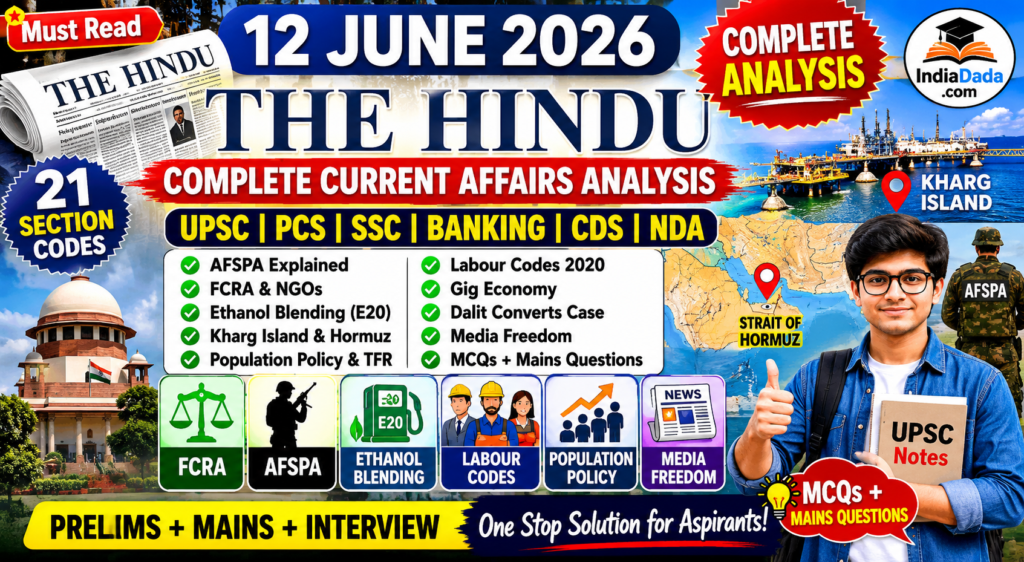
Introduction – 12 June 2026 The Hindu Analysis for UPSC, PCS, SSC & Competitive Exams
Current Affairs आज लगभग सभी Competitive Exams का सबसे महत्वपूर्ण हिस्सा बन चुका है। UPSC Civil Services Examination, State PCS, SSC, Banking, Railway, NDA, CDS, CAPF तथा अन्य सरकारी परीक्षाओं में Daily Current Affairs का योगदान लगातार बढ़ता जा रहा है।
12 June 2026 के The Hindu Newspaper में कई महत्वपूर्ण राष्ट्रीय एवं अंतरराष्ट्रीय विषय प्रकाशित हुए, जिनका सीधा संबंध Governance, International Relations, Social Justice, Internal Security, Energy Security, Population Policy, Public Health तथा Constitutional Issues से है।
आज के प्रमुख Topics
- Hormuz Security Initiative
- Strait of Hormuz & India's Energy Security
- PM Modi France Visit & G7 Summit
- Homemakers are Nation Builders (Supreme Court Judgment)
- Compensation Rights for Housewives
- FCRA Amendment Bill
- Labour Codes & Worker Rights
- Population Policy & Larger Family Debate
- Vasectomy Awareness & Family Planning
- SC Status for Dalit Converts
- Nicobar Elections Debate
- Rajya Sabha Election Rules
- Tenth Schedule Issues
- AFSPA & Internal Security
- Ethanol Blending Policy
- Bacillary Dysentery
- Child Custody Laws
- NewsClick Case
- Kharg Island & Global Oil Trade
UPSC Perspective
GS Paper 1
Population Policy, Women Empowerment, Family Planning, Social Issues
GS Paper 2
Governance, Judiciary, FCRA, India-France Relations, Reservation Issues
GS Paper 3
Energy Security, Ethanol Blending, Labour Reforms, Internal Security
Essay & Interview
Women Empowerment, Demographic Dividend, Civil Society, Strategic Affairs
UPSC अब केवल समाचार नहीं पूछता, बल्कि समाचार के पीछे छिपे Concepts, Constitutional Provisions, Governance Challenges और Policy Implications को समझने की अपेक्षा करता है।
इस Analysis को कैसे पढ़ें?
पहली बार Concept समझने के लिए पढ़ें।
महत्वपूर्ण Facts एवं Keywords नोट करें।
Mains Notes तैयार करें।
MCQs एवं Answer Writing Practice करें।
Hormuz Security Initiative, Strait of Hormuz & India's Energy Security
12 June 2026 के Current Affairs में सबसे महत्वपूर्ण अंतरराष्ट्रीय विषयों में से एक Hormuz Security Initiative रहा। फ्रांस द्वारा प्रस्तावित इस पहल का उद्देश्य Strait of Hormuz क्षेत्र में समुद्री सुरक्षा, ऊर्जा आपूर्ति की स्थिरता और वैश्विक व्यापार मार्गों की सुरक्षा सुनिश्चित करना है।
भारत दुनिया के सबसे बड़े ऊर्जा आयातकों में से एक है और भारत की तेल एवं गैस आपूर्ति का बड़ा हिस्सा इसी क्षेत्र से होकर गुजरता है। इसलिए यह विषय UPSC GS Paper 2, GS Paper 3, International Relations तथा Energy Security के दृष्टिकोण से अत्यंत महत्वपूर्ण है।
Strait of Hormuz क्या है?
Strait of Hormuz एक संकीर्ण समुद्री मार्ग (Narrow Sea Passage) है जो Persian Gulf को Gulf of Oman तथा Arabian Sea से जोड़ता है।
Important Facts
- विश्व के लगभग 20% Crude Oil Trade का आवागमन यहीं से होता है।
- यह विश्व का सबसे महत्वपूर्ण Energy Transit Route माना जाता है।
- Saudi Arabia, UAE, Kuwait, Iraq, Qatar तथा अन्य Gulf देशों का तेल इसी मार्ग से निर्यात होता है।
- भारत की ऊर्जा सुरक्षा भी इस मार्ग पर काफी हद तक निर्भर करती है।
Hormuz Security Initiative क्या है?
फ्रांस और अन्य सहयोगी देशों द्वारा प्रस्तावित इस Initiative का मुख्य उद्देश्य समुद्री मार्गों की सुरक्षा सुनिश्चित करना, समुद्री डकैती (Piracy) को रोकना, तेल आपूर्ति को सुरक्षित रखना तथा क्षेत्रीय तनाव के दौरान अंतरराष्ट्रीय व्यापार को प्रभावित होने से बचाना है।
मुख्य उद्देश्य
- Freedom of Navigation को सुरक्षित रखना
- Oil Tankers की सुरक्षा सुनिश्चित करना
- Maritime Security Cooperation बढ़ाना
- Global Supply Chain को सुरक्षित रखना
- Regional Stability को बढ़ावा देना
भारत के लिए Strait of Hormuz क्यों महत्वपूर्ण है?
भारत अपनी ऊर्जा आवश्यकताओं का बड़ा हिस्सा आयात करता है। भारत की Crude Oil Import Requirement का महत्वपूर्ण भाग Gulf Region से आता है।
Energy Security
भारत के लिए निरंतर तेल आपूर्ति सुनिश्चित होती है।
Trade Security
भारत के समुद्री व्यापार की सुरक्षा सुनिश्चित होती है।
Strategic Interests
पश्चिम एशिया में भारत की रणनीतिक उपस्थिति मजबूत होती है।
Economic Stability
तेल कीमतों में अचानक वृद्धि का जोखिम कम होता है।
यदि Strait of Hormuz बंद हो जाए तो क्या होगा?
- विश्व स्तर पर Crude Oil Prices तेजी से बढ़ सकती हैं।
- भारत में पेट्रोल एवं डीजल महंगे हो सकते हैं।
- Inflation बढ़ सकती है।
- Global Supply Chain प्रभावित हो सकती है।
- कई देशों की Energy Security संकट में पड़ सकती है।
UNCLOS और Freedom of Navigation
United Nations Convention on the Law of the Sea (UNCLOS) के अनुसार अंतरराष्ट्रीय समुद्री मार्गों पर सभी देशों को Freedom of Navigation का अधिकार प्राप्त है।
UNCLOS का उद्देश्य यह सुनिश्चित करना है कि कोई भी देश अंतरराष्ट्रीय समुद्री मार्गों का अनुचित उपयोग करके वैश्विक व्यापार को बाधित न कर सके।
भारत की SAGAR Initiative से संबंध
भारत की SAGAR (Security And Growth for All in the Region) नीति का उद्देश्य हिंद महासागर क्षेत्र में सभी देशों की सुरक्षा एवं सामूहिक विकास को बढ़ावा देना है।
SAGAR Initiative के प्रमुख उद्देश्य
- Maritime Security
- Regional Cooperation
- Blue Economy Development
- Disaster Response
- Freedom of Navigation
UPSC Mains Perspective
Potential Question
"Strait of Hormuz is vital for India's Energy Security. Examine its strategic importance and discuss the role of international maritime cooperation in ensuring regional stability."
Key Takeaways
- Strait of Hormuz विश्व का सबसे महत्वपूर्ण Energy Transit Route है।
- विश्व के लगभग 20% Oil Trade का आवागमन यहीं से होता है।
- भारत की Energy Security इस क्षेत्र से जुड़ी हुई है।
- Hormuz Security Initiative Maritime Cooperation को बढ़ावा देता है।
- UNCLOS Freedom of Navigation सुनिश्चित करता है।
PM Modi France Visit, India-France Strategic Partnership & G7 Summit 2026
12 June 2026 के Current Affairs में प्रधानमंत्री नरेंद्र मोदी की फ्रांस यात्रा और G7 Summit में भारत की भागीदारी प्रमुख चर्चा का विषय रही। यह यात्रा केवल एक राजनयिक दौरा नहीं बल्कि भारत और फ्रांस के बीच बढ़ते रणनीतिक सहयोग, रक्षा साझेदारी, ऊर्जा सुरक्षा और वैश्विक शासन में भारत की भूमिका का प्रतीक है।
भारत और फ्रांस के संबंध क्यों महत्वपूर्ण हैं?
भारत और फ्रांस के संबंध पिछले कई दशकों से लगातार मजबूत हुए हैं। दोनों देश लोकतांत्रिक मूल्यों, बहुपक्षवाद (Multilateralism), जलवायु परिवर्तन, रक्षा सहयोग तथा इंडो-पैसिफिक क्षेत्र में स्थिरता को बढ़ावा देने के लिए साथ कार्य कर रहे हैं।
India-France Relations at a Glance
- Strategic Partnership – 1998
- Defence Cooperation
- Space Cooperation
- Nuclear Energy Cooperation
- Maritime Security Cooperation
- Indo-Pacific Partnership
G7 Summit क्या है?
G7 (Group of Seven) विश्व की सात प्रमुख विकसित अर्थव्यवस्थाओं का समूह है। यह वैश्विक आर्थिक, राजनीतिक एवं रणनीतिक मुद्दों पर चर्चा के लिए एक महत्वपूर्ण मंच माना जाता है।
क्या भारत G7 का सदस्य है?
नहीं। भारत G7 का सदस्य नहीं है, लेकिन विश्व की प्रमुख उभरती अर्थव्यवस्था होने के कारण उसे अक्सर Guest Country के रूप में आमंत्रित किया जाता है।
PM Modi की France Visit के प्रमुख उद्देश्य
Defence Cooperation
रक्षा क्षेत्र में सहयोग और नई तकनीकों पर चर्चा।
Energy Security
वैश्विक ऊर्जा आपूर्ति और रणनीतिक सहयोग को मजबूत करना।
Maritime Security
Indo-Pacific एवं Western Indian Ocean में सहयोग।
Global Governance
बहुपक्षीय संस्थाओं में सुधार और वैश्विक मुद्दों पर समन्वय।
India-France Defence Partnership
भारत और फ्रांस के बीच रक्षा सहयोग लगातार बढ़ रहा है। दोनों देशों के बीच संयुक्त सैन्य अभ्यास, रक्षा तकनीक साझेदारी तथा आधुनिक सैन्य उपकरणों की खरीद सहयोग के महत्वपूर्ण क्षेत्र हैं।
मुख्य रक्षा सहयोग
- Rafale Fighter Aircraft Deal
- Varuna Naval Exercise
- Garuda Air Exercise
- Shakti Military Exercise
- Defence Technology Cooperation
Indo-Pacific Region में सहयोग
Indo-Pacific क्षेत्र वर्तमान समय में वैश्विक राजनीति का सबसे महत्वपूर्ण क्षेत्र बन चुका है। भारत और फ्रांस दोनों इस क्षेत्र में स्वतंत्र, सुरक्षित और नियम-आधारित समुद्री व्यवस्था का समर्थन करते हैं।
Free, Open and Inclusive Indo-Pacific वर्तमान वैश्विक रणनीतिक विमर्श का प्रमुख आधार बन चुका है।
भारत को फ्रांस से क्या लाभ मिलता है?
- उन्नत रक्षा तकनीक तक पहुंच
- सुरक्षित समुद्री व्यापार मार्ग
- इंडो-पैसिफिक क्षेत्र में रणनीतिक समर्थन
- ऊर्जा सुरक्षा सहयोग
- Space Technology एवं Research Cooperation
- Climate Action Partnership
UPSC Mains Perspective
Potential Question
"India-France Strategic Partnership has emerged as one of the most significant pillars of India's foreign policy. Discuss."
Prelims Facts to Remember
- France is a G7 Member Country.
- India is not a G7 member but frequently invited as Guest Nation.
- Rafale Aircraft are manufactured in France.
- Varuna is a bilateral naval exercise between India and France.
- Both countries support a Free and Open Indo-Pacific.
Homemakers are Nation Builders: Supreme Court Judgment & Compensation Rights for Housewives
12 June 2026 के Current Affairs में Supreme Court का एक ऐतिहासिक निर्णय चर्चा में रहा, जिसमें न्यायालय ने कहा कि "Homemakers are Nation Builders" अर्थात गृहिणियां राष्ट्र निर्माण में महत्वपूर्ण भूमिका निभाती हैं और उनके कार्य को आर्थिक दृष्टि से महत्वहीन नहीं माना जा सकता।
यह निर्णय महिलाओं के अवैतनिक घरेलू कार्य (Unpaid Domestic Work) की सामाजिक, आर्थिक एवं कानूनी मान्यता को मजबूत करता है। UPSC GS Paper 1 (Society), GS Paper 2 (Judiciary) तथा Essay के लिए यह विषय अत्यंत महत्वपूर्ण है।
पूरा मामला क्या था?
यह मामला एक सड़क दुर्घटना (Road Accident) से संबंधित था जिसमें एक गृहिणी की मृत्यु हो गई। मुआवजा (Compensation) तय करते समय यह प्रश्न उठा कि चूंकि गृहिणी किसी औपचारिक नौकरी में नहीं थीं, तो उनकी आर्थिक आय कैसे निर्धारित की जाए।
Supreme Court ने कहा कि गृहिणियों का घरेलू कार्य परिवार, समाज और राष्ट्र के लिए अत्यंत महत्वपूर्ण योगदान है और इसे आर्थिक मूल्य प्रदान किया जाना चाहिए।
Supreme Court Observation
Homemakers केवल घरेलू कार्य नहीं करतीं बल्कि परिवार के सामाजिक, शैक्षिक और आर्थिक विकास में भी महत्वपूर्ण योगदान देती हैं।
Homemakers को Nation Builders क्यों कहा गया?
Child Development
बच्चों के पालन-पोषण एवं शिक्षा में महत्वपूर्ण भूमिका।
Family Stability
परिवार की सामाजिक एवं भावनात्मक स्थिरता बनाए रखना।
Economic Contribution
घरेलू कार्य करके अप्रत्यक्ष आर्थिक योगदान देना।
Nation Building
बेहतर मानव संसाधन (Human Resource) निर्माण में योगदान।
Unpaid Care Economy क्या होती है?
जब कोई व्यक्ति परिवार की देखभाल, बच्चों की परवरिश, बुजुर्गों की सेवा, भोजन बनाना, घर की सफाई और अन्य घरेलू कार्य करता है लेकिन उसके बदले कोई वेतन प्राप्त नहीं करता, तो इसे Unpaid Care Work कहा जाता है।
महत्वपूर्ण तथ्य
- विश्वभर में महिलाओं द्वारा किया गया Unpaid Work GDP में शामिल नहीं होता।
- यह कार्य अर्थव्यवस्था को अप्रत्यक्ष रूप से मजबूत बनाता है।
- OECD तथा UN Women कई बार इस कार्य को औपचारिक मान्यता देने की सिफारिश कर चुके हैं।
Compensation Calculation में क्या बदलाव हुआ?
Supreme Court ने कहा कि गृहिणी के घरेलू कार्य को Compensation Calculation का हिस्सा बनाया जाए। यदि किसी दुर्घटना में गृहिणी की मृत्यु होती है तो केवल उनकी प्रत्यक्ष आय ही नहीं बल्कि घरेलू देखभाल (Domestic Care Services) के नुकसान को भी मुआवजे में शामिल किया जाना चाहिए।
मुख्य सिद्धांत
- Domestic Work का आर्थिक मूल्य है।
- Homemakers का योगदान अमूल्य है।
- Compensation तय करते समय घरेलू सेवाओं की लागत जोड़ी जानी चाहिए।
- Gender Justice को बढ़ावा मिलेगा।
महिला सशक्तिकरण के संदर्भ में महत्व
यह निर्णय केवल Compensation तक सीमित नहीं है बल्कि महिलाओं के कार्य को सामाजिक सम्मान और कानूनी मान्यता प्रदान करने की दिशा में महत्वपूर्ण कदम माना जा रहा है।
संभावित प्रभाव
- Gender Equality को बढ़ावा मिलेगा।
- महिलाओं के घरेलू कार्य को मान्यता मिलेगी।
- Social Justice मजबूत होगा।
- Policy Making में Care Economy को महत्व मिल सकता है।
Challenges
- Domestic Work का सटीक आर्थिक मूल्य निर्धारित करना कठिन है।
- भारत में अधिकांश Care Work अनौपचारिक है।
- विभिन्न सामाजिक परिस्थितियों में मूल्यांकन अलग हो सकता है।
Way Forward
- Unpaid Care Work पर नियमित डेटा संग्रह किया जाए।
- Gender Sensitive Policies विकसित की जाएं।
- महिलाओं के आर्थिक योगदान को राष्ट्रीय विमर्श का हिस्सा बनाया जाए।
- Social Security Framework को मजबूत किया जाए।
"A nation's development is not measured only by its GDP but also by the invisible work performed every day inside millions of households."
UPSC Mains Perspective
Potential Question
"Discuss the significance of recognising unpaid domestic work in promoting gender justice and inclusive development in India."
Prelims Quick Revision
- Supreme Court termed Homemakers as Nation Builders.
- Domestic Care Work has economic value.
- Compensation calculation should include loss of domestic services.
- Important topic for Women Empowerment and Social Justice.
FCRA Amendment Bill, NGO Regulation & Civil Society Debate
12 June 2026 के The Hindu Analysis में Foreign Contribution Regulation Act (FCRA) से संबंधित प्रस्तावित संशोधनों तथा Civil Society Organizations पर उसके प्रभाव को लेकर महत्वपूर्ण चर्चा हुई। यह विषय UPSC GS Paper 2 (Governance, Polity, NGOs, Pressure Groups) तथा Essay के लिए अत्यंत महत्वपूर्ण है।
FCRA क्या है?
Foreign Contribution Regulation Act (FCRA) भारत में विदेशी स्रोतों से प्राप्त होने वाले धन (Foreign Contribution) को नियंत्रित करने वाला कानून है।
इसका मुख्य उद्देश्य यह सुनिश्चित करना है कि विदेशी फंडिंग का उपयोग राष्ट्रीय हित, सार्वजनिक व्यवस्था तथा लोकतांत्रिक संस्थाओं को प्रभावित करने के लिए न किया जाए।
FCRA Timeline
- FCRA First Enacted – 1976
- New FCRA Act – 2010
- Major Amendment – 2020
- Further Reform Debate – 2026
Civil Society Organizations क्या होती हैं?
Civil Society Organizations (CSOs), Non-Governmental Organizations (NGOs), Charitable Trusts, Social Welfare Organizations और Voluntary Groups समाज के विभिन्न क्षेत्रों में कार्य करते हैं।
Education
शिक्षा और जागरूकता कार्यक्रम।
Healthcare
स्वास्थ्य सेवाओं तक पहुंच बढ़ाना।
Women Welfare
महिला सशक्तिकरण और अधिकार।
Rural Development
ग्रामीण क्षेत्रों में विकास कार्यक्रम।
FCRA के पक्ष में तर्क
Government Perspective
- Foreign Influence को नियंत्रित करना।
- Money Laundering को रोकना।
- National Security को मजबूत बनाना।
- Funding Transparency बढ़ाना।
- Illegal Political Influence को रोकना।
FCRA के विरोध में तर्क
NGO Perspective
- NGOs के संचालन में कठिनाई बढ़ सकती है।
- Social Development Projects प्रभावित हो सकते हैं।
- Small NGOs के लिए Compliance Cost बढ़ सकती है।
- Civil Society की स्वतंत्रता सीमित हो सकती है।
भारत में NGOs की भूमिका
भारत जैसे विशाल और विविधतापूर्ण देश में NGOs सरकार और समाज के बीच एक महत्वपूर्ण सेतु का कार्य करते हैं।
NGOs के प्रमुख योगदान
- गरीबी उन्मूलन
- महिला सशक्तिकरण
- बाल संरक्षण
- स्वास्थ्य एवं पोषण
- स्किल डेवलपमेंट
- पर्यावरण संरक्षण
- विकलांग व्यक्तियों का सशक्तिकरण
FCRA और राष्ट्रीय सुरक्षा
सरकार का तर्क है कि कुछ मामलों में विदेशी फंडिंग का उपयोग राजनीतिक प्रभाव, सामाजिक अशांति तथा अवैध गतिविधियों को बढ़ावा देने के लिए किया जा सकता है। इसलिए निगरानी और पारदर्शिता आवश्यक है।
Transparency and Accountability must go hand in hand with Freedom of Association.
मुख्य चुनौतियां
Compliance Burden
छोटे संगठनों पर अतिरिक्त प्रशासनिक दबाव।
Funding Delays
विकास परियोजनाओं में वित्तीय बाधाएं।
Monitoring Issues
प्रभावी निगरानी तंत्र की आवश्यकता।
Balance of Freedom
सुरक्षा और स्वतंत्रता के बीच संतुलन।
Way Forward
- Risk-Based Monitoring System विकसित किया जाए।
- Genuine NGOs के लिए प्रक्रिया सरल बनाई जाए।
- Transparency एवं Accountability बढ़ाई जाए।
- Technology Based Compliance Framework अपनाया जाए।
- National Security और Civil Society Freedom के बीच संतुलन बनाया जाए।
UPSC Mains Perspective
Potential Question
"Discuss the role of NGOs in India's development process. Examine the challenges associated with foreign funding and the significance of FCRA."
Prelims Quick Revision
- FCRA regulates foreign contributions received by organizations.
- Originally enacted in 1976.
- Major reforms introduced in 2010 and 2020.
- Important topic from Governance and Internal Security perspective.
Labour Codes, Worker Rights & Gig Economy Challenges in India
12 June 2026 के The Hindu Analysis में भारत के नए Labour Codes और श्रमिकों की सुरक्षा से जुड़ी चुनौतियों पर विशेष चर्चा की गई। सरकार द्वारा श्रम कानूनों को सरल बनाने के लिए चार Labour Codes लागू किए गए हैं, लेकिन अभी भी श्रमिकों के अधिकार, सामाजिक सुरक्षा और रोजगार स्थिरता से जुड़े कई प्रश्न बने हुए हैं।
Labour Codes क्या हैं?
भारत सरकार ने 29 पुराने Labour Laws को मिलाकर 4 नए Labour Codes बनाए हैं। इनका उद्देश्य श्रम कानूनों को सरल, पारदर्शी और उद्योगों के लिए अधिक अनुकूल बनाना है।
Four Labour Codes
- Code on Wages, 2019
- Industrial Relations Code, 2020
- Occupational Safety, Health and Working Conditions Code, 2020
- Code on Social Security, 2020
Labour Reforms की आवश्यकता क्यों थी?
Simplification
अनेक कानूनों को एकीकृत करना।
Ease of Doing Business
उद्योगों के लिए नियम सरल बनाना।
Transparency
श्रम प्रशासन में पारदर्शिता बढ़ाना।
Digital Compliance
ऑनलाइन अनुपालन को बढ़ावा देना।
Current Concerns Highlighted in the Debate
Labour Codes लागू होने के बावजूद श्रमिकों की सुरक्षा से जुड़े कई मुद्दे अभी भी चर्चा में हैं।
- Contract Workers की Job Security
- Minimum Wage Implementation
- Gig Workers की Social Security
- Trade Union Representation
- Fixed Term Employment की चुनौतियां
Gig Economy क्या है?
Gig Economy ऐसे रोजगार मॉडल को कहा जाता है जिसमें व्यक्ति स्थायी कर्मचारी न होकर स्वतंत्र रूप से कार्य करता है या डिजिटल प्लेटफॉर्म के माध्यम से सेवाएं प्रदान करता है।
Examples of Gig Workers
- Food Delivery Partners
- Ride Sharing Drivers
- Freelancers
- E-Commerce Delivery Workers
- Platform Based Service Providers
Gig Workers के सामने प्रमुख समस्याएं
No Fixed Income
नियमित वेतन की गारंटी नहीं।
No Social Security
पेंशन, बीमा और अन्य सुविधाओं का अभाव।
Job Uncertainty
रोजगार की स्थिरता कम होती है।
Limited Legal Protection
श्रम अधिकारों की सीमित सुरक्षा।
Code on Social Security, 2020 का महत्व
यह Code पहली बार Gig Workers और Platform Workers को Social Security Framework में शामिल करने का प्रयास करता है।
Potential Benefits
- Insurance Coverage
- Health Benefits
- Pension Support
- Accident Compensation
- Social Welfare Schemes
भारत का Labour Market Structure
Important Facts
- भारत का बड़ा श्रमबल Informal Sector में कार्य करता है।
- कई श्रमिक Social Security से वंचित हैं।
- Skill Development और Formalization प्रमुख चुनौतियां हैं।
- Gig Economy तेजी से विस्तार कर रही है।
Challenges in Implementation
- राज्यों द्वारा नियमों का असमान कार्यान्वयन।
- Awareness की कमी।
- Informal Workers की पहचान करना कठिन।
- Social Security Funding की चुनौती।
Way Forward
- Universal Social Security Coverage विकसित की जाए।
- Gig Workers के लिए विशेष Welfare Framework तैयार किया जाए।
- Labour Inspection को Technology आधारित बनाया जाए।
- Skill Development और Formal Employment को बढ़ावा दिया जाए।
- Minimum Wage Enforcement मजबूत किया जाए।
Economic growth becomes sustainable only when workers' rights and social security grow alongside businesses.
UPSC Mains Perspective
Potential Question
"Discuss the significance of Labour Codes in India. Examine the challenges faced by Gig Workers and suggest measures for ensuring social security."
Prelims Quick Revision
- India consolidated 29 Labour Laws into 4 Labour Codes.
- Code on Wages was enacted in 2019.
- Three other Labour Codes were enacted in 2020.
- Gig Workers are covered under the Code on Social Security.
Population Policy, Larger Family Debate & Demographic Transition in India
12 June 2026 के Current Affairs में भारत की Population Policy और "क्या भारत को बड़ी Families को Incentivize करना चाहिए?" इस विषय पर व्यापक चर्चा हुई। कुछ राज्यों द्वारा जन्म दर (Fertility Rate) बढ़ाने के लिए प्रोत्साहन देने के प्रस्तावों ने इस बहस को और महत्वपूर्ण बना दिया है।
Population Policy क्या होती है?
Population Policy वह सरकारी रणनीति होती है जिसके माध्यम से जनसंख्या वृद्धि, जन्म दर, मृत्यु दर, आयु संरचना और मानव संसाधन विकास को संतुलित करने का प्रयास किया जाता है।
Population Policy Objectives
- Population Stabilization
- Maternal Health Improvement
- Child Health Protection
- Human Resource Development
- Sustainable Economic Growth
Larger Family Debate क्यों शुरू हुई?
हाल के वर्षों में भारत के कई राज्यों में Total Fertility Rate (TFR) में कमी दर्ज की गई है। कुछ विशेषज्ञों का मानना है कि यदि जन्म दर लगातार घटती रही तो भविष्य में भारत भी वृद्ध होती जनसंख्या (Aging Population) की चुनौती का सामना कर सकता है।
Total Fertility Rate (TFR)
किसी महिला द्वारा अपने जीवनकाल में औसतन जन्म दिए जाने वाले बच्चों की संख्या को Total Fertility Rate कहा जाता है।
Demographic Transition Theory
जनसंख्या परिवर्तन को समझने के लिए Demographic Transition Model का उपयोग किया जाता है।
Stage 1
High Birth Rate + High Death Rate
Stage 2
High Birth Rate + Falling Death Rate
Stage 3
Declining Birth Rate
Stage 4
Low Birth Rate + Low Death Rate
बड़ी Families को Incentivize करने के पक्ष में तर्क
Future Workforce
भविष्य में कार्यबल की कमी नहीं होगी।
Demographic Balance
Aging Population की समस्या कम हो सकती है।
Economic Productivity
युवा आबादी आर्थिक विकास में योगदान देती है।
Social Stability
Dependency Ratio संतुलित रह सकता है।
विरोध में तर्क
- Resources पर अतिरिक्त दबाव बढ़ सकता है।
- Urban Infrastructure पर बोझ बढ़ सकता है।
- Unemployment की समस्या बढ़ सकती है।
- गरीबी और असमानता बढ़ने का खतरा हो सकता है।
- Environmental Sustainability प्रभावित हो सकती है।
Demographic Dividend क्या है?
जब किसी देश की कार्यशील आयु वर्ग (15–64 वर्ष) की जनसंख्या आश्रित जनसंख्या (Children + Elderly) से अधिक होती है, तो उसे Demographic Dividend कहा जाता है।
Benefits of Demographic Dividend
- Higher Economic Growth
- Greater Productivity
- Innovation & Entrepreneurship
- Higher Savings Rate
- Stronger Labour Market
भारत की वर्तमान स्थिति
Current Scenario
- भारत विश्व की सबसे बड़ी आबादी वाला देश है।
- कई राज्यों में Fertility Rate Replacement Level के आसपास पहुंच चुकी है।
- कुछ राज्यों में वृद्ध जनसंख्या की हिस्सेदारी बढ़ रही है।
- युवा आबादी अभी भी भारत की सबसे बड़ी ताकत है।
Policy Challenges
Regional Differences
राज्यों के बीच Fertility Rate में बड़ा अंतर।
Employment Creation
युवाओं के लिए पर्याप्त रोजगार की आवश्यकता।
Education & Skills
मानव संसाधन विकास पर ध्यान जरूरी।
Healthcare Burden
बढ़ती जनसंख्या के लिए स्वास्थ्य सुविधाएं।
Way Forward
- Population Stabilization Approach अपनाई जाए।
- Skill Development को प्राथमिकता दी जाए।
- Women Education एवं Health में निवेश बढ़ाया जाए।
- Demographic Dividend का प्रभावी उपयोग किया जाए।
- Regional Population Trends के अनुसार नीति बनाई जाए।
Population is not merely a number; it becomes an asset only when supported by education, skills and opportunities.
UPSC Mains Perspective
Potential Question
"Should India incentivize larger families in the context of declining fertility rates? Critically examine."
Prelims Quick Revision
- TFR stands for Total Fertility Rate.
- Demographic Dividend depends on working-age population.
- Population Policy focuses on stabilization and human development.
- Aging Population is emerging as a future challenge.
Vasectomy Awareness, Family Planning & Women's Health in India
12 June 2026 के Current Affairs में Family Planning और Vasectomy Awareness से जुड़ा मुद्दा चर्चा में रहा। भारत में दशकों से परिवार नियोजन कार्यक्रम चलाए जा रहे हैं, लेकिन आज भी Contraception और Sterilization का अधिकांश भार महिलाओं पर ही पड़ता है।
विशेषज्ञों का मानना है कि Family Planning को Gender-Neutral बनाने तथा पुरुषों की भागीदारी बढ़ाने की आवश्यकता है। UPSC GS Paper 1 (Society), GS Paper 2 (Health), GS Paper 3 (Human Development) तथा Essay के लिए यह विषय अत्यंत महत्वपूर्ण है।
Family Planning क्या है?
Family Planning का अर्थ है परिवार के आकार, बच्चों के बीच अंतराल तथा प्रजनन संबंधी निर्णयों को वैज्ञानिक और स्वैच्छिक तरीके से नियंत्रित करना।
Objectives of Family Planning
- Population Stabilization
- Maternal Health Improvement
- Child Health Protection
- Women Empowerment
- Better Quality of Life
Vasectomy क्या है?
Vasectomy पुरुष नसबंदी (Male Sterilization) की एक सुरक्षित और सरल चिकित्सा प्रक्रिया है, जिसमें शुक्राणुओं (Sperms) के प्रवाह को रोक दिया जाता है ताकि गर्भधारण न हो सके।
Important Features of Vasectomy
- Safe Procedure
- Permanent Contraceptive Method
- Short Recovery Time
- Low Medical Risk
- Highly Effective
भारत में पुरुष भागीदारी कम क्यों है?
Social Myths
नसबंदी को लेकर कई भ्रांतियां मौजूद हैं।
Lack of Awareness
वैज्ञानिक जानकारी का अभाव।
Cultural Barriers
पारंपरिक सोच और सामाजिक दबाव।
Gender Bias
परिवार नियोजन की जिम्मेदारी महिलाओं पर डालना।
महिलाओं पर Family Planning का भार
भारत में अधिकांश Sterilization Procedures महिलाओं पर किए जाते हैं। Female Sterilization की तुलना में Male Sterilization का प्रतिशत काफी कम है।
- महिलाओं को अधिक स्वास्थ्य जोखिम झेलने पड़ते हैं।
- Reproductive Burden असमान रूप से महिलाओं पर पड़ता है।
- Gender Equality प्रभावित होती है।
- Healthcare Access में असंतुलन उत्पन्न हो सकता है।
Women's Health क्यों महत्वपूर्ण है?
Maternal Health
सुरक्षित मातृत्व सुनिश्चित करना।
Nutrition
बेहतर पोषण और स्वास्थ्य।
Reproductive Rights
महिलाओं को निर्णय लेने का अधिकार।
Human Development
स्वस्थ परिवार और समाज का निर्माण।
Government Initiatives
Major Family Welfare Programmes
- National Health Mission (NHM)
- Mission Parivar Vikas
- Family Planning Programme
- Reproductive & Child Health Programme
- Population Stabilization Initiatives
Gender Equality Perspective
Sustainable Family Planning तभी संभव है जब पुरुष और महिलाएं दोनों समान रूप से जिम्मेदारी साझा करें।
Family Planning should not be viewed as a women's issue alone; it is a shared responsibility of both partners.
Challenges Before India
- Low Male Participation
- Rural Awareness Gap
- Social Stigma
- Healthcare Accessibility Issues
- Gender-Based Misconceptions
Way Forward
- Male Participation बढ़ाने के लिए Awareness Campaign चलाए जाएं।
- Scientific Information का प्रसार किया जाए।
- Gender-Neutral Family Planning Approach अपनाई जाए।
- Primary Healthcare Network को मजबूत किया जाए।
- Women-Centric Burden को कम किया जाए।
UPSC Mains Perspective
Potential Question
"Discuss the challenges associated with male participation in family planning programmes in India. Suggest measures to improve gender-balanced reproductive health policies."
Prelims Quick Revision
- Vasectomy is a male sterilization procedure.
- Family Planning is linked to Population Stabilization.
- Mission Parivar Vikas focuses on family welfare.
- Women's Health is an important component of Human Development.
SC Status for Dalit Converts, Reservation Debate & Constitutional Challenges
12 June 2026 के Current Affairs में Dalit Converts को Scheduled Caste (SC) Status देने का मुद्दा पुनः चर्चा में रहा। इस विषय की जांच के लिए गठित समिति ने अपनी रिपोर्ट तैयार कर ली है, जिससे यह बहस एक बार फिर राष्ट्रीय स्तर पर महत्वपूर्ण बन गई है।
यह मुद्दा संविधान, सामाजिक न्याय, धर्मांतरण, आरक्षण नीति और समान अवसरों से जुड़ा हुआ है। UPSC GS Paper 1 (Indian Society), GS Paper 2 (Constitution & Governance) तथा Essay के लिए यह अत्यंत महत्वपूर्ण विषय है।
विवाद क्या है?
वर्तमान में संविधान (Scheduled Castes) Order, 1950 के अनुसार Scheduled Caste का दर्जा मुख्यतः हिंदू, सिख और बौद्ध धर्म से जुड़े कुछ समुदायों को दिया जाता है।
प्रश्न यह उठता है कि यदि कोई Dalit व्यक्ति ईसाई (Christianity) या इस्लाम (Islam) धर्म स्वीकार कर लेता है, तो क्या उसे SC Reservation का लाभ मिलता रहना चाहिए?
Core Question
क्या सामाजिक भेदभाव धर्म परिवर्तन के बाद समाप्त हो जाता है, या वह नए धर्म में भी जारी रहता है?
Scheduled Castes क्या हैं?
Scheduled Castes वे समुदाय हैं जिन्हें ऐतिहासिक रूप से सामाजिक भेदभाव, अस्पृश्यता और सामाजिक बहिष्कार का सामना करना पड़ा।
Constitutional Basis
- Article 341
- Scheduled Castes Order, 1950
- Reservation Framework
- Social Justice Provisions
SC Status देने के पक्ष में तर्क
Continued Discrimination
धर्म परिवर्तन के बाद भी सामाजिक भेदभाव समाप्त नहीं होता।
Equality Principle
समानता के अधिकार के अनुरूप अवसर मिलने चाहिए।
Social Justice
ऐतिहासिक अन्याय की भरपाई जारी रहनी चाहिए।
Inclusive Welfare
सभी वंचित समुदायों तक लाभ पहुंचना चाहिए।
विरोध में तर्क
- SC Status का आधार मूल रूप से सामाजिक-धार्मिक संदर्भ था।
- धर्म परिवर्तन के बाद नई सामाजिक पहचान बनती है।
- Reservation Structure पर अतिरिक्त दबाव पड़ सकता है।
- Policy Implementation जटिल हो सकती है।
सुप्रीम कोर्ट और आयोगों की भूमिका
इस विषय पर समय-समय पर विभिन्न आयोगों, समितियों और न्यायालयों में चर्चा होती रही है। वर्तमान बहस का उद्देश्य सामाजिक वास्तविकताओं का अध्ययन करना और यह समझना है कि क्या धर्म परिवर्तन के बाद भी सामाजिक पिछड़ापन जारी रहता है।
Key Issues Under Examination
- Post-Conversion Social Status
- Access to Opportunities
- Social Exclusion
- Economic Backwardness
- Constitutional Equality
संवैधानिक प्रावधान
Article 14
समानता का अधिकार।
Article 15
भेदभाव के विरुद्ध सुरक्षा।
Article 16
रोजगार में समान अवसर।
Article 341
Scheduled Castes की अधिसूचना।
सामाजिक न्याय के संदर्भ में महत्व
भारत में Reservation केवल आर्थिक सहायता का माध्यम नहीं है, बल्कि यह सामाजिक प्रतिनिधित्व और ऐतिहासिक अन्याय को दूर करने का उपकरण भी है।
Reservation is not merely a welfare measure; it is a mechanism for ensuring social justice and representation.
Challenges Ahead
- सामाजिक पिछड़ेपन को मापना जटिल है।
- धर्म और जाति के संबंधों का मूल्यांकन कठिन है।
- राजनीतिक और सामाजिक मतभेद मौजूद हैं।
- Reservation Policy पर व्यापक प्रभाव पड़ सकता है।
Way Forward
- Evidence-Based Policy Making को बढ़ावा दिया जाए।
- समग्र सामाजिक अध्ययन किए जाएं।
- सामाजिक न्याय और समानता के सिद्धांतों को प्राथमिकता दी जाए।
- डेटा आधारित निर्णय लिए जाएं।
- सभी हितधारकों के साथ व्यापक परामर्श किया जाए।
UPSC Mains Perspective
Potential Question
"Examine the constitutional and social dimensions of granting Scheduled Caste status to Dalit converts."
Prelims Quick Revision
- Article 341 deals with Scheduled Castes.
- Reservation is linked with social justice and representation.
- Dalit Convert Reservation remains an ongoing policy debate.
- Important topic from Polity, Society and Governance perspective.
Nicobar Elections Debate, Tribal Governance & Democratic Representation
12 June 2026 के Current Affairs में Nicobar Islands में चुनावी व्यवस्था (Election System) को लेकर उभरती बहस चर्चा का विषय रही। यह मुद्दा केवल चुनावों तक सीमित नहीं है बल्कि Tribal Rights, Traditional Governance Systems और Democratic Representation से भी जुड़ा हुआ है।
UPSC GS Paper 2 (Governance), GS Paper 1 (Tribal Society), Constitution तथा Essay के लिए यह एक अत्यंत महत्वपूर्ण विषय है।
Nicobar Islands कहाँ स्थित हैं?
Nicobar Islands, Andaman and Nicobar Islands Union Territory का दक्षिणी भाग हैं। ये द्वीप समूह बंगाल की खाड़ी और अंडमान सागर के बीच स्थित हैं तथा भारत की सामरिक दृष्टि से अत्यंत महत्वपूर्ण स्थिति रखते हैं।
Important Facts About Nicobar Islands
- Andaman and Nicobar Islands का हिस्सा।
- भारत का दक्षिणतम बिंदु – Indira Point यहीं स्थित है।
- कई आदिवासी समुदाय यहां निवास करते हैं।
- Strategic Location in Indian Ocean Region.
वर्तमान विवाद क्या है?
प्रशासन द्वारा स्थानीय शासन प्रणाली में चुनाव आधारित कुछ नए प्रावधानों पर विचार किया जा रहा है। दूसरी ओर कई Tribal Communities को आशंका है कि इससे उनकी पारंपरिक शासन व्यवस्था (Traditional Tribal Governance) कमजोर हो सकती है।
Tribal Concerns
- Traditional Institutions कमजोर हो सकती हैं।
- Tribal Identity पर प्रभाव पड़ सकता है।
- Customary Governance Systems समाप्त हो सकती हैं।
- स्थानीय प्रतिनिधित्व प्रभावित हो सकता है।
Tribal Governance क्या होती है?
भारत के कई आदिवासी क्षेत्रों में पारंपरिक नेतृत्व और सामुदायिक निर्णय प्रणाली लंबे समय से कार्यरत है। इन व्यवस्थाओं का आधार स्थानीय परंपराएं, सामाजिक सहमति और सामुदायिक भागीदारी होती है।
Features of Tribal Governance
- Community Participation
- Consensus Based Decision Making
- Customary Laws
- Local Resource Management
- Traditional Leadership
लोकतांत्रिक चुनाव प्रणाली के पक्ष में तर्क
Greater Representation
अधिक लोगों को प्रतिनिधित्व का अवसर।
Transparency
जवाबदेही और पारदर्शिता बढ़ती है।
Participation
लोकतांत्रिक भागीदारी को बढ़ावा।
Institutional Strengthening
स्थानीय संस्थाओं को मजबूत बनाना।
पारंपरिक व्यवस्था के पक्ष में तर्क
Why Tribal Communities Support Traditional Systems?
- स्थानीय संस्कृति की रक्षा होती है।
- सामुदायिक एकता बनी रहती है।
- निर्णय स्थानीय जरूरतों के अनुसार होते हैं।
- बाहरी राजनीतिक हस्तक्षेप कम होता है।
संवैधानिक संदर्भ
भारतीय संविधान आदिवासी समुदायों के संरक्षण और उनके सामाजिक-सांस्कृतिक अधिकारों की रक्षा के लिए विशेष प्रावधान प्रदान करता है।
Article 244
Scheduled Areas & Tribal Areas Administration.
Fifth Schedule
Scheduled Areas Administration.
Sixth Schedule
Autonomous Tribal Areas Governance.
PESA Act
Tribal Self Governance Promotion.
भारत के लिए व्यापक महत्व
Nicobar Debate केवल एक स्थानीय मुद्दा नहीं है। यह पूरे भारत में Tribal Autonomy और Democratic Governance के बीच संतुलन की चुनौती को दर्शाता है।
True democracy is not merely about elections; it is also about protecting cultural diversity and local self-governance.
Challenges Ahead
- Modern Governance और Traditional Systems के बीच संतुलन।
- Tribal Rights की सुरक्षा।
- Political Representation सुनिश्चित करना।
- Development और Cultural Preservation का समन्वय।
Way Forward
- Participatory Governance Model विकसित किया जाए।
- Tribal Communities के साथ व्यापक परामर्श किया जाए।
- Traditional Institutions को सम्मान दिया जाए।
- Inclusive Democratic Framework अपनाया जाए।
- Local Culture और Constitutional Values के बीच संतुलन बनाया जाए।
UPSC Mains Perspective
Potential Question
"Discuss the challenges involved in balancing democratic representation and traditional tribal governance systems in India."
Prelims Quick Revision
- Nicobar Islands are part of Andaman & Nicobar Islands UT.
- Indira Point is located in Nicobar Islands.
- PESA Act promotes tribal self-governance.
- Important topic from Governance and Tribal Affairs perspective.
Rajya Sabha Election Rules, Nomination Rejection & Tenth Schedule Debate
12 June 2026 के Current Affairs में Rajya Sabha Election से जुड़ा एक विवाद चर्चा में रहा, जिसमें एक उम्मीदवार का नामांकन (Nomination) निरस्त कर दिया गया। इस घटना ने चुनावी प्रक्रिया, उम्मीदवारों की पात्रता, लोकतांत्रिक प्रतिनिधित्व तथा Tenth Schedule (Anti-Defection Law) से जुड़े व्यापक संवैधानिक प्रश्नों को पुनः चर्चा में ला दिया।
Rajya Sabha क्या है?
Rajya Sabha भारतीय संसद का उच्च सदन (Upper House) है। इसे Council of States भी कहा जाता है क्योंकि यह राज्यों और केंद्रशासित प्रदेशों का प्रतिनिधित्व करता है।
Rajya Sabha Important Facts
- Maximum Strength – 250 Members
- Current Strength – 245 Members
- Permanent House (Never Dissolved)
- One-third Members Retire Every Two Years
- Vice President is the Ex-Officio Chairman
Rajya Sabha Members का चुनाव कैसे होता है?
Rajya Sabha के सदस्य सीधे जनता द्वारा नहीं चुने जाते। उनका चुनाव राज्य विधानसभाओं के निर्वाचित सदस्य (MLAs) Proportional Representation System द्वारा करते हैं।
Election Method
- Indirect Election
- Single Transferable Vote (STV)
- Proportional Representation System
- MLAs Act as Electors
Nomination Rejection क्या होता है?
किसी उम्मीदवार द्वारा दाखिल किए गए नामांकन पत्र (Nomination Papers) की जांच निर्वाचन अधिकारी द्वारा की जाती है। यदि कानूनी या प्रक्रियात्मक शर्तें पूरी नहीं होतीं तो नामांकन निरस्त किया जा सकता है।
Possible Reasons for Rejection
- Incomplete Documents
- Incorrect Information
- Failure to Meet Eligibility Criteria
- Procedural Violations
- Legal Disqualifications
लोकतंत्र में निष्पक्ष चुनाव क्यों महत्वपूर्ण हैं?
Representation
जनता की आवाज संसद तक पहुंचती है।
Accountability
राजनीतिक दल जवाबदेह बनते हैं।
Transparency
चुनावी प्रक्रिया में विश्वास बढ़ता है।
Constitutional Governance
लोकतांत्रिक संस्थाएं मजबूत होती हैं।
Tenth Schedule क्या है?
Tenth Schedule को Anti-Defection Law भी कहा जाता है। इसे 52nd Constitutional Amendment Act, 1985 के माध्यम से जोड़ा गया था।
Purpose of Anti-Defection Law
- Political Defections रोकना
- Government Stability बनाए रखना
- Party Discipline सुनिश्चित करना
- Political Corruption कम करना
Defection क्या होती है?
जब कोई निर्वाचित प्रतिनिधि अपनी राजनीतिक पार्टी छोड़ देता है या पार्टी व्हिप के विरुद्ध मतदान करता है, तो उसे Defection माना जा सकता है।
Party Switching
दल बदलना।
Whip Violation
पार्टी निर्देशों का उल्लंघन।
Political Instability
सरकार पर प्रभाव।
Democratic Concerns
प्रतिनिधित्व पर प्रश्न।
Anti-Defection Law की आलोचना
- Legislators की स्वतंत्रता सीमित हो सकती है।
- Speaker की निष्पक्षता पर प्रश्न उठते हैं।
- Political Debate प्रभावित हो सकती है।
- निर्णय प्रक्रिया में देरी होती है।
Speaker की भूमिका
Defection से जुड़े मामलों में अंतिम निर्णय आमतौर पर Speaker या Chairman द्वारा लिया जाता है। इसलिए उनकी निष्पक्षता लोकतंत्र के लिए अत्यंत महत्वपूर्ण मानी जाती है।
A strong democracy depends not only on elections but also on the fairness of institutions that govern them.
Way Forward
- Election Processes को और अधिक पारदर्शी बनाया जाए।
- Nomination Scrutiny को तकनीकी रूप से मजबूत किया जाए।
- Anti-Defection Cases के लिए समय सीमा निर्धारित की जाए।
- Institutional Neutrality सुनिश्चित की जाए।
- Democratic Accountability को मजबूत किया जाए।
UPSC Mains Perspective
Potential Question
"Critically examine the effectiveness of the Anti-Defection Law in strengthening parliamentary democracy in India."
Prelims Quick Revision
- Rajya Sabha is the Upper House of Parliament.
- Members are elected through Proportional Representation.
- Tenth Schedule deals with Anti-Defection Law.
- Added by the 52nd Constitutional Amendment Act, 1985.
- Vice President is the Chairman of Rajya Sabha.
AFSPA, Internal Security & Challenges in Conflict-Affected Areas
12 June 2026 के Current Affairs में Armed Forces Special Powers Act (AFSPA) पुनः चर्चा में रहा। AFSPA भारत के Internal Security Framework का एक महत्वपूर्ण हिस्सा है, विशेषकर उन क्षेत्रों में जहां लंबे समय से उग्रवाद, आतंकवाद या सशस्त्र विद्रोह जैसी चुनौतियां मौजूद हैं।
यह विषय UPSC GS Paper 3 (Internal Security), GS Paper 2 (Governance & Human Rights) तथा Essay के लिए अत्यंत महत्वपूर्ण है।
AFSPA क्या है?
Armed Forces Special Powers Act (AFSPA) एक विशेष कानून है जो सशस्त्र बलों (Armed Forces) को "Disturbed Areas" में कानून एवं व्यवस्था बनाए रखने हेतु विशेष अधिकार प्रदान करता है।
AFSPA Overview
- Enacted in 1958
- Initially for North-East Region
- Applicable in Disturbed Areas
- Focus on Internal Security Operations
Disturbed Area क्या होता है?
Disturbed Area वह क्षेत्र होता है जहां गंभीर कानून-व्यवस्था की समस्या, आतंकवाद, उग्रवाद या सशस्त्र विद्रोह जैसी परिस्थितियां मौजूद हों।
Possible Reasons for Disturbed Area Declaration
- Insurgency
- Terrorism
- Armed Rebellion
- Serious Security Threats
- Breakdown of Public Order
AFSPA के अंतर्गत विशेष अधिकार
Search Operations
सुरक्षा बल तलाशी अभियान चला सकते हैं।
Arrest Powers
संदिग्ध व्यक्तियों को गिरफ्तार करने का अधिकार।
Counter-Insurgency
उग्रवाद विरोधी अभियान चलाने की शक्ति।
Security Operations
राष्ट्रीय सुरक्षा सुनिश्चित करना।
AFSPA के पक्ष में तर्क
Why Supporters Defend AFSPA?
- उग्रवाद प्रभावित क्षेत्रों में प्रभावी कार्रवाई संभव होती है।
- सुरक्षा बलों को त्वरित निर्णय लेने की सुविधा मिलती है।
- राष्ट्रीय एकता एवं अखंडता की रक्षा होती है।
- आतंकवाद विरोधी अभियानों में सहायता मिलती है।
AFSPA की आलोचनाएं
- Human Rights Concerns
- Excessive Use of Force के आरोप
- Accountability Issues
- Public Trust पर प्रभाव
- Long-Term Deployment Concerns
Human Rights Perspective
कई Human Rights Organizations का मानना है कि AFSPA के कार्यान्वयन के दौरान नागरिक अधिकारों की सुरक्षा भी उतनी ही महत्वपूर्ण है जितनी राष्ट्रीय सुरक्षा।
National Security and Human Rights should not be viewed as competing goals; both must coexist in a constitutional democracy.
महत्वपूर्ण समितियां एवं आयोग
Jeevan Reddy Committee
AFSPA की समीक्षा हेतु गठित समिति।
Second ARC
Administrative Reforms Commission Recommendations.
Supreme Court
AFSPA के कार्यान्वयन पर कई महत्वपूर्ण टिप्पणियां।
Human Rights Bodies
जवाबदेही और पारदर्शिता की मांग।
भारत की Internal Security Challenges
Key Challenges
- Cross-Border Terrorism
- Insurgency
- Radicalization
- Illegal Arms Movement
- Organized Security Threats
Way Forward
- Security Operations और Human Rights के बीच संतुलन।
- Community Engagement को बढ़ावा देना।
- Development-Based Conflict Resolution Strategy अपनाना।
- Periodic Review Mechanism विकसित करना।
- Transparency एवं Accountability को मजबूत बनाना।
UPSC Mains Perspective
Potential Question
"Discuss the significance of AFSPA in maintaining internal security. Also examine the concerns related to human rights and accountability."
Prelims Quick Revision
- AFSPA stands for Armed Forces Special Powers Act.
- Originally enacted in 1958.
- Applicable in Disturbed Areas.
- Important for Internal Security and Counter-Insurgency Operations.
- Frequently asked in UPSC Prelims and Mains.
AFSPA, Internal Security & Challenges in Conflict-Affected Areas
12 June 2026 के Current Affairs में Armed Forces Special Powers Act (AFSPA) पुनः चर्चा में रहा। AFSPA भारत के Internal Security Framework का एक महत्वपूर्ण हिस्सा है, विशेषकर उन क्षेत्रों में जहां लंबे समय से उग्रवाद, आतंकवाद या सशस्त्र विद्रोह जैसी चुनौतियां मौजूद हैं।
यह विषय UPSC GS Paper 3 (Internal Security), GS Paper 2 (Governance & Human Rights) तथा Essay के लिए अत्यंत महत्वपूर्ण है।
AFSPA क्या है?
Armed Forces Special Powers Act (AFSPA) एक विशेष कानून है जो सशस्त्र बलों (Armed Forces) को "Disturbed Areas" में कानून एवं व्यवस्था बनाए रखने हेतु विशेष अधिकार प्रदान करता है।
AFSPA Overview
- Enacted in 1958
- Initially for North-East Region
- Applicable in Disturbed Areas
- Focus on Internal Security Operations
Disturbed Area क्या होता है?
Disturbed Area वह क्षेत्र होता है जहां गंभीर कानून-व्यवस्था की समस्या, आतंकवाद, उग्रवाद या सशस्त्र विद्रोह जैसी परिस्थितियां मौजूद हों।
Possible Reasons for Disturbed Area Declaration
- Insurgency
- Terrorism
- Armed Rebellion
- Serious Security Threats
- Breakdown of Public Order
AFSPA के अंतर्गत विशेष अधिकार
Search Operations
सुरक्षा बल तलाशी अभियान चला सकते हैं।
Arrest Powers
संदिग्ध व्यक्तियों को गिरफ्तार करने का अधिकार।
Counter-Insurgency
उग्रवाद विरोधी अभियान चलाने की शक्ति।
Security Operations
राष्ट्रीय सुरक्षा सुनिश्चित करना।
AFSPA के पक्ष में तर्क
Why Supporters Defend AFSPA?
- उग्रवाद प्रभावित क्षेत्रों में प्रभावी कार्रवाई संभव होती है।
- सुरक्षा बलों को त्वरित निर्णय लेने की सुविधा मिलती है।
- राष्ट्रीय एकता एवं अखंडता की रक्षा होती है।
- आतंकवाद विरोधी अभियानों में सहायता मिलती है।
AFSPA की आलोचनाएं
- Human Rights Concerns
- Excessive Use of Force के आरोप
- Accountability Issues
- Public Trust पर प्रभाव
- Long-Term Deployment Concerns
Human Rights Perspective
कई Human Rights Organizations का मानना है कि AFSPA के कार्यान्वयन के दौरान नागरिक अधिकारों की सुरक्षा भी उतनी ही महत्वपूर्ण है जितनी राष्ट्रीय सुरक्षा।
National Security and Human Rights should not be viewed as competing goals; both must coexist in a constitutional democracy.
महत्वपूर्ण समितियां एवं आयोग
Jeevan Reddy Committee
AFSPA की समीक्षा हेतु गठित समिति।
Second ARC
Administrative Reforms Commission Recommendations.
Supreme Court
AFSPA के कार्यान्वयन पर कई महत्वपूर्ण टिप्पणियां।
Human Rights Bodies
जवाबदेही और पारदर्शिता की मांग।
भारत की Internal Security Challenges
Key Challenges
- Cross-Border Terrorism
- Insurgency
- Radicalization
- Illegal Arms Movement
- Organized Security Threats
Way Forward
- Security Operations और Human Rights के बीच संतुलन।
- Community Engagement को बढ़ावा देना।
- Development-Based Conflict Resolution Strategy अपनाना।
- Periodic Review Mechanism विकसित करना।
- Transparency एवं Accountability को मजबूत बनाना।
UPSC Mains Perspective
Potential Question
"Discuss the significance of AFSPA in maintaining internal security. Also examine the concerns related to human rights and accountability."
Prelims Quick Revision
- AFSPA stands for Armed Forces Special Powers Act.
- Originally enacted in 1958.
- Applicable in Disturbed Areas.
- Important for Internal Security and Counter-Insurgency Operations.
- Frequently asked in UPSC Prelims and Mains.
Ethanol Blending Policy, Biofuels & India's Energy Transition
12 June 2026 के Current Affairs में भारत सरकार द्वारा Ethanol Blended Fuel को बढ़ावा देने के लिए उठाए गए कदम चर्चा में रहे। सरकार ने Ethanol Blending Programme (EBP) को प्रोत्साहित करने के लिए Excise Duty में राहत सहित कई नीतिगत कदम उठाए हैं।
यह विषय UPSC GS Paper 3 (Economy, Environment, Energy Security), Prelims, Essay तथा Interview के लिए अत्यंत महत्वपूर्ण है क्योंकि यह Energy Security, Climate Change और Sustainable Development से जुड़ा हुआ है।
Ethanol क्या है?
Ethanol एक प्रकार का Biofuel है जो मुख्य रूप से गन्ने, मक्का, कृषि अपशिष्ट तथा अन्य जैविक स्रोतों से तैयार किया जाता है। इसे पेट्रोल में मिलाकर वाहनों के लिए ईंधन के रूप में उपयोग किया जाता है।
Key Facts About Ethanol
- Renewable Fuel
- Produced from Biomass
- Environment Friendly
- Reduces Fossil Fuel Dependence
- Supports Farmers' Income
Ethanol Blending Programme (EBP) क्या है?
Ethanol Blending Programme भारत सरकार की एक प्रमुख पहल है जिसके अंतर्गत पेट्रोल में निर्धारित प्रतिशत तक Ethanol मिलाया जाता है ताकि Crude Oil Imports को कम किया जा सके और स्वच्छ ऊर्जा को बढ़ावा दिया जा सके।
Main Objectives of EBP
- Reduce Oil Imports
- Promote Clean Energy
- Reduce Carbon Emissions
- Support Farmers
- Enhance Energy Security
भारत को Ethanol Blending की आवश्यकता क्यों है?
Energy Security
विदेशी तेल पर निर्भरता कम होती है।
Foreign Exchange Savings
Crude Oil Import Bill कम होता है।
Farmer Welfare
किसानों को अतिरिक्त आय का स्रोत मिलता है।
Environmental Benefits
प्रदूषण और Carbon Emission कम होता है।
E20 Fuel क्या है?
E20 Fuel का अर्थ है ऐसा ईंधन जिसमें 20% Ethanol और 80% Petrol का मिश्रण हो। भारत सरकार चरणबद्ध तरीके से E20 Fuel Adoption को बढ़ावा दे रही है।
Common Fuel Types
- E10 = 10% Ethanol + 90% Petrol
- E20 = 20% Ethanol + 80% Petrol
- E85 = 85% Ethanol Blend
- E100 = Pure Ethanol
Ethanol Blending के लाभ
Positive Outcomes
- Cleaner Combustion
- Lower Greenhouse Gas Emissions
- Reduced Crude Oil Dependence
- Rural Economic Growth
- Better Energy Diversification
Challenges Associated with Ethanol Blending
- Feedstock Availability
- Water Intensive Crops Concern
- Storage & Transportation Infrastructure
- Vehicle Compatibility Issues
- Food vs Fuel Debate
Food vs Fuel Debate
कुछ विशेषज्ञों का मानना है कि यदि खाद्य फसलों का उपयोग बड़े पैमाने पर Biofuel उत्पादन के लिए किया जाएगा तो खाद्य सुरक्षा (Food Security) प्रभावित हो सकती है।
The future of energy transition depends on balancing energy needs, environmental sustainability and food security.
National Biofuel Policy
Energy Security
आयातित ईंधन पर निर्भरता कम करना।
Waste Utilization
कृषि अपशिष्ट का उपयोग।
Climate Goals
Emission Reduction Targets प्राप्त करना।
Green Economy
Sustainable Growth को बढ़ावा देना।
Way Forward
- Second Generation Biofuels को बढ़ावा दिया जाए।
- Crop Diversification को प्रोत्साहित किया जाए।
- Biofuel Infrastructure मजबूत किया जाए।
- Research & Development में निवेश बढ़ाया जाए।
- Sustainable Feedstock Sources विकसित किए जाएं।
UPSC Mains Perspective
Potential Question
"Discuss the significance of Ethanol Blending Programme in ensuring India's energy security and achieving environmental sustainability."
Prelims Quick Revision
- Ethanol is a Biofuel.
- E20 Fuel contains 20% Ethanol.
- Ethanol Blending reduces Crude Oil Imports.
- Important for Energy Security and Climate Goals.
- Related to National Biofuel Policy.
Bacillary Dysentery, Public Health Challenges & Disease Prevention
12 June 2026 के The Hindu Analysis में Bacillary Dysentery नामक बीमारी का उल्लेख किया गया, जो UPSC Prelims के Science & Technology, Health तथा Environment Sections के लिए महत्वपूर्ण विषय है। यह बीमारी मुख्य रूप से दूषित भोजन (Contaminated Food) और दूषित पानी (Contaminated Water) के माध्यम से फैलती है।
Bacillary Dysentery क्या है?
Bacillary Dysentery एक गंभीर आंत संबंधी (Intestinal) संक्रामक रोग है, जो मुख्य रूप से Shigella Bacteria के कारण होता है। इस रोग में रोगी को बार-बार दस्त, पेट दर्द, बुखार और कभी-कभी रक्तयुक्त मल की समस्या हो सकती है।
Key Facts
- Caused by Shigella Bacteria
- Highly Infectious Disease
- Spread through Contaminated Food & Water
- Affects Intestinal Tract
- Common in Areas with Poor Sanitation
यह बीमारी कैसे फैलती है?
Bacillary Dysentery मुख्य रूप से Fecal-Oral Route द्वारा फैलती है। जब संक्रमित व्यक्ति के मल के सूक्ष्म कण भोजन या पानी में पहुंच जाते हैं, तब अन्य लोगों में संक्रमण फैल सकता है।
Modes of Transmission
- Contaminated Drinking Water
- Contaminated Food
- Poor Personal Hygiene
- Improper Hand Washing
- Unsanitary Living Conditions
मुख्य लक्षण (Symptoms)
Diarrhea
बार-बार दस्त आना।
Abdominal Pain
पेट में दर्द और ऐंठन।
Fever
शरीर का तापमान बढ़ना।
Dehydration
शरीर में पानी की कमी।
किन लोगों को अधिक खतरा होता है?
High-Risk Groups
- Children Below 5 Years
- Elderly People
- Malnourished Individuals
- People Living in Poor Sanitation Areas
- Individuals with Weak Immunity
भारत में Public Health Challenges
भारत में स्वच्छ पेयजल, उचित स्वच्छता व्यवस्था और स्वास्थ्य जागरूकता की कमी के कारण जलजनित रोग (Water-Borne Diseases) अभी भी एक बड़ी चुनौती बने हुए हैं।
Unsafe Water
सुरक्षित पेयजल की कमी।
Poor Sanitation
अपर्याप्त स्वच्छता व्यवस्था।
Malnutrition
कुपोषण के कारण रोग प्रतिरोधक क्षमता कम होना।
Health Awareness Gap
स्वास्थ्य शिक्षा का अभाव।
Disease Prevention Measures
Preventive Strategies
- Safe Drinking Water
- Regular Hand Washing
- Proper Food Hygiene
- Improved Sanitation Facilities
- Public Health Awareness Campaigns
Government Initiatives
Major Public Health Programmes
- Jal Jeevan Mission
- Swachh Bharat Mission
- National Health Mission (NHM)
- Integrated Disease Surveillance Programme (IDSP)
- Poshan Abhiyaan
SDGs से संबंध
Bacillary Dysentery की रोकथाम Sustainable Development Goals (SDGs) के Goal 3 (Good Health and Well-being) तथा Goal 6 (Clean Water and Sanitation) से सीधे जुड़ी हुई है।
Clean water, proper sanitation and public awareness remain the strongest weapons against water-borne diseases.
Way Forward
- Universal Access to Safe Drinking Water सुनिश्चित किया जाए।
- Sanitation Infrastructure मजबूत किया जाए।
- Community Health Awareness बढ़ाई जाए।
- Disease Surveillance Systems को मजबूत बनाया जाए।
- Preventive Healthcare पर अधिक निवेश किया जाए।
UPSC Mains Perspective
Potential Question
"Discuss the major public health challenges associated with water-borne diseases in India. Suggest measures for effective disease prevention."
Prelims Quick Revision
- Bacillary Dysentery is caused by Shigella bacteria.
- Spread through contaminated food and water.
- Water-borne infectious disease.
- Related to sanitation and public health.
- Important from Science, Environment and Health perspective.
Child Custody Laws, Family Courts & Rights of the Child in India
12 June 2026 के Current Affairs में Child Custody से संबंधित एक महत्वपूर्ण कानूनी विवाद चर्चा में रहा। Supreme Court ने पुनः स्पष्ट किया कि Child Custody Cases में सबसे महत्वपूर्ण सिद्धांत "Welfare of the Child" होता है।
यह विषय भारतीय संविधान, पारिवारिक कानून (Family Law), बाल अधिकार (Child Rights) तथा न्यायिक प्रणाली से जुड़ा हुआ है। UPSC GS Paper 2, GS Paper 1 तथा Essay के लिए यह अत्यंत महत्वपूर्ण विषय है।
Child Custody क्या होती है?
जब माता-पिता के बीच तलाक, अलगाव या अन्य पारिवारिक विवाद उत्पन्न होता है, तब यह तय करना पड़ता है कि बच्चे की देखभाल और संरक्षण की जिम्मेदारी किसके पास होगी। इसी प्रक्रिया को Child Custody कहा जाता है।
Key Principle
भारतीय न्यायालयों का प्रमुख सिद्धांत है — "Best Interest and Welfare of the Child"
भारत में Child Custody के प्रकार
Physical Custody
बच्चा एक अभिभावक के साथ रहता है।
Joint Custody
दोनों अभिभावक जिम्मेदारी साझा करते हैं।
Legal Custody
बच्चे के भविष्य से जुड़े निर्णय लेने का अधिकार।
Third Party Custody
विशेष परिस्थितियों में किसी अन्य व्यक्ति को संरक्षण।
Supreme Court का दृष्टिकोण
न्यायालय बार-बार यह स्पष्ट कर चुका है कि Child Custody का निर्णय माता-पिता के अधिकारों के आधार पर नहीं बल्कि बच्चे के हितों के आधार पर किया जाना चाहिए।
Factors Considered by Courts
- Child's Welfare
- Educational Needs
- Emotional Well-being
- Financial Stability
- Safety & Security
- Child's Preference (Age Appropriate Cases)
बाल अधिकार (Child Rights) क्यों महत्वपूर्ण हैं?
प्रत्येक बच्चे को सुरक्षित वातावरण, शिक्षा, स्वास्थ्य, पोषण और भावनात्मक विकास का अधिकार प्राप्त है।
Major Child Rights
- Right to Survival
- Right to Education
- Right to Protection
- Right to Development
- Right to Participation
संवैधानिक एवं कानूनी आधार
Article 21
जीवन एवं व्यक्तिगत स्वतंत्रता का अधिकार।
Article 39(f)
बच्चों के स्वस्थ विकास का संरक्षण।
Juvenile Justice Act
बच्चों की सुरक्षा एवं देखभाल।
Guardians and Wards Act
अभिभावकता और संरक्षण संबंधी प्रावधान।
Family Courts की भूमिका
Family Courts का उद्देश्य पारिवारिक विवादों का त्वरित एवं संवेदनशील समाधान प्रदान करना है। Child Custody मामलों में Family Courts बच्चे के सर्वोत्तम हित को प्राथमिकता देती हैं।
Functions of Family Courts
- Custody Disputes Resolution
- Mediation & Counselling
- Guardianship Matters
- Family Welfare Promotion
- Child Protection Measures
मुख्य चुनौतियां
- लंबित न्यायिक मामले (Judicial Delays)
- माता-पिता के बीच तनाव
- बच्चों पर मानसिक प्रभाव
- Cross-Border Custody Disputes
- Emotional Trauma
In every custody dispute, the child's welfare must remain above all other considerations.
Way Forward
- Child-Centric Judicial Approach अपनाई जाए।
- Mediation एवं Counselling को बढ़ावा दिया जाए।
- Family Courts की क्षमता बढ़ाई जाए।
- Child Rights Awareness मजबूत की जाए।
- Time-Bound Disposal Mechanism विकसित किया जाए।
UPSC Mains Perspective
Potential Question
"Discuss the significance of the 'Welfare of the Child' principle in child custody disputes in India."
Prelims Quick Revision
- Child Welfare is the primary consideration in custody disputes.
- Article 39(f) relates to child development and protection.
- Family Courts handle custody-related matters.
- Important topic from Polity, Society and Judiciary perspective.
NewsClick Case, Media Freedom & Accountability of Investigating Agencies
12 June 2026 के Current Affairs में NewsClick Case एक बार फिर चर्चा का विषय बना। इस मामले ने Media Freedom, National Security, Investigating Agencies की भूमिका, Freedom of Speech तथा Constitutional Rights को लेकर महत्वपूर्ण बहस को जन्म दिया है।
UPSC GS Paper 2 (Polity & Governance), GS Paper 3 (Internal Security), Essay तथा Interview के लिए यह एक अत्यंत महत्वपूर्ण समसामयिक विषय है।
NewsClick Case क्या है?
NewsClick एक Digital News Platform है जो विभिन्न राष्ट्रीय एवं अंतरराष्ट्रीय मुद्दों पर समाचार एवं विश्लेषण प्रकाशित करता है। इस प्लेटफॉर्म पर विदेशी फंडिंग, राष्ट्रीय सुरक्षा और सूचना प्रसार से जुड़े आरोपों की जांच की गई, जिससे यह मामला व्यापक चर्चा में आया।
Key Issues Involved
- Foreign Funding Allegations
- National Security Concerns
- Digital Media Regulation
- Freedom of Press
- Role of Investigative Agencies
Press Freedom क्या है?
Press Freedom का अर्थ है कि मीडिया संस्थान बिना अनुचित हस्तक्षेप के समाचार एकत्रित, प्रकाशित और प्रसारित कर सकें। यह लोकतंत्र के सबसे महत्वपूर्ण स्तंभों में से एक माना जाता है।
Role of Free Media
- Inform Citizens
- Promote Transparency
- Strengthen Democracy
- Ensure Accountability
- Facilitate Public Debate
संवैधानिक आधार
भारतीय संविधान में Press Freedom का स्पष्ट उल्लेख नहीं है, लेकिन इसे Article 19(1)(a) के अंतर्गत Freedom of Speech and Expression का हिस्सा माना जाता है।
Article 19(1)(a)
Freedom of Speech & Expression.
Article 19(2)
Reasonable Restrictions.
Rule of Law
Constitutional Governance.
Due Process
Fair Investigation Mechanism.
Investigating Agencies की भूमिका
Investigative Agencies का कार्य कानून के अनुसार जांच करना, अपराधों का पता लगाना तथा राष्ट्रीय सुरक्षा की रक्षा करना है।
Responsibilities of Investigative Agencies
- Evidence Collection
- Fair Investigation
- National Security Protection
- Legal Compliance
- Judicial Cooperation
मुख्य बहस क्या है?
National Security
विदेशी हस्तक्षेप और सुरक्षा जोखिमों की जांच आवश्यक।
Press Freedom
मीडिया की स्वतंत्रता सुरक्षित रहनी चाहिए।
Accountability
सभी संस्थाएं जवाबदेह हों।
Constitutional Balance
स्वतंत्रता और सुरक्षा के बीच संतुलन।
लोकतंत्र में मीडिया का महत्व
मीडिया को अक्सर लोकतंत्र का चौथा स्तंभ (Fourth Pillar of Democracy) कहा जाता है। यह सरकार, प्रशासन और सार्वजनिक संस्थाओं की जवाबदेही सुनिश्चित करने में महत्वपूर्ण भूमिका निभाता है।
A free press strengthens democracy, while a responsible press strengthens public trust.
Challenges
- Fake News & Misinformation
- Digital Media Regulation
- Foreign Influence Concerns
- Balancing Security & Freedom
- Public Trust Deficit
Way Forward
- Media Freedom की रक्षा की जाए।
- Investigations को कानून के अनुसार पारदर्शी बनाया जाए।
- Digital Media Regulation स्पष्ट हो।
- National Security एवं Fundamental Rights में संतुलन बनाया जाए।
- Institutional Accountability मजबूत की जाए।
UPSC Mains Perspective
Potential Question
"Discuss the importance of media freedom in a democracy. How can India balance national security concerns with freedom of expression?"
Prelims Quick Revision
- Press Freedom is derived from Article 19(1)(a).
- Reasonable Restrictions are provided under Article 19(2).
- Media is often called the Fourth Pillar of Democracy.
- Important topic from Governance and Polity perspective.
Kharg Island, Iran-USA Tensions & Global Oil Trade Dynamics
12 June 2026 के The Hindu Analysis में Kharg Island (Khark Island) और Iran-USA Relations से जुड़ी घटनाएं चर्चा में रहीं। यह विषय International Relations, Energy Security, Geopolitics, Maritime Trade तथा Global Economy के दृष्टिकोण से अत्यंत महत्वपूर्ण है।
UPSC GS Paper 2 (International Relations), GS Paper 3 (Energy Security), Prelims एवं Interview के लिए यह एक High-Value Current Affairs Topic माना जा रहा है।
Kharg Island कहाँ स्थित है?
Kharg Island (Khark Island) ईरान (Iran) के दक्षिण-पश्चिमी तट के निकट Persian Gulf में स्थित एक महत्वपूर्ण द्वीप है। यह Iran के सबसे महत्वपूर्ण Oil Export Terminals में से एक माना जाता है।
Location Facts
- Located in Persian Gulf
- Belongs to Iran
- South-West Coast of Iran
- Strategically Important Energy Hub
- Major Crude Oil Export Terminal
Kharg Island इतना महत्वपूर्ण क्यों है?
Iran के अधिकांश Crude Oil Exports इसी द्वीप के माध्यम से विश्व बाजार तक पहुंचते हैं। इसलिए इसे अक्सर Iran की Energy Lifeline भी कहा जाता है।
Oil Export Hub
ईरान के तेल निर्यात का प्रमुख केंद्र।
Strategic Location
Persian Gulf के महत्वपूर्ण क्षेत्र में स्थित।
Energy Security
वैश्विक तेल आपूर्ति में योगदान।
Geopolitical Importance
क्षेत्रीय शक्ति संतुलन में महत्वपूर्ण भूमिका।
Iran-USA Tensions का कारण क्या है?
Iran और United States के बीच कई दशकों से राजनीतिक, सामरिक और परमाणु कार्यक्रम (Nuclear Programme) को लेकर मतभेद बने हुए हैं।
Major Issues Between Iran and USA
- Iran Nuclear Programme
- Economic Sanctions
- Regional Security Issues
- Persian Gulf Tensions
- Oil Trade Disputes
Global Oil Trade पर प्रभाव
यदि Persian Gulf क्षेत्र में तनाव बढ़ता है तो विश्व के ऊर्जा बाजार पर सीधा प्रभाव पड़ता है। तेल की कीमतें बढ़ सकती हैं और वैश्विक आपूर्ति श्रृंखला प्रभावित हो सकती है।
Possible Global Impact
- Increase in Crude Oil Prices
- Supply Chain Disruptions
- Global Inflation Pressure
- Energy Market Volatility
- Shipping Costs Increase
भारत पर इसका क्या प्रभाव पड़ सकता है?
Impact on India
- Oil Import Bill बढ़ सकता है।
- Petrol-Diesel Prices प्रभावित हो सकती हैं।
- Inflation बढ़ सकती है।
- Energy Security पर दबाव बढ़ सकता है।
- Trade Deficit प्रभावित हो सकता है।
Persian Gulf का रणनीतिक महत्व
Persian Gulf विश्व के सबसे महत्वपूर्ण ऊर्जा क्षेत्रों में से एक है। यहां स्थित कई देश विश्व के प्रमुख Oil Exporters हैं।
Iran
Major Oil Producer.
Saudi Arabia
Largest Oil Exporter.
UAE
Strategic Energy Partner.
Qatar
Major LNG Exporter.
Historical Importance of Kharg Island
ऐतिहासिक रूप से भी Kharg Island व्यापारिक दृष्टि से महत्वपूर्ण रहा है। प्राचीन काल में भारत और पश्चिम एशिया के बीच समुद्री व्यापार मार्गों में इसका उल्लेख मिलता है।
Energy security is no longer just an economic issue; it has become a strategic and geopolitical necessity.
Way Forward
- Global Diplomatic Engagement को बढ़ावा दिया जाए।
- Energy Supply Sources का Diversification किया जाए।
- Strategic Petroleum Reserves को मजबूत किया जाए।
- Renewable Energy Investments बढ़ाए जाएं।
- Regional Stability के लिए Multilateral Cooperation को प्रोत्साहित किया जाए।
UPSC Mains Perspective
Potential Question
"Discuss the strategic significance of Kharg Island in the context of global energy security and West Asian geopolitics."
Prelims Quick Revision
- Kharg Island is located in the Persian Gulf.
- It is a major Iranian Oil Export Terminal.
- Important for Global Energy Security.
- Related to Iran-USA geopolitical tensions.
- Frequently relevant in International Relations and Mapping Questions.
Miscellaneous Prelims Facts, Important Places & Quick Revision Notes
UPSC Prelims में अक्सर ऐसे तथ्यात्मक (Fact-Based) प्रश्न पूछे जाते हैं जो Current Affairs Articles के छोटे भागों में छिपे होते हैं। 12 June 2026 के The Hindu Analysis में भी कई ऐसे स्थान, संस्थाएं, कानूनी प्रावधान और महत्वपूर्ण शब्दावली शामिल थीं जो Prelims के लिए अत्यंत उपयोगी हैं।
Important Places in News
Kharg Island
- Located in Persian Gulf
- Belongs to Iran
- Major Oil Export Hub
- Important for Global Energy Trade
Strait of Hormuz
- Connects Persian Gulf with Gulf of Oman
- One of the World's Most Important Oil Transit Routes
- Critical for India's Energy Security
Nicobar Islands
- Part of Andaman & Nicobar Islands UT
- Home to Indigenous Tribal Communities
- Strategically Important in Indian Ocean Region
Important Constitutional Articles
Article 14
Equality Before Law
Article 15
Prohibition of Discrimination
Article 16
Equality of Opportunity
Article 19(1)(a)
Freedom of Speech & Expression
Article 21
Right to Life & Personal Liberty
Article 39(f)
Protection of Children
Article 244
Tribal Areas Administration
Article 341
Scheduled Castes
Important Acts in News
Acts to Remember
- Foreign Contribution Regulation Act (FCRA)
- Armed Forces Special Powers Act (AFSPA)
- Guardians and Wards Act
- Juvenile Justice Act
- PESA Act
- Labour Codes 2019-2020
Important International Organisations & Forums
G7
Group of Seven Developed Economies
UNCLOS
Law of the Sea Convention
UN Women
Gender Equality Initiatives
OECD
Economic Cooperation Organisation
Important Health Terms
Health Revision Notes
- Bacillary Dysentery – Caused by Shigella Bacteria
- Water-Borne Disease
- Importance of Safe Drinking Water
- Role of Public Health Infrastructure
Important Economic Terms
Economy Quick Notes
- Demographic Dividend
- Total Fertility Rate (TFR)
- Ethanol Blending Programme
- Biofuel Economy
- Gig Economy
- Social Security
Important Governance Terms
- Anti-Defection Law
- Tenth Schedule
- Freedom of Press
- Civil Society Organisations
- Accountability Mechanisms
- Democratic Representation
In UPSC Prelims, often the difference between selection and non-selection lies in remembering small but important facts.
One Minute Revision Table
| Topic | Important Fact |
|---|---|
| Kharg Island | Iran Oil Export Hub |
| Hormuz | Major Oil Transit Route |
| FCRA | Foreign Funding Regulation |
| AFSPA | Internal Security Law |
| TFR | Total Fertility Rate |
| E20 Fuel | 20% Ethanol Blend |
| Bacillary Dysentery | Shigella Bacteria |
UPSC Mains Practice Questions & Answer Writing Section
UPSC Civil Services Examination में Current Affairs केवल तथ्य याद रखने का विषय नहीं है। वास्तविक सफलता इस बात पर निर्भर करती है कि आप किसी समसामयिक विषय को कितनी गहराई से समझते हैं और उत्तर लेखन (Answer Writing) में उसे कितनी प्रभावी ढंग से प्रस्तुत कर सकते हैं।
GS Paper 1 Questions
Question 1
भारत में घटती प्रजनन दर (Fertility Rate) और बढ़ती वृद्ध जनसंख्या भविष्य में कौन-सी चुनौतियां उत्पन्न कर सकती हैं? चर्चा कीजिए।
Word Limit: 150 Words
Question 2
महिलाओं द्वारा किए जाने वाले अवैतनिक घरेलू कार्य (Unpaid Care Work) को आर्थिक मान्यता देने की आवश्यकता पर चर्चा कीजिए।
Word Limit: 250 Words
GS Paper 2 Questions
Question 3
Scheduled Caste Status for Dalit Converts से संबंधित संवैधानिक एवं सामाजिक आयामों का विश्लेषण कीजिए।
Word Limit: 250 Words
Question 4
भारत में NGOs की भूमिका का मूल्यांकन करते हुए FCRA के महत्व पर चर्चा कीजिए।
Word Limit: 150 Words
Question 5
लोकतंत्र में स्वतंत्र मीडिया की भूमिका का परीक्षण कीजिए। राष्ट्रीय सुरक्षा और प्रेस स्वतंत्रता के बीच संतुलन कैसे स्थापित किया जा सकता है?
Word Limit: 250 Words
GS Paper 3 Questions
Question 6
AFSPA की आवश्यकता एवं उससे जुड़े मानवाधिकार संबंधी मुद्दों का समालोचनात्मक परीक्षण कीजिए।
Word Limit: 250 Words
Question 7
Ethanol Blending Programme भारत की ऊर्जा सुरक्षा को कैसे मजबूत कर सकता है?
Word Limit: 150 Words
Question 8
Gig Economy के बढ़ते विस्तार के संदर्भ में श्रमिकों के सामाजिक सुरक्षा अधिकारों की समीक्षा कीजिए।
Word Limit: 250 Words
International Relations Questions
Question 9
Strait of Hormuz और Kharg Island वैश्विक ऊर्जा सुरक्षा के लिए क्यों महत्वपूर्ण हैं? भारत पर इनके प्रभाव का विश्लेषण कीजिए।
Word Limit: 250 Words
Question 10
भारत-फ्रांस रणनीतिक साझेदारी के प्रमुख आयामों पर चर्चा कीजिए।
Word Limit: 150 Words
Essay Practice Topics
- Population is an Asset Only When It Is Skilled.
- Women as Nation Builders.
- Energy Security in an Uncertain World.
- Balancing Security and Freedom in a Democracy.
- Inclusive Development and Social Justice.
Answer Writing Framework
Introduction
Definition, Context, Current Affairs Link
Body
Facts, Analysis, Constitutional Aspects
Challenges
Issues, Limitations, Criticism
Way Forward
Reforms, Recommendations
Conclusion
Balanced & Positive Ending
UPSC Mains rewards analytical thinking, balanced arguments and structured presentation rather than mere information.
MCQ Practice Set – 12 June 2026 The Hindu Analysis
निम्नलिखित MCQs UPSC, PCS, SSC, CDS, CAPF, NDA तथा अन्य Competitive Exams को ध्यान में रखते हुए तैयार किए गए हैं। सभी प्रश्न 12 June 2026 Current Affairs Analysis पर आधारित हैं।
Q1. Strait of Hormuz किसे जोड़ता है?
A. Arabian Sea और Bay of Bengal
B. Persian Gulf और Gulf of Oman
C. Red Sea और Mediterranean Sea
D. Black Sea और Caspian Sea
Show Answer
Answer: B
Q2. Kharg Island किस देश से संबंधित है?
A. Iraq
B. Saudi Arabia
C. Iran
D. UAE
Show Answer
Answer: C
Q3. AFSPA पहली बार किस वर्ष लागू किया गया था?
A. 1947
B. 1950
C. 1958
D. 1962
Show Answer
Answer: C
Q4. Tenth Schedule किससे संबंधित है?
A. Panchayati Raj
B. Anti-Defection Law
C. Emergency Provisions
D. Fundamental Duties
Show Answer
Answer: B
Q5. Article 341 किससे संबंधित है?
A. Scheduled Castes
B. Scheduled Tribes
C. Fundamental Rights
D. Governor Powers
Show Answer
Answer: A
Q6. Bacillary Dysentery मुख्यतः किस जीवाणु से होती है?
A. Salmonella
B. Vibrio Cholerae
C. Shigella
D. E.Coli
Show Answer
Answer: C
Q7. E20 Fuel में Ethanol की मात्रा कितनी होती है?
A. 10%
B. 15%
C. 20%
D. 25%
Show Answer
Answer: C
Q8. FCRA का संबंध किससे है?
A. Labour Reforms
B. Foreign Funding Regulation
C. Election Reforms
D. Judicial Reforms
Show Answer
Answer: B
Q9. Rajya Sabha के सदस्यों का चुनाव किस प्रणाली से होता है?
A. First Past The Post
B. Direct Election
C. Proportional Representation by STV
D. Presidential Nomination
Show Answer
Answer: C
Q10. Article 19(1)(a) किस अधिकार से संबंधित है?
A. Equality
B. Freedom of Speech & Expression
C. Freedom of Religion
D. Right to Education
Show Answer
Answer: B
Q11. PESA Act मुख्यतः किससे संबंधित है?
A. Urban Governance
B. Tribal Self Governance
C. Labour Welfare
D. Women Empowerment
Show Answer
Answer: B
Q12. G7 का सदस्य कौन है?
A. India
B. China
C. France
D. Brazil
Show Answer
Answer: C
Q13. Homemakers are Nation Builders टिप्पणी किस संस्था ने की?
A. Parliament
B. NITI Aayog
C. Supreme Court
D. Election Commission
Show Answer
Answer: C
Q14. Demographic Dividend का संबंध किससे है?
A. Agricultural Output
B. Working Age Population
C. Tax Revenue
D. Foreign Investment
Show Answer
Answer: B
Q15. UNCLOS किससे संबंधित है?
A. Climate Change
B. Human Rights
C. Law of the Sea
D. Nuclear Energy
Show Answer
Answer: C
MCQ Score Analysis
- 13–15 Correct → Excellent Preparation
- 10–12 Correct → Good Preparation
- 7–9 Correct → Need Revision
- Below 7 → Re-read Current Affairs Notes
Practice converts information into retention and retention into marks.
Conclusion, FAQ & Final Revision Notes – 12 June 2026 The Hindu Analysis
12 June 2026 का The Hindu Analysis UPSC, State PCS, SSC, Banking, CDS, CAPF तथा अन्य Competitive Exams के लिए अत्यंत महत्वपूर्ण रहा। इस Analysis में International Relations, Energy Security, Population Policy, Social Justice, Internal Security, Public Health, Labour Reforms, Governance तथा Constitutional Issues जैसे विविध विषय शामिल रहे।
यदि अभ्यर्थी इन Topics को केवल समाचार के रूप में नहीं बल्कि Conceptual Understanding, Constitutional Linkages, Governance Challenges और Current Relevance के साथ समझते हैं, तो Prelims, Mains और Interview तीनों स्तरों पर बेहतर प्रदर्शन कर सकते हैं।
Final Revision Notes (One Page Summary)
Hormuz
Global Oil Transit Route
Kharg Island
Iran's Oil Export Hub
FCRA
Foreign Funding Regulation
AFSPA
Internal Security Law
E20 Fuel
20% Ethanol Blend
TFR
Total Fertility Rate
Article 341
Scheduled Castes
Tenth Schedule
Anti-Defection Law
Frequently Asked Questions (FAQ)
Q1. UPSC के लिए 12 June 2026 का सबसे महत्वपूर्ण Topic कौन सा है?
Strait of Hormuz, AFSPA, FCRA, Population Policy तथा India-France Relations सबसे महत्वपूर्ण विषय माने जा सकते हैं।
Q2. Kharg Island कहाँ स्थित है?
Kharg Island Iran के Persian Gulf क्षेत्र में स्थित एक प्रमुख Oil Export Terminal है।
Q3. AFSPA क्यों महत्वपूर्ण है?
AFSPA भारत के Internal Security Framework का महत्वपूर्ण हिस्सा है और UPSC में बार-बार पूछा जाता है।
Q4. E20 Fuel क्या है?
E20 Fuel में 20% Ethanol और 80% Petrol का मिश्रण होता है।
Q5. FCRA का पूरा नाम क्या है?
Foreign Contribution Regulation Act.
Important Keywords for Revision
SEO Keywords
- 12 June 2026 Current Affairs
- The Hindu Analysis 12 June 2026
- UPSC Current Affairs June 2026
- Daily Current Affairs for UPSC
- Current Affairs Notes PDF
- UPSC Prelims Current Affairs
- UPSC Mains Current Affairs Analysis
- IndiaDada Current Affairs
Success in UPSC does not come from reading more sources. It comes from revising the same source multiple times with better understanding.
📚 Continue Your Preparation with IndiaDada
Daily Current Affairs, UPSC Notes, MCQs, Mains Answer Writing, Mock Tests और Exam-Oriented Analysis के लिए IndiaDada.com को नियमित रूप से विजिट करें।
Continue Learning With IndiaDada
UPSC, SSC CGL, UPTET, Current Affairs, Government Jobs, School Education, Higher Education, Notes, PDF, MCQ, PYQ, Mock Tests और Exam Preparation की सम्पूर्ण सामग्री अब एक ही प्लेटफॉर्म पर।
Daily Current Affairs
Daily Current Affairs Notes, PDF & Analysis
🎯Current Affairs MCQ
Daily Quiz, Practice Sets & Mock Questions
🇮🇳UPSC Preparation
Prelims, CSAT, Mains Notes & PYQs
📑SSC CGL
Notes, Previous Papers & Mock Tests
🧠UPTET Preparation
Latest Notes, MCQ & Practice Sets
💼Government Jobs
Latest Sarkari Naukri & Recruitment Updates
🔥 Important Study Resources
🌐 Important Official Resources
🎯 Popular Exam Categories
🚀 Stay Connected With IndiaDada.com
Daily Current Affairs, UPSC, SSC CGL, UPTET, Government Jobs, Previous Year Papers, Notes, MCQ, Mock Tests तथा Latest Exam Updates प्राप्त करने के लिए IndiaDada.com के साथ जुड़े रहें।
Visit IndiaDada.com