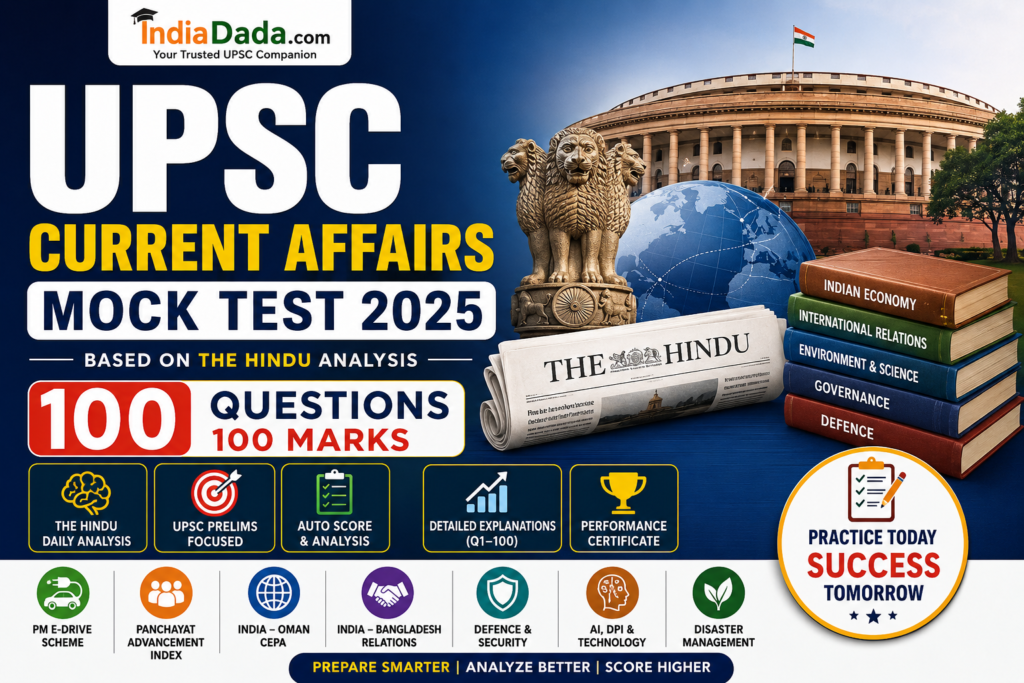
UPSC Prelims 2027 Practice Set | The Hindu Analysis (27 June 2026)
Current Affairs ko sirf padhna enough nahi hota. UPSC Prelims, Mains aur Interview teenon ki demand alag hoti hai. Isi liye is special practice series me hum ek hi newspaper analysis ko exam-oriented format me convert karenge.
Is Practice Set me Kya Milega?
- 30 High Quality UPSC Prelims MCQs (Explanation ke saath)
- Topic-wise Detailed Notes (Teacher Style)
- Mains Answer Writing Practice
- UPSC Interview Questions with Model Answers
- PYQ Based Analysis
- Trap Options ki Explanation
- Exam Revision Notes
- Memory Tricks
- Coral Reefs
- India–New Zealand Free Trade Agreement
- Organ Donation & Transplant System
- International Relations
- Environment & Ecology
- Governance
Teacher Advice (Most Important)
Bahut se students newspaper padhte hain lekin exam me question nahi bana paate. Iska reason simple hai — UPSC facts nahi, concepts ko test karta hai.Isliye jab bhi koi Current Affairs Topic padho, hamesha ye 5 sawal khud se poochho.
| Question | Purpose |
|---|---|
| What? | Topic kya hai? |
| Why? | Ye news me kyu aaya? |
| How? | Ye kaise kaam karta hai? |
| Importance? | India aur UPSC ke liye iska kya importance hai? |
| Future? | Aage iska impact kya ho sakta hai? |
UPSC kabhi bhi newspaper ki line directly nahi poochta.UPSC concept, application, statement-based questions aur elimination technique ko test karta hai.Isi wajah se har MCQ ke baad explanation padhna answer se bhi jyada important hota hai.
Is Series ko Kaise Padhein?
- Step 1 → Pehle pura topic samajhiye.
- Step 2 → Notes revise kariye.
- Step 3 → MCQ solve kariye bina answer dekhe.
- Step 4 → Har explanation ko dhyan se padhiye.
- Step 5 → Mains answer likhne ki practice kariye.
- Step 6 → Interview Questions ke answers khud bolkar practice kariye.
- Section 2 → Coral Reefs Complete Teacher Notes
- Section 3 → UPSC Prelims MCQs (Q1–Q10)
- Section 4 → India-New Zealand FTA Complete Notes
- Section 5 → MCQs (Q11–Q20)
- Section 6 → Organ Donation Complete Notes
- Section 7 → MCQs (Q21–Q30)
- Section 8 → UPSC Mains Answer Writing (Teacher Guidance)
- Section 9 → UPSC Interview Questions with Best Answers
- Section 10 → Revision Notes + PYQs + FAQs
UPSC Prelims Practice Set (MCQ 1–5)
Neeche diye gaye Questions 27 June 2026 The Hindu Analysis ke important topics par based hain. Pehle khud answer dijiye, uske baad explanation padhiye.
MCQ 1.
India-New Zealand Free Trade Agreement (FTA) ka primary objective kya hota hai?
- (A) Tax collection badhana
- (B) Defence Cooperation ko badhana
- (C) Trade barriers ko reduce karna
- (D) Visa free travel dena
MCQ 2.
Rules of Origin ka sambandh kis se hai?
- (A) Product kis desh me manufacture hua
- (B) Product ki quality
- (C) Product ka transport route
- (D) Currency Exchange Rate
MCQ 3.
Coral Bleaching ka sabse bada reason kya mana jata hai?
- (A) Ocean Temperature Increase
- (B) Moon Gravity
- (C) Earthquake
- (D) Glacier Formation
MCQ 4.
Biorock Technology ka use kis purpose ke liye kiya jata hai?
- (A) Coal Mining
- (B) Coral Reef Restoration
- (C) Nuclear Energy
- (D) Oil Refining
MCQ 5.
Blast Fishing kis prakaar ki activity hai?
- (A) Sustainable Fishing
- (B) Destructive Fishing Method
- (C) Scientific Research
- (D) Deep Sea Navigation
UPSC Prelims Practice Set (MCQ 6–10)
Ab hum Statement Based aur Conceptual Questions practice karenge. UPSC me is type ke Questions kaafi frequently pooche jaate hain. Har Question ko dhyan se padhiye aur elimination technique apply kijiye.
MCQ 6. Statement Based Question
Free Trade Agreement (FTA) ke sambandh me nimnalikhit statements par vichar kijiye:
- 1. FTA ka objective do countries ke beech trade barriers ko kam karna hota hai.
- 2. Har FTA me sabhi products par 100% tariff remove kar diya jata hai.
Neeche diye gaye options me se sahi answer chuniye.
- (A) Only Statement 1 is Correct
- (B) Only Statement 2 is Correct
- (C) Both Statements are Correct
- (D) Neither Statement is Correct
MCQ 7
Tariff Barrier ka matlab kya hota hai?
- (A) Imported Goods par Tax Lagana
- (B) Passport Verification
- (C) Digital Payment System
- (D) Currency Printing
MCQ 8. Match the Following
| List-I | List-II |
|---|---|
| 1. Coral Reef | A. Marine Biodiversity |
| 2. Biorock Technology | B. Reef Restoration |
| 3. Blast Fishing | C. Marine Ecosystem Damage |
Correct Match chuniye.
- (A) 1-A, 2-B, 3-C
- (B) 1-B, 2-C, 3-A
- (C) 1-C, 2-A, 3-B
- (D) 1-A, 2-C, 3-B
MCQ 9
Artificial Coral Reef banane ka sabse bada objective kya hai?
- (A) Tourism ko completely band karna
- (B) Marine Biodiversity ko Restore karna
- (C) Salt Production badhana
- (D) Ocean Mining karna
MCQ 10. Multi Statement Question
Coral Reefs ke sambandh me nimnalikhit statements par vichar kijiye.
- 1. Coral Reefs marine biodiversity ke hotspot hote hain.
- 2. Ocean Warming coral bleaching ka major reason hai.
- 3. Coral Reefs sirf Polar Regions me paaye jaate hain.
- (A) Only 1 and 2
- (B) Only 2 and 3
- (C) Only 1 and 3
- (D) 1,2 and 3
- FTA = Trade Promotion
- Tariff = Import Tax
- Rules of Origin = Country of Production
- Coral Bleaching = Ocean Warming
- Biorock = Reef Restoration
- Blast Fishing = Illegal & Destructive
- Artificial Reef = Marine Biodiversity Recovery
UPSC Prelims Practice Set (MCQ 11–15)
Ab hum Advanced UPSC Pattern Questions practice karenge. Yeh Questions sirf factual knowledge nahi, balki conceptual clarity aur analytical thinking ko bhi test karte hain. Teacher ki salah hai ki pehle answer khud attempt kariye, uske baad explanation padhiye.
MCQ 11. Assertion & Reason
Assertion (A): Free Trade Agreement (FTA) se participating countries ke beech trade volume badhne ki sambhavna hoti hai.
Reason (R): FTA me tariff aur kuch trade barriers ko reduce ya eliminate kiya jata hai.
- (A) A aur R dono sahi hain, aur R, A ki sahi explanation hai.
- (B) A aur R dono sahi hain, lekin R, A ki explanation nahi hai.
- (C) A sahi hai, R galat hai.
- (D) A galat hai, R sahi hai.
MCQ 12. Multi Statement Question
Rules of Origin ke sambandh me nimnalikhit statements par vichar kijiye:
- 1. Yeh determine karta hai ki product kis country ka maana jayega.
- 2. Iska use FTA benefits dene ke liye kiya jata hai.
- 3. Yeh sirf agricultural products par apply hota hai.
- (A) Only 1 and 2
- (B) Only 2 and 3
- (C) Only 1 and 3
- (D) 1,2 and 3
MCQ 13
Coral Reefs ko "Rainforests of the Sea" kyon kaha jata hai?
- (A) Kyunki ye bahut zyada rainfall produce karte hain.
- (B) Kyunki yahan marine biodiversity bahut adhik hoti hai.
- (C) Kyunki ye glaciers ke paas paaye jaate hain.
- (D) Kyunki ye sirf deep ocean me milte hain.
MCQ 14. Statement Based
Artificial Coral Reefs ke sambandh me nimnalikhit statements par vichar kijiye:
- 1. Artificial reefs damaged marine habitats ko restore karne me madad karte hain.
- 2. Artificial reefs se fish population badhne me bhi sahayata mil sakti hai.
- 3. Artificial reefs ka environment par hamesha negative impact hota hai.
- (A) Only 1 and 2
- (B) Only 2 and 3
- (C) Only 1 and 3
- (D) All Three
MCQ 15. Conceptual Question
Blast Fishing environment ke liye harmful kyon mana jata hai?
- (A) Sirf machhliyon ko nuksan pahunchata hai.
- (B) Coral Reefs aur Marine Biodiversity dono ko destroy karta hai.
- (C) Ocean Temperature ko badha deta hai.
- (D) Sea Level Rise ka direct reason hai.
- FTA → Trade Promotion & Tariff Reduction
- Rules of Origin → Country of Product Identification
- Coral Reef → Rainforest of the Sea
- Artificial Reef → Ecosystem Restoration
- Blast Fishing → Illegal & Destructive Practice
UPSC Prelims Practice Set (MCQ 16–20)
Ab hum UPSC ke Advanced Level Questions solve karenge. Is section me Economy, Environment, International Relations aur Science & Technology ko integrate kiya gaya hai. Yeh Questions latest UPSC trend ke hisaab se conceptual understanding ko test karte hain.
MCQ 16. Multi Statement Question
Free Trade Agreement (FTA) ke sambandh me nimnalikhit statements par vichar kijiye.
- 1. FTA se bilateral trade ko badhava milta hai.
- 2. FTA ka uddeshya customs duty ko completely remove karna hi hota hai.
- 3. Sensitive products ko agreement se bahar rakha ja sakta hai.
- (A) Only 1 and 2
- (B) Only 1 and 3
- (C) Only 2 and 3
- (D) 1, 2 and 3
MCQ 17. Match the Following
| List-I | List-II |
|---|---|
| 1. Coral Bleaching | A. Ocean Temperature Rise |
| 2. Biorock Technology | B. Reef Restoration |
| 3. Blast Fishing | C. Marine Habitat Destruction |
| 4. Artificial Reef | D. Fish Habitat Development |
Correct Answer choose kijiye.
- (A) 1-A,2-B,3-C,4-D
- (B) 1-B,2-C,3-D,4-A
- (C) 1-D,2-A,3-B,4-C
- (D) 1-C,2-D,3-A,4-B
MCQ 18
PM Matsya Sampada Yojana ka mukhya objective kya hai?
- (A) Fisheries Sector ka Sustainable Development
- (B) Defence Manufacturing
- (C) Textile Export Promotion
- (D) Aviation Infrastructure
MCQ 19. Assertion & Reason
Assertion (A): Coral Reefs climate change ke prati bahut sensitive hote hain.
Reason (R): Ocean warming aur ocean acidification coral ecosystem ko prabhavit karte hain.
- (A) Both A and R are correct and R is the correct explanation of A.
- (B) Both A and R are correct but R is not the correct explanation.
- (C) A is correct but R is incorrect.
- (D) A is incorrect but R is correct.
MCQ 20. Concept Based Question
Blue Economy ka sabse appropriate objective kya hai?
- (A) Marine Resources ka Sustainable Use
- (B) Ocean Mining ko maximum badhana
- (C) Plastic Waste ko Ocean me dump karna
- (D) Marine Tourism ko regulate na karna
- FTA → Bilateral Trade Promotion
- Rules of Origin → Trade Benefit Eligibility
- PM Matsya Sampada Yojana → Fisheries Development
- Coral Bleaching → Ocean Warming
- Blue Economy → Sustainable Marine Development
- Biorock Technology → Coral Restoration
- Blast Fishing → Illegal Fishing Practice
Teacher's UPSC Advice
UPSC Prelims me 70–80% questions direct facts se nahi, balki concepts ke application se aate hain. Har MCQ solve karte waqt sirf answer yaad mat kariye. Yeh samajhiye ki UPSC examiner kis concept ko test kar raha hai. Agar concept clear hai, to naye pattern ke questions bhi aasani se solve ho jayenge.
UPSC Prelims Practice Set (MCQ 21–25)
Is section me diye gaye Questions UPSC Civil Services Examination ke latest trend ko dhyan me rakhkar prepare kiye gaye hain. Pehle Question khud solve kariye, uske baad Teacher Explanation padhiye.
MCQ 21. Multi Statement Question
Coral Reefs ke sambandh me nimnalikhit statements par vichar kijiye:
- 1. Coral reefs tropical warm waters me adhik paaye jaate hain.
- 2. Coral polyps aur Zooxanthellae algae ke beech symbiotic relationship hota hai.
- 3. Coral reefs freshwater lakes me naturally develop hote hain.
- (A) Only 1 and 2
- (B) Only 2 and 3
- (C) Only 1 and 3
- (D) 1, 2 and 3
MCQ 22. Elimination Based Question
Free Trade Agreement ka sabse bada economic benefit kya hota hai?
- (A) Bilateral Trade ko promote karna
- (B) Border Security badhana
- (C) Election Process ko improve karna
- (D) Judicial Reforms lana
MCQ 23. Match the Following
| Scheme / Concept | Related Area |
|---|---|
| 1. PM Matsya Sampada Yojana | A. Fisheries Sector |
| 2. Blue Economy | B. Sustainable Ocean Development |
| 3. Coral Bleaching | C. Climate Change Impact |
| 4. Rules of Origin | D. International Trade |
- (A) 1-A, 2-B, 3-C, 4-D
- (B) 1-B, 2-A, 3-D, 4-C
- (C) 1-C, 2-D, 3-A, 4-B
- (D) 1-D, 2-C, 3-B, 4-A
MCQ 24. Assertion & Reason
Assertion (A): Blast Fishing ko illegal mana jata hai.
Reason (R): Yeh Coral Reefs aur Marine Biodiversity dono ko severe damage pahunchata hai.
- (A) Both A and R are correct and R is the correct explanation.
- (B) Both are correct but R is not the correct explanation.
- (C) A is correct but R is incorrect.
- (D) A is incorrect but R is correct.
MCQ 25. UPSC Conceptual Question
3D Printed Artificial Coral Reef ka sabse bada advantage kya hai?
- (A) Marine Habitat Restoration
- (B) Glacier Melting ko rokna
- (C) Oil Production badhana
- (D) River Pollution ko khatam karna
- Coral Polyps + Zooxanthellae = Symbiotic Relationship
- FTA = Trade Promotion
- Rules of Origin = Country of Product Identification
- PM Matsya Sampada Yojana = Fisheries Development
- Blue Economy = Sustainable Ocean Resource Management
- Blast Fishing = Illegal & Destructive Practice
- 3D Printed Artificial Reef = Marine Ecosystem Restoration
Teacher's Final Advice
Har MCQ ko sirf yaad karne ki bajay uske peeche ka concept samajhiye. UPSC examiner facts ke saath conceptual clarity aur analytical thinking ko test karta hai. Isi approach se aap unknown questions ko bhi elimination technique ki madad se solve kar sakte hain.
UPSC Prelims Practice Set (MCQ 26–30)
Yeh Practice Set ka Final Round hai. In Questions me Economy, International Relations, Environment aur Science & Technology ko integrate kiya gaya hai. Inhe solve karte waqt UPSC ki elimination strategy ka use zarur kariye.
MCQ 26. Multi Statement Question
Blue Economy ke sambandh me nimnalikhit statements par vichar kijiye:
- 1. Blue Economy ka objective marine resources ka sustainable use hai.
- 2. Iska focus economic development ke saath environmental conservation par bhi hota hai.
- 3. Blue Economy ka sambandh sirf fisheries sector se hai.
- (A) Only 1 and 2
- (B) Only 2 and 3
- (C) Only 1 and 3
- (D) 1, 2 and 3
MCQ 27. Assertion & Reason
Assertion (A): Coral Bleaching ke baad bhi coral kuch samay tak zinda reh sakte hain.
Reason (R): Agar environmental conditions improve ho jaye to Zooxanthellae algae wapas aa sakti hain.
- (A) Both A and R are correct and R is the correct explanation.
- (B) Both are correct but R is not the explanation.
- (C) A is correct but R is incorrect.
- (D) A is incorrect but R is correct.
MCQ 28
International Trade me Rules of Origin ka sabse important role kya hai?
- (A) Product ki quality decide karna
- (B) Product ka manufacturing country identify karna
- (C) Shipping company select karna
- (D) Import tax collect karna
MCQ 29. Integrated Question
3D Printed Artificial Coral Reefs ka sambandh kis combination se hai?
- (A) Science & Technology + Environment
- (B) Economy + Agriculture
- (C) Polity + Governance
- (D) History + Culture
MCQ 30. UPSC Standard Conceptual Question
Agar kisi Current Affairs Topic me Economy, Environment aur Science tino ka integration ho, to UPSC aspirant ko sabse pehle kya karna chahiye?
- (A) Sirf Newspaper Article yaad karna
- (B) Static Concepts ko Current Affairs se Link karna
- (C) Sirf Facts ratna
- (D) Sirf Government Scheme yaad karna
30 MCQs Complete – Final Revision Box
- FTA → Bilateral Trade Promotion
- Rules of Origin → Country of Origin Identification
- Tariff vs Non-Tariff Barriers → Economy Basics
- Coral Reefs → Marine Biodiversity Hotspot
- Coral Bleaching → Ocean Warming & Climate Change
- Biorock Technology → Coral Reef Restoration
- Blast Fishing → Illegal & Destructive Fishing Practice
- 3D Printed Artificial Reef → Science + Environment Integration
- PM Matsya Sampada Yojana → Fisheries & Blue Economy
- Blue Economy → Sustainable Ocean Resource Management
Teacher's Prelims Strategy
Agar aapne in 30 MCQs me 24 ya usse adhik questions sahi kiye hain, to aapki conceptual preparation kaafi achchi direction me hai. Agar score 18–23 ke beech hai, to explanations ko dobara padhiye aur weak concepts revise kijiye. Agar score 18 se kam hai, to pehle NCERT aur Standard Books ke basics ko strong banaiye, phir Current Affairs ko unse connect karke practice kariye.
Teacher's Motivation
UPSC sirf knowledge ka exam nahi hai, balki Conceptual Clarity, Analytical Thinking aur Consistency ka exam hai. Har din 20–30 quality MCQs solve kariye, mistakes ka analysis kariye aur static concepts ko current affairs se link kijiye. Isi approach se Prelims me score aur Mains me answer quality dono improve honge.
UPSC Mains Answer Writing Practice (GS Paper II & GS Paper III)
UPSC Mains me sirf knowledge hona enough nahi hota. Examiner dekhna chahta hai ki aap apne ideas ko kitni clarity, structure aur balance ke saath present karte hain.Isi liye neeche diye gaye Questions ke saath Model Framework aur Teacher Tips bhi diye gaye hain.
Teacher Formula for High Score Answer
- Introduction (20-30 Words)
- Body (5-8 Points with Subheadings)
- Examples / Current Affairs
- Government Initiatives
- Challenges + Way Forward
- Balanced Conclusion
Question 1 (10 Marks | 150 Words)
Q. India-New Zealand Free Trade Agreement (FTA) kis prakar Bharat ki Economy aur Strategic Relations ko strengthen kar sakta hai?
Answer Writing Approach
- FTA ki Definition
- Trade Growth
- Investment Opportunities
- Employment Generation
- Strategic Partnership
- Challenges
- Way Forward
Free Trade Agreement (FTA) do ya adhik countries ke beech trade barriers ko reduce karne wala economic agreement hota hai. Iska objective trade aur investment ko badhava dena hota hai.
Model Body- Export Opportunities Increase
- Import Cost Reduction
- New Market Access
- Technology Transfer
- Employment Creation
- Supply Chain Diversification
- Strategic Indo-Pacific Cooperation
Balanced trade policy, domestic industry protection aur global competitiveness ke saath India-New Zealand FTA long-term economic growth me mahatvapurn yogdan de sakta hai.
Question 2 (15 Marks | 250 Words)
Q. Coral Reefs ko "Rainforests of the Sea" kyon kaha jata hai? Climate Change ke context me iske conservation ki avashyakta par charcha kijiye.
Teacher Answer Structure
- Definition
- Importance
- Threats
- Climate Change Impact
- Government Efforts
- Global Initiatives
- Way Forward
Coral Reefs duniya ke sabse productive marine ecosystems me se ek hain aur inhe "Rainforests of the Sea" kaha jata hai kyunki yahan marine biodiversity bahut adhik hoti hai.
Body- Marine Biodiversity Hotspot
- Fish Habitat
- Tourism Support
- Coastal Protection
- Climate Regulation
- Livelihood Support
- Ocean Warming
- Ocean Acidification
- Pollution
- Blast Fishing
- Overfishing
- Marine Protected Areas
- Biorock Technology
- Artificial Coral Reef
- Community Participation
- Sustainable Fisheries
Question 3 (10 Marks)
Q. Blue Economy kya hai? Bharat ke Sustainable Development Goals (SDGs) me iska kya yogdan hai?
- Definition
- Blue Economy Components
- PM Matsya Sampada Yojana
- Marine Biotechnology
- Renewable Ocean Energy
- Blue Tourism
- Sustainable Livelihood
Question 4 (15 Marks)
Q. Rules of Origin aur Tariff Barriers International Trade ko kis prakar prabhavit karte hain?
- Rules of Origin Meaning
- Tariff vs Non-Tariff Barriers
- FTA Benefits
- Trade Diversion
- Trade Creation
- Indian Perspective
- Challenges
- Conclusion
Teacher's Golden Answer Writing Tips
- Answer hamesha Definition se start kariye.
- Paragraph ke bajay Bullet Points ka use kariye.
- Har answer me Current Affairs Example add kariye.
- Government Scheme mention kariye.
- Data ya Report ka reference dene ki habit banaiye.
- Conclusion positive aur solution-oriented rakhiye.
Common Mistakes in UPSC Mains
- Direct answer start kar dena.
- Introduction skip karna.
- Conclusion na likhna.
- Diagram ya Flowchart use na karna.
- Static aur Current Affairs ko link na karna.
- Word Limit cross kar dena.
- One-sided answer likhna.
Teacher's Final Advice
Har din kam se kam 2 GS Answers likhiye. Pehle 10 minutes me framework banaiye, phir 20–25 minutes me answer complete kariye. Har answer me Introduction → Body → Way Forward → Conclusion ka structure follow kariye. Isi disciplined practice se 120+ marks GS Papers me score karna aasaan ho jata hai.
UPSC Personality Test (Interview) – Teacher Guided Practice
UPSC Interview केवल Knowledge Test नहीं होता, बल्कि यह आपकी Personality, Decision Making Ability, Leadership, Communication Skills, Honesty, Confidence और Administrative Thinking का परीक्षण होता है।Interview Board यह नहीं देखता कि आपको हर प्रश्न का उत्तर आता है या नहीं, बल्कि यह देखता है कि आप कठिन परिस्थितियों में कितना संतुलित (Balanced) और तार्किक (Logical) सोचते हैं।
Teacher Tip
याद रखें — UPSC Interview में Right Personality ज्यादा महत्वपूर्ण है, केवल Right Answer नहीं।
प्रश्न 1.
अपने बारे में बताइए। (Introduce Yourself)
- अपना नाम
- जन्म स्थान
- शैक्षणिक पृष्ठभूमि
- कार्य अनुभव (यदि हो)
- UPSC चुनने का उद्देश्य
- रुचियाँ (Hobbies)
उत्तर 60–90 सेकंड के भीतर समाप्त करें। अनावश्यक पारिवारिक विवरण या बहुत लंबी कहानी न बताएं।
प्रश्न 2.
आप Civil Services में क्यों आना चाहते हैं?
- Public Service की भावना
- Policy Making में योगदान
- Grassroot Level Development
- Inclusive Growth
- Transparent Governance
Salary, Power या Prestige को मुख्य कारण कभी न बताएं।
प्रश्न 3.
आज के समाचार (Current Affairs) में सबसे महत्वपूर्ण मुद्दा कौन-सा है?
- Issue बताइए
- Background समझाइए
- India पर प्रभाव
- Challenges
- Way Forward
प्रश्न 4.
India-New Zealand Free Trade Agreement (FTA) भारत के लिए क्यों महत्वपूर्ण है?
- Trade बढ़ेगा
- Export Opportunities
- Investment Increase
- Employment Generation
- Strategic Partnership
- Indo-Pacific Cooperation
प्रश्न 5.
यदि आपको किसी जिले का District Magistrate बनाया जाए, तो आपकी पहली प्राथमिकता क्या होगी?
- Law and Order
- Public Grievance Redressal
- Education
- Health Services
- Digital Governance
- Transparency
प्रश्न 6.
Climate Change भारत के लिए सबसे बड़ी चुनौती क्यों है?
- Extreme Weather
- Flood
- Drought
- Agriculture Loss
- Food Security
- Water Crisis
प्रश्न 7.
यदि Interview Board आपके उत्तर से असहमत हो जाए तो आप क्या करेंगे?
मैं पूरे सम्मान (Respect) के साथ अपना दृष्टिकोण प्रस्तुत करूँगा। यदि Board का दृष्टिकोण अधिक उचित लगे तो उसे स्वीकार करूँगा। UPSC Interview में विनम्रता (Humility) और सीखने की भावना (Learning Attitude) सबसे महत्वपूर्ण होती है।
प्रश्न 8.
Blue Economy क्या है?
- Sustainable Use of Ocean Resources
- Marine Economy
- Fisheries
- Shipping
- Renewable Ocean Energy
- Marine Tourism
प्रश्न 9.
Coral Reefs को बचाने के लिए भारत क्या प्रयास कर रहा है?
- Marine Protected Areas
- Coastal Regulation
- Pollution Control
- Community Participation
- Research Programmes
प्रश्न 10.
एक अच्छे IAS Officer की सबसे महत्वपूर्ण Quality क्या होनी चाहिए?
- Integrity (ईमानदारी)
- Leadership
- Empathy (संवेदनशीलता)
- Decision Making
- Accountability
- Problem Solving
Interview के दौरान होने वाली सामान्य गलतियाँ
- बहुत तेज़ या बहुत धीमी आवाज़ में बोलना।
- आत्मविश्वास और Over Confidence में अंतर न समझना।
- गलत तथ्य होने पर भी बहस करना।
- उत्तर को अनावश्यक रूप से लंबा करना।
- Eye Contact बनाए न रखना।
- Body Language पर ध्यान न देना।
- Current Affairs की तैयारी अधूरी रखना।
Teacher's Interview Success Formula
Interview में हमेशा Think → Pause → Answer की रणनीति अपनाइए। उत्तर देने से पहले 2–3 सेकंड सोचें, फिर शांत और स्पष्ट भाषा में उत्तर दें। यदि किसी प्रश्न का उत्तर नहीं पता है, तो विनम्रता से स्वीकार करें — गलत उत्तर देने से बेहतर है "I am sorry, I don't know this at the moment." कहना।
UPSC Personality Test Master Guide (Teacher Style)
UPSC Personality Test (Interview) केवल Questions & Answers का Session नहीं होता। यह आपकी Overall Personality, Administrative Thinking, Leadership, Ethics, Communication Skills और Decision Making Ability का मूल्यांकन करता है।एक सफल IAS Officer बनने के लिए केवल किताबों का ज्ञान पर्याप्त नहीं है, बल्कि व्यवहार, संतुलन, ईमानदारी और समाज के प्रति दृष्टिकोण भी महत्वपूर्ण होता है।
DAF (Detailed Application Form) क्या है?
DAF यानी Detailed Application Form UPSC Interview का सबसे महत्वपूर्ण दस्तावेज़ होता है। Interview Board आपके DAF को ध्यान से पढ़ता है और अधिकांश प्रश्न उसी से पूछे जाते हैं।
DAF में शामिल मुख्य जानकारी
- नाम एवं जन्म स्थान
- Educational Qualification
- Graduation Subject
- Work Experience
- Optional Subject
- Achievements
- Sports
- Hobbies
- Extra Curricular Activities
- Home State एवं District
DAF Based Questions कैसे तैयार करें?
| DAF Entry | Possible Interview Questions |
|---|---|
| Hobby - Reading Books | आप किस प्रकार की पुस्तकें पढ़ते हैं? आपकी Favourite Book कौन-सी है? |
| District | आपके जिले की प्रमुख समस्याएँ क्या हैं? |
| Graduation | आपके Subject का Administration में क्या उपयोग है? |
| Sports | Sports Leadership कैसे विकसित करता है? |
| Job Experience | Private Job छोड़कर Civil Services क्यों? |
Interview में Body Language क्यों महत्वपूर्ण है?
Interview Board आपके उत्तरों के साथ-साथ आपकी Body Language भी Observe करता है। अच्छी Body Language आपके आत्मविश्वास और सकारात्मक व्यक्तित्व को दर्शाती है।
Good Body Language Tips
- सीधे बैठें (Sit Straight)
- Natural Smile रखें
- Eye Contact Maintain करें
- Hands को नियंत्रित रखें
- Face Expressions शांत रखें
- Confidence दिखाएँ, Over Confidence नहीं
Interview Dress Code
| Male Candidates | Female Candidates |
|---|---|
| Light Shirt + Dark Trouser | Simple Saree / Formal Suit |
| Polished Shoes | Comfortable Formal Footwear |
| Simple Tie (Optional) | Minimal Jewellery |
| Well Groomed Hair | Neat Hairstyle |
Communication Skills कैसे Improve करें?
- Daily Newspaper पढ़ें।
- Mirror Practice करें।
- Current Affairs को अपने शब्दों में Explain करें।
- English एवं Hindi दोनों में बोलने का अभ्यास करें।
- हर उत्तर 1–2 मिनट में Complete करने की Practice करें।
Interview में Answer देने का Golden Formula
STEP 1 : Question को ध्यान से सुनें।
STEP 2 : 2–3 सेकंड सोचें।
STEP 3 : Structured Answer दें।
STEP 4 : Positive Conclusion दें।
यदि Answer नहीं आता तो क्या करें?
यदि किसी प्रश्न का उत्तर नहीं पता है तो गलत जानकारी देने के बजाय विनम्रता से कहें—
"Sorry Sir/Ma'am, I am not aware of this at the moment. I would like to learn about it."
UPSC Interview में किन बातों से बचें?
- Argument करना
- Fake Information देना
- Guess Answer देना
- Political Bias दिखाना
- Very Long Answers
- Negative Attitude
- Interrupt करना
- Over Confidence
Teacher's 25 Success Tips for UPSC Interview
- DAF की प्रत्येक लाइन Prepare करें।
- अपने Home District का पूरा अध्ययन करें।
- Current Affairs Daily पढ़ें।
- Editorial Analysis करें।
- Eye Contact Maintain करें।
- Calm रहें।
- Honest रहें।
- Logical Thinking विकसित करें।
- Balanced Opinion रखें।
- Smile करें।
- Dress Professionally.
- Clear Voice रखें।
- Answer Structured रखें।
- Examples का उपयोग करें।
- Facts और Opinions अलग रखें।
- Ethics का ध्यान रखें।
- Constitutional Values याद रखें।
- Women & Vulnerable Groups के प्रति संवेदनशील रहें।
- National Interest को प्राथमिकता दें।
- Time Management सीखें।
- Daily Mock Interview करें।
- Recording देखकर Self Analysis करें।
- Confidence Practice से आता है।
- Learning Attitude रखें।
- Never Stop Improving.
Interview Day Checklist
| Checklist | Status |
|---|---|
| DAF Copies | ✔ |
| Original Documents | ✔ |
| Passport Size Photos | ✔ |
| Formal Dress | ✔ |
| Current Affairs Revision | ✔ |
| Reach Before Time | ✔ |
Teacher's Final Message
UPSC Interview में Perfect Answer देने की आवश्यकता नहीं होती। Board ऐसे उम्मीदवार की तलाश करता है जो ईमानदार (Honest), विनम्र (Humble), तार्किक (Logical), संवेदनशील (Empathetic) और जिम्मेदार (Responsible) हो। इसलिए अपनी Personality को Natural रखें और हर उत्तर में संविधान के मूल्यों (Constitutional Values) तथा Public Service की भावना को प्रदर्शित करें।
UPSC Mains Answer Writing Masterclass (Teacher Style Guide)
UPSC Mains में केवल Knowledge होना पर्याप्त नहीं है। Success इस बात पर निर्भर करती है कि आप सीमित समय (Limited Time) और सीमित शब्दों (Word Limit) में अपने विचार कितनी स्पष्टता, तार्किकता (Logic) और संतुलित दृष्टिकोण (Balanced Perspective) के साथ प्रस्तुत करते हैं।UPSC Board Facts के साथ-साथ आपकी Analysis, Critical Thinking, Constitutional Values और Problem Solving Ability को भी देखता है।
Teacher Tip
Remember: "Good Knowledge + Good Presentation = High Marks."
UPSC Mains Answer Structure (Golden Formula)
| Part | Purpose |
|---|---|
| Introduction | Question का Context और Background |
| Body | Main Analysis, Facts, Arguments, Examples |
| Conclusion | Positive Way Forward और Balanced Closing |
Introduction कैसे लिखें?
Introduction 2–3 Lines का होना चाहिए। इसमें Question का Context, Definition, Constitutional Article, Report, Current Affairs या Data का उपयोग किया जा सकता है।
Example
यदि Question Climate Change पर है तो शुरुआत इस प्रकार करें—
"Climate Change आज केवल Environmental Issue नहीं बल्कि Economic, Social और National Security Challenge भी बन चुका है।"
Body कैसे लिखें?
- Answer को छोटे Paragraphs में लिखें।
- Bullet Points का उचित उपयोग करें।
- Headings और Subheadings दें।
- Relevant Examples जोड़ें।
- Government Reports का उल्लेख करें।
- Committee Recommendations शामिल करें।
- Flowchart एवं Diagram का उपयोग करें।
Conclusion कैसे लिखें?
Conclusion हमेशा सकारात्मक (Positive), Practical और Solution Oriented होना चाहिए।
Model Conclusion
"यदि Government, Society और Citizens मिलकर Sustainable Development की दिशा में कार्य करें, तो भारत Inclusive Growth एवं Developed Nation बनने की दिशा में तेजी से आगे बढ़ सकता है।"
10 Marker vs 15 Marker vs 20 Marker Strategy
| Question Type | Word Limit | Ideal Time |
|---|---|---|
| 10 Marks | 150 Words | 7–8 Minutes |
| 15 Marks | 250 Words | 10–11 Minutes |
| 20 Marks | 250+ Words | 11–12 Minutes |
Directive Words को कैसे समझें?
| Directive | Meaning |
|---|---|
| Discuss | दोनों पक्षों की चर्चा करें। |
| Analyse | कारण एवं प्रभाव समझाएँ। |
| Examine | विस्तृत परीक्षण करें। |
| Critically Examine | Positive + Negative दोनों लिखें। |
| Evaluate | Assessment देकर निष्कर्ष दें। |
| Comment | अपना Balanced Opinion दें। |
| Justify | Facts एवं Examples से समर्थन करें। |
Flowchart और Diagram का उपयोग
UPSC Mains में Simple Flowcharts, Maps और Diagrams Answer को अधिक Attractive और Scoring बनाते हैं।
Example Flow
Problem → Causes → Impact → Government Initiatives → Challenges → Way Forward
Answer में किन Sources का उल्लेख करें?
- Indian Constitution
- NITI Aayog Reports
- Economic Survey
- Union Budget
- UN Reports
- SDGs
- Supreme Court Judgements
- Government Schemes
- Committee Reports
High Scoring Answer Writing Formula
| Step | Action |
|---|---|
| 1 | Question को दो बार पढ़ें। |
| 2 | Directive Word पहचानें। |
| 3 | Keyword Underline करें। |
| 4 | 30 Seconds में Structure सोचें। |
| 5 | Introduction लिखें। |
| 6 | Body को Headings में Divide करें। |
| 7 | Examples एवं Data जोड़ें। |
| 8 | Way Forward दें। |
| 9 | Positive Conclusion लिखें। |
Teacher's Top 20 Answer Writing Tips
- Daily कम से कम 2 Answers लिखें।
- Previous Year Questions Solve करें।
- Word Limit का पालन करें।
- Introduction छोटा रखें।
- Body सबसे मजबूत रखें।
- Conclusion सकारात्मक रखें।
- Bullet Points का उपयोग करें।
- Important Keywords Underline करें।
- Maps एवं Flowcharts बनाएं।
- Examples जरूर जोड़ें।
- Committee Reports याद रखें।
- Government Schemes शामिल करें।
- Current Affairs Link करें।
- Balanced Opinion दें।
- Constitutional Values लिखें।
- Time Management सीखें।
- Presentation साफ रखें।
- Facts और Opinions अलग रखें।
- Mock Evaluation कराएँ।
- Daily Practice ही Success की Key है।
Common Mistakes in UPSC Mains
- Question की Demand को Ignore करना।
- Word Limit Cross करना।
- Very Long Introduction लिखना।
- Conclusion छोड़ देना।
- Examples न देना।
- Only Theory लिखना, Analysis नहीं करना।
- Current Affairs को Link न करना।
- Poor Handwriting और Untidy Presentation।
Teacher's Final Advice
UPSC Mains में Top Rank वही Candidate प्राप्त करता है जो केवल जानकारी (Information) नहीं, बल्कि Analysis, Logical Thinking, Constitutional Values और Practical Solutions प्रस्तुत करता है। हर उत्तर को इस प्रकार लिखें कि Examiner को लगे कि आप भविष्य के एक जिम्मेदार Civil Servant हैं।
UPSC Mains Model Answers (Teacher Style)
इस सेक्शन में The Hindu Analysis (27 June 2026) के महत्वपूर्ण Topics पर UPSC GS Paper-II एवं GS Paper-III के स्तर के Model Answers दिए गए हैं। प्रत्येक उत्तर Introduction → Body → Conclusion Format में तैयार किया गया है ताकि विद्यार्थी उत्तर लिखने की सही तकनीक (Answer Writing Technique) सीख सकें।
Teacher Advice
उत्तर को केवल याद न करें। पहले Question की Demand समझें, फिर उसी Structure में स्वयं Answer लिखने का अभ्यास करें।
Model Answer 1
Q. India-New Zealand FTA भारत की अर्थव्यवस्था के लिए क्यों महत्वपूर्ण है? (15 Marks)
Introduction
Free Trade Agreement (FTA) दो देशों के बीच व्यापार को आसान बनाने वाला समझौता है, जिसमें Tariff एवं Trade Barriers को कम किया जाता है।
Body
- Export Market का विस्तार।
- Dairy, Agriculture एवं Services Sector में अवसर।
- FDI एवं Technology Transfer को बढ़ावा।
- Employment Generation।
- Indo-Pacific Strategic Partnership मजबूत होगी।
Challenges
- Domestic Dairy Sector पर दबाव।
- Trade Deficit बढ़ने की संभावना।
- Competition में वृद्धि।
Way Forward
- Sensitive Sectors की सुरक्षा।
- MSME Competitiveness बढ़ाना।
- Skill Development पर ध्यान।
Conclusion
यदि संतुलित नीति अपनाई जाए तो India-New Zealand FTA भारत की Export-Led Growth एवं Global Trade Integration को नई दिशा दे सकता है।
Model Answer 2
Q. Blue Economy भारत के विकास में कैसे योगदान दे सकती है? (10 Marks)
Introduction
Blue Economy का अर्थ समुद्री संसाधनों (Marine Resources) का Sustainable एवं Responsible उपयोग है।
Main Points
- Marine Fisheries
- Port Development
- Coastal Tourism
- Offshore Renewable Energy
- Blue Jobs Creation
Challenges
- Marine Pollution
- Climate Change
- Illegal Fishing
Way Forward
Integrated Coastal Zone Management, Marine Conservation एवं Community Participation को बढ़ावा देना चाहिए।
Model Answer 3
Q. Climate Change भारत की Food Security को कैसे प्रभावित करता है? (15 Marks)
Key Points
- Irregular Rainfall
- Crop Yield में कमी
- Heat Waves
- Water Scarcity
- Farmer Income पर प्रभाव
Way Forward
- Climate Smart Agriculture
- Micro Irrigation
- Drought Resistant Seeds
- Crop Insurance
Model Answer 4
Q. Coral Reefs का संरक्षण क्यों आवश्यक है? (10 Marks)
- Marine Biodiversity
- Fish Breeding Ground
- Tourism
- Coastal Protection
- Blue Economy Support
भारत को Coral Restoration Programme एवं Marine Protected Areas को मजबूत करना चाहिए।
Model Answer 5
Q. भारत की Indo-Pacific Strategy का महत्व स्पष्ट कीजिए। (15 Marks)
Main Dimensions
- Regional Security
- Freedom of Navigation
- Trade Connectivity
- Maritime Cooperation
- Strategic Partnerships
Conclusion
Indo-Pacific Strategy भारत की आर्थिक, सामरिक एवं कूटनीतिक (Diplomatic) भूमिका को और अधिक मजबूत बनाती है।
Value Addition for High Marks
- Article 51 (International Peace)
- Sustainable Development Goals (SDGs)
- Economic Survey Data
- NITI Aayog Reports
- UN Sustainable Development Framework
- Examples from Current Affairs
Teacher's Golden Formula
हर Mains Answer में कम से कम एक Diagram, एक Government Initiative, एक Current Affairs Example और एक Positive Way Forward अवश्य जोड़ें। यही Strategy 6–8 Marks वाले उत्तर को 10–12 Marks तक पहुंचा सकती है।
UPSC Prelims 2027 Rapid Revision Notes (Teacher Style)
UPSC Prelims में सफलता केवल अधिक पढ़ने से नहीं, बल्कि बार-बार Revision करने से मिलती है। इस सेक्शन में The Hindu Analysis (27 June 2026) से जुड़े महत्वपूर्ण Facts, One-Liners, PYQ Concepts और Revision Notes दिए गए हैं ताकि परीक्षा से पहले कम समय में अधिक से अधिक Topics Revise किए जा सकें।
Teacher Strategy
Prelims में अक्सर Questions सीधे Facts से नहीं बल्कि Concepts पर आधारित होते हैं। इसलिए केवल One-Liners याद न करें, उनके पीछे का Concept भी समझें।
100% Exam-Oriented One-Liner Revision (Part-1)
| No. | One-Liner Fact |
|---|---|
| 1 | FTA (Free Trade Agreement) का उद्देश्य Trade Barriers को कम करना है। |
| 2 | Tariff Reduction से Export एवं Import दोनों प्रभावित होते हैं। |
| 3 | Blue Economy समुद्री संसाधनों के Sustainable उपयोग पर आधारित है। |
| 4 | Exclusive Economic Zone (EEZ) समुद्री आर्थिक गतिविधियों के लिए महत्वपूर्ण क्षेत्र है। |
| 5 | Coral Reefs को "Rainforests of the Ocean" कहा जाता है। |
| 6 | Climate Change कृषि उत्पादकता को सीधे प्रभावित करता है। |
| 7 | Heat Wave भारत में सबसे तेजी से बढ़ती प्राकृतिक आपदाओं में से एक है। |
| 8 | Marine Biodiversity Blue Economy की आधारशिला है। |
| 9 | Indo-Pacific भारत की Strategic Foreign Policy का महत्वपूर्ण क्षेत्र है। |
| 10 | Sustainable Development Goals (SDGs) वर्ष 2030 तक प्राप्त करने का लक्ष्य है। |
| 11 | NITI Aayog भारत का प्रमुख Public Policy Think Tank है। |
| 12 | Economic Survey Budget से पहले प्रस्तुत किया जाता है। |
| 13 | Current Affairs + Static Knowledge = UPSC Success Formula. |
| 14 | Environment से प्रत्येक वर्ष 15–20 Questions पूछे जाते हैं। |
| 15 | International Relations के Questions समाचार आधारित होते हैं। |
PYQ Trend Analysis
UPSC पिछले वर्षों का Pattern
- Concept Based Questions अधिक पूछे जा रहे हैं।
- Current Affairs को Static Subjects से जोड़कर Questions पूछे जाते हैं।
- Environment एवं Ecology का Weightage लगातार बढ़ रहा है।
- Economy में Application Based Questions आते हैं।
- International Relations वर्तमान घटनाओं से जुड़ा रहता है।
Fact vs Trap (UPSC Favourite Pattern)
| Fact | UPSC Trap |
|---|---|
| FTA Tariff कम करता है। | FTA सभी Taxes समाप्त नहीं करता। |
| Blue Economy Sustainable Development पर आधारित है। | Blue Economy केवल Fisheries तक सीमित नहीं है। |
| Climate Change Agriculture को प्रभावित करता है। | केवल Temperature ही प्रभाव का कारण नहीं है। |
| Coral Reefs Living Organisms हैं। | ये केवल Rocks नहीं हैं। |
Important Reports & Organisations
| Organisation | Importance |
|---|---|
| United Nations (UN) | Global Governance |
| World Bank | Development Finance |
| IMF | Global Financial Stability |
| WTO | International Trade Rules |
| NITI Aayog | Policy Planning in India |
Teacher's Quick Revision Formula
- Revision 1 → Same Day
- Revision 2 → After 3 Days
- Revision 3 → After 7 Days
- Revision 4 → After 15 Days
- Revision 5 → Before Exam
Last Minute Revision Checklist
- ✔ Current Affairs Notes
- ✔ Maps Revision
- ✔ Environment Species
- ✔ International Organisations
- ✔ Government Schemes
- ✔ Economy Basics
- ✔ Polity Important Articles
- ✔ Science & Technology Updates
- ✔ Previous Year Questions
- ✔ Self-Made Short Notes
Teacher's Final Revision Advice
Exam से एक दिन पहले नया Topic शुरू न करें। अपने Short Notes, One-Liners, PYQs और Current Affairs का Revision करें। UPSC Prelims में Smart Revision, Conceptual Clarity और Elimination Technique आपकी सबसे बड़ी Strength होती है।
Success Mantra
Read → Revise → Recall → Practice → Repeat
UPSC 2027 Final Revision Kit (Teacher Style)
यदि आपने पूरा The Hindu Analysis पढ़ लिया है, MCQs Practice कर लिए हैं और Mains Answer Writing भी सीख ली है, तो अब समय है Final Revision का। यह सेक्शन आपको Exam Hall Ready बनाने के लिए तैयार किया गया है।
Teacher Advice
UPSC Topper बनने के लिए केवल Knowledge नहीं बल्कि Revision Strategy, Time Management और Smart Elimination Technique सबसे अधिक महत्वपूर्ण होती है।
50 Most Expected UPSC Prelims Topics (2027)
| Topic | Priority |
|---|---|
| Climate Change | ★★★★★ |
| Blue Economy | ★★★★★ |
| India-New Zealand FTA | ★★★★★ |
| Indo-Pacific | ★★★★★ |
| Coral Reefs | ★★★★★ |
| Ocean Currents | ★★★★☆ |
| Global Trade | ★★★★☆ |
| Economic Survey | ★★★★☆ |
| Budget Highlights | ★★★★☆ |
| Government Schemes | ★★★★★ |
| International Organisations | ★★★★★ |
| Science & Technology | ★★★★☆ |
| Environment Conventions | ★★★★★ |
| Agriculture | ★★★★☆ |
| Internal Security | ★★★★☆ |
Teacher's Elimination Technique
Step-1
Extreme Words पहचानिए।Always, Never, Only, Completely, Entirely जैसे शब्द अक्सर Statement को गलत बना देते हैं।
Step-2
Static Knowledge + Current Affairs को जोड़कर सोचिए।
Step-3
दो Options हटाने के बाद ही Final Answer चुनिए।
10 CSAT Practice Tips
- Daily Reading Comprehension करें।
- Basic Maths मजबूत रखें।
- Logical Reasoning Practice करें।
- Time Limit में Mock Test दें।
- Calculator की आदत छोड़ें।
- Accuracy को Speed से अधिक महत्व दें।
- PYQs Solve करें।
- Weak Areas पहचानें।
- Revision करते रहें।
- Negative Marking को ध्यान में रखें।
Top 25 Interview Rapid Fire Questions
- Why Civil Services?
- Tell us about yourself.
- Why your Optional Subject?
- What is Good Governance?
- Define Inclusive Growth.
- What are SDGs?
- Explain Cooperative Federalism.
- Difference between Policy & Law?
- Role of Technology in Governance?
- How will you fight Corruption?
- What is Ethical Leadership?
- How will you handle Public Protest?
- How can AI help Administration?
- What is Climate Justice?
- India's biggest challenge?
- Women Empowerment?
- Digital India Benefits?
- What is Blue Economy?
- Importance of Constitution?
- What motivates you?
- Leadership Example?
- Your Strengths?
- Your Weakness?
- Biggest Administrative Challenge?
- Your Vision for India 2047?
30-Day Smart Revision Plan
| Days | Target |
|---|---|
| Day 1–5 | Polity + Current Affairs |
| Day 6–10 | History + Art & Culture |
| Day 11–15 | Geography + Environment |
| Day 16–20 | Economy + Science & Tech |
| Day 21–25 | Mock Tests + PYQs |
| Day 26–30 | Full Revision + Weak Areas |
7-Day Final Crash Plan
- Day 1 → Current Affairs Revision
- Day 2 → Polity & Economy
- Day 3 → Geography & Environment
- Day 4 → History & Culture
- Day 5 → Science & Tech + Schemes
- Day 6 → Full Length Mock Test
- Day 7 → Only Revision & Rest
Exam Hall Time Management
- पहले आसान Questions Attempt करें।
- एक Question पर 1 Minute से अधिक समय न दें।
- Guess Work कम करें।
- Final 15 Minutes OMR Review के लिए रखें।
- Stress Free रहें।
Common Mistakes to Avoid
- Daily Newspaper छोड़ देना।
- Current Affairs को Static से Link न करना।
- Mock Tests का Analysis न करना।
- Word Limit Ignore करना।
- Interview Practice न करना।
- Revision को अंतिम समय तक टालना।
- Sources बार-बार बदलना।
- Negative Thinking रखना।
Teacher's Golden Success Formula
Concept + Current Affairs + PYQs + Revision + Mock Tests + Positive Mindset = UPSC Success
Final Motivation for UPSC Aspirants
UPSC केवल एक परीक्षा नहीं, बल्कि धैर्य (Patience), अनुशासन (Discipline), निरंतर अभ्यास (Consistency) और राष्ट्र सेवा (Public Service) की भावना की परीक्षा है।हर दिन थोड़ा-थोड़ा सीखिए, नियमित Revision कीजिए और अपनी गलतियों से सीखते रहिए। याद रखिए—
"Success in UPSC is not about studying the most. It is about studying the smartest, revising consistently and believing in yourself."
Team IndiaDada.com
Learn Today • Lead Tomorrow 🇮🇳
Frequently Asked Questions (FAQs) – UPSC The Hindu Analysis
इस सेक्शन में UPSC Aspirants द्वारा अक्सर पूछे जाने वाले महत्वपूर्ण प्रश्नों के उत्तर दिए गए हैं। ये FAQs आपकी तैयारी को और अधिक स्पष्ट एवं प्रभावी बनाएंगे।
Q1. The Hindu Newspaper UPSC के लिए क्यों महत्वपूर्ण है?
The Hindu Newspaper UPSC Prelims, Mains और Interview तीनों के लिए महत्वपूर्ण माना जाता है क्योंकि इसमें National Issues, International Relations, Economy, Environment, Science & Technology, Polity तथा Editorial Analysis विस्तार से प्रकाशित होते हैं।
Q2. क्या केवल The Hindu पढ़कर UPSC Crack किया जा सकता है?
नहीं। The Hindu केवल Current Affairs का स्रोत है। इसके साथ NCERT, Standard Books, Previous Year Questions (PYQs), Government Reports और नियमित Mock Tests भी आवश्यक हैं।
Q3. The Hindu Analysis कैसे पढ़ें?
- Main Issue पहचानें।
- Background समझें।
- Constitution या Law से जोड़ें।
- Current Affairs को Static Subjects से Link करें।
- Short Notes बनाएं।
- Revision अवश्य करें।
Q4. UPSC Prelims में Current Affairs का कितना महत्व है?
हर वर्ष लगभग 20–30 प्रश्न सीधे या अप्रत्यक्ष रूप से Current Affairs से जुड़े होते हैं। इसलिए Daily Newspaper Analysis और Monthly Revision दोनों आवश्यक हैं।
Q5. UPSC Mains में Current Affairs को Answer में कैसे शामिल करें?
उत्तर लिखते समय Government Reports, Recent Examples, Constitutional Articles, Supreme Court Judgements, Committee Reports तथा Current Developments को उचित स्थान पर जोड़ें।
Q6. Interview में Current Affairs से किस प्रकार के प्रश्न पूछे जाते हैं?
Interview Board अक्सर Current Events पर आपकी राय (Opinion), Logical Thinking, Administrative Approach तथा Balanced Decision Making Ability का परीक्षण करता है।
Q7. क्या Daily Newspaper पढ़ना आवश्यक है?
हाँ। यदि समय कम हो तो कम से कम विश्वसनीय Current Affairs Analysis और Editorial Summary का नियमित अध्ययन करें।
Q8. कितनी बार Revision करना चाहिए?
| Revision | Suggested Time |
|---|---|
| 1st Revision | Same Day |
| 2nd Revision | After 3 Days |
| 3rd Revision | After 7 Days |
| Final Revision | Before Exam |
Teacher's Final Guidance
UPSC Preparation एक Marathon है, Sprint नहीं। Daily Newspaper Reading, Concept Building, Regular Revision, PYQ Practice, Mock Tests और Answer Writing का संतुलित अभ्यास ही सफलता की कुंजी है।
हर Topic को केवल याद करने के बजाय उसे समझने (Understand), जोड़ने (Connect), लिखने (Write) और दोहराने (Revise) की आदत विकसित करें।
Quick Revision Checklist
- ✔ 30 MCQs Practice Complete
- ✔ Mains Model Answers Revised
- ✔ Interview Questions Practised
- ✔ Current Affairs Notes Updated
- ✔ PYQs Solved
- ✔ Revision Completed
- ✔ Mock Test Analysis Done
Final Motivation
UPSC में सफलता किसी एक दिन की मेहनत से नहीं, बल्कि हर दिन की निरंतर तैयारी (Consistency), सही रणनीति (Strategy) और आत्मविश्वास (Confidence) से मिलती है।
आज का एक छोटा कदम (Small Daily Improvement) आपको कल एक सफल Civil Servant बना सकता है।
Continue Your UPSC Journey with IndiaDada.com
यदि आपको यह The Hindu Analysis उपयोगी लगा हो, तो अगले Daily Analysis, UPSC Prelims MCQs, Mains Answer Writing Practice, Interview Guidance और Weekly Revision Notes भी अवश्य पढ़ें।
- Daily Current Affairs
- UPSC Prelims MCQ Series
- GS Mains Answer Writing
- Editorial Analysis
- Essay Writing Guidance
- Interview Preparation
- Previous Year Questions (PYQs)
📚 IndiaDada.com
Learn Smart • Revise Better • Crack UPSC
Continue Learning With IndiaDada
UPSC, SSC CGL, UPTET, Current Affairs, Government Jobs, School Education, Higher Education, Notes, PDF, MCQ, PYQ, Mock Tests और Exam Preparation की सम्पूर्ण सामग्री अब एक ही प्लेटफॉर्म पर।
Daily Current Affairs
Daily Current Affairs Notes, PDF & Analysis
🎯Current Affairs MCQ
Daily Quiz, Practice Sets & Mock Questions
🇮🇳UPSC Preparation
Prelims, CSAT, Mains Notes & PYQs
📑SSC CGL
Notes, Previous Papers & Mock Tests
🧠UPTET Preparation
Latest Notes, MCQ & Practice Sets
💼Government Jobs
Latest Sarkari Naukri & Recruitment Updates
🔥 Important Study Resources
🌐 Important Official Resources
🎯 Popular Exam Categories
🚀 Stay Connected With IndiaDada.com
Daily Current Affairs, UPSC, SSC CGL, UPTET, Government Jobs, Previous Year Papers, Notes, MCQ, Mock Tests तथा Latest Exam Updates प्राप्त करने के लिए IndiaDada.com के साथ जुड़े रहें।
Visit IndiaDada.com