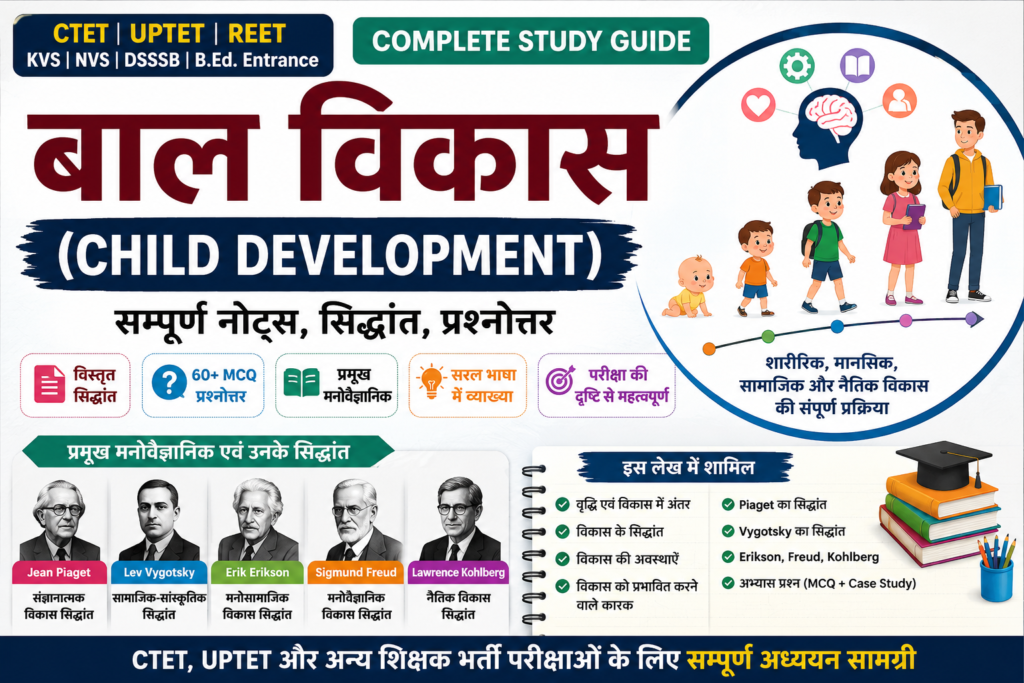
Section 1 – Psychology Basics (Master Question Pack)
UPTET, CTET, REET, DSSSB, KVS, NVS तथा सभी Teaching Exams के लिए 100% Original Master Question Bank. इस सेक्शन में केवल Unique एवं Exam-Oriented Questions शामिल किए जाएंगे।
Topics Covered
- Psychology Meaning
- History of Psychology
- Wilhelm Wundt
- First Psychology Laboratory
- William James
- Tabula Rasa
- John Locke
- Jean Jacques Rousseau
- Behaviourism
- Educational Psychology
- Observation Method
- Experimental Method
- Cross Sectional Study
- Longitudinal Study
- Woodworth S-O-R Model
✅ Correct Answer
B. दर्शनशास्त्र (Philosophy)
Explanation
प्रारम्भिक समय में मनोविज्ञान को दर्शनशास्त्र की शाखा माना जाता था। बाद में Wilhelm Wundt ने 1879 में पहली प्रयोगशाला स्थापित कर इसे स्वतंत्र वैज्ञानिक विषय के रूप में स्थापित किया।
Exam Tip
👉 "Psychology was first a branch of Philosophy." यह Teaching Exams का सबसे अधिक पूछा जाने वाला तथ्य है।
✅ Correct Answer
C. Wilhelm Wundt
Explanation
Wilhelm Wundt ने 1879 में Germany के Leipzig में पहली Psychology Laboratory स्थापित की। इसी कारण उन्हें Father of Experimental Psychology कहा जाता है।
Quick Revision
✔ First Laboratory → Leipzig (Germany)
✔ Year → 1879
✔ Founder → Wilhelm Wundt
✅ Correct Answer
B. बच्चा जन्म से कोरी पट्टी के समान होता है।
Explanation
John Locke के अनुसार जन्म के समय बालक का मस्तिष्क एक Blank Slate (Tabula Rasa) की तरह होता है तथा अनुभव एवं वातावरण उसके व्यक्तित्व का निर्माण करते हैं।
Remember
John Locke = Tabula Rasa = Blank Slate = Empiricism
Growth & Development (वृद्धि एवं विकास)
यह सेक्शन CTET, UPTET, REET, DSSSB, KVS, NVS तथा सभी Teaching Exams के लिए Growth एवं Development से जुड़े सबसे महत्वपूर्ण Original Questions का संग्रह है।
Topics Covered
B. मात्रात्मक परिवर्तन (Quantitative Change)
वृद्धि शरीर के आकार, लंबाई, वजन तथा अंगों के विस्तार से संबंधित होती है। इसे मापा जा सकता है, इसलिए यह Quantitative प्रक्रिया है।
Growth = Measurement = Height + Weight + Size
C. जीवनपर्यन्त चलने वाली गुणात्मक एवं प्रगतिशील प्रक्रिया
विकास केवल शरीर तक सीमित नहीं होता। इसमें शारीरिक, मानसिक, सामाजिक, भावनात्मक, नैतिक तथा भाषायी सभी परिवर्तन शामिल होते हैं।
Development = Qualitative + Progressive + Lifelong Process
B. वृद्धि मात्रात्मक है जबकि विकास गुणात्मक एवं व्यापक प्रक्रिया है।
Growth केवल शरीर की मापनीय वृद्धि को दर्शाता है जबकि Development व्यक्ति के सम्पूर्ण व्यक्तित्व में होने वाले क्रमिक एवं व्यवस्थित परिवर्तनों को व्यक्त करता है।
✔ Growth → Quantitative
✔ Development → Qualitative + Quantitative
✔ Development Includes Growth
D. वृद्धि
कोशिकाओं की संख्या एवं आकार में वृद्धि होने से शरीर का आकार बढ़ता है। इसे Growth (वृद्धि) कहते हैं।
B. सामाजिक विकास
Sharing, Cooperation, Team Work, Friendship आदि Social Development के प्रमुख संकेतक हैं।
Sharing + Cooperation + Group Work = Social Development
Principles of Development (विकास के सिद्धांत)
इस सेक्शन में विकास के मूल सिद्धांतों पर आधारित सबसे महत्वपूर्ण एवं Exam-Oriented प्रश्न शामिल किए गए हैं।
Topics Covered
Center → Arm → Hand → Fingers
Heredity + Environment = Development
Heredity + Environment = Development
Development Principles से लगभग प्रत्येक परीक्षा में 2–4 प्रश्न पूछे जाते हैं।
Heredity & Environment (आनुवंशिकता एवं वातावरण)
CTET, UPTET, REET, KVS, DSSSB तथा सभी Teaching Exams के लिए आनुवंशिकता एवं वातावरण से जुड़े महत्वपूर्ण प्रश्न।
Topics Covered
Nature = Heredity
Nurture = Environment
Heredity × Environment = Development
Twin Studies = Nature vs Nurture Research
23 Pairs = 46 Chromosomes
Development = Heredity + Environment
✔ Nature vs Nurture
✔ Woodworth Formula
✔ Genes & Chromosomes
✔ Family, School & Society
✔ Heredity vs Environment
✔ Lamarck → Acquired Characters
✔ Darwin → Natural Selection
✔ Mendel → Father of Genetics
✔ Galton → Heredity & Intelligence
✔ Woodworth → Heredity × Environment = Development
Jean Piaget Theory (जीन पियाजे का संज्ञानात्मक विकास सिद्धांत)
यह सेक्शन CTET, UPTET, REET, KVS, DSSSB तथा अन्य Teaching Exams के लिए Jean Piaget की Cognitive Development Theory पर आधारित Original MCQs प्रस्तुत करता है।
Topics Covered
Adaptation = Assimilation + Accommodation
Assimilation + Accommodation → Equilibration
Assimilation = Old Schema + New Experience
Accommodation = Modify Existing Schema
Assimilation + Accommodation = Equilibration
✔ Stage 1 → Sensorimotor (0–2 Years)
✔ Learning by Senses & Actions
✔ Object Permanence Begins
✔ Object Permanence
✔ Sensorimotor Stage
✔ Learning Through Senses
✔ Birth–2 Years
✔ Reflexes
✔ Circular Reactions
✔ Deferred Imitation
✔ Object Permanence
✔ Learning through Senses & Motor Activities
Sensorimotor → 0–2 Years
Preoperational → 2–7 Years
Preoperational Stage = Symbolic Thinking
Egocentrism → Preoperational Stage
✔ 2–7 Years
✔ Symbolic Thinking
✔ Egocentrism
✔ Animism
✔ Rapid Language Development
✔ Activity Based Learning
✔ Discovery Learning
✔ Child-Centred Education
✔ Learning by Doing
✔ Age Appropriate Teaching
| Stage | Age | Main Characteristics |
|---|---|---|
| Sensorimotor | 0–2 Years | Object Permanence, Reflexes |
| Preoperational | 2–7 Years | Egocentrism, Animism, Symbolic Thinking |
| Concrete Operational | 7–11 Years | Conservation, Seriation, Classification |
| Formal Operational | 11+ Years | Abstract Thinking, Hypothetical Reasoning |
Lev Vygotsky Theory (लेव वायगोत्स्की का सिद्धांत)
CTET, UPTET, REET, DSSSB, KVS तथा सभी Teaching Exams के लिए Lev Vygotsky की Social Constructivist Theory पर आधारित महत्वपूर्ण प्रश्न।
Topics Covered
Vygotsky = Social Constructivism
Learning = Social Interaction
ZPD = Can Do With Help
✔ ZPD = Learning Zone
✔ Scaffolding = Temporary Support
✔ Teacher = Facilitator
MKO = Teacher + Parent + Expert + Skilled Peer
Language → Tool of Thinking
Private Speech → Self Guidance → Inner Speech
✔ Collaborative Learning
✔ Guided Learning
✔ Scaffolding
✔ Peer Learning
✔ Teacher as Facilitator
Vygotsky = Social + Cultural Learning
Support More → Support Less → Independent Learning
Without Help ❌
With Help ✅ = ZPD
✔ Teacher as Facilitator
✔ Guided Discovery
✔ Cooperative Learning
✔ Social Interaction
✔ Scaffolding
Social Interaction = Better Learning
Private Speech → Inner Speech → Self Regulation
Step by Step Guidance = Scaffolding
✔ Social Constructivism
✔ ZPD
✔ MKO
✔ Scaffolding
✔ Private Speech
✔ Inner Speech
✔ Language as Tool of Thought
Language Develops Through Social Interaction
Culture Shapes Thinking
Guide → Participate → Learn
✔ Cooperative Learning
✔ Guided Participation
✔ Social Interaction
✔ Peer Discussion
✔ Collaborative Activities
Language Develops Through Social Interaction
Culture Shapes Thinking
Guide → Participate → Learn
✔ Cooperative Learning
✔ Guided Participation
✔ Social Interaction
✔ Peer Discussion
✔ Collaborative Activities
✔ Social Constructivism
✔ ZPD
✔ MKO
✔ Scaffolding
✔ Private Speech
✔ Inner Speech
✔ Culture & Language
✔ Cooperative Learning
| Concept | Key Point |
|---|---|
| ZPD | Can Do With Guidance |
| Scaffolding | Temporary Support by Teacher |
| MKO | More Knowledgeable Other |
| Private Speech | Self-Guidance During Learning |
| Inner Speech | Internal Thinking Process |
| Language | Tool of Thinking |
| Learning | Occurs Through Social Interaction |
| Teacher | Facilitator & Guide |
Lawrence Kohlberg Theory (नैतिक विकास का सिद्धांत)
CTET, UPTET, REET, KVS, DSSSB एवं अन्य Teaching Exams के लिए Lawrence Kohlberg की Moral Development Theory पर आधारित महत्वपूर्ण प्रश्न।
Topics Covered
Kohlberg = Moral Development Theory
3 Levels → 6 Stages
Pre-Conventional = Punishment & Reward
✔ Kohlberg → Moral Development
✔ 3 Levels
✔ 6 Stages
✔ First Level → Pre-Conventional
✔ Basis → Punishment & Reward
Stage 1 = Punishment Avoidance
Stage 2 = Reward + Personal Benefit
Stage 3 = Good Boy / Good Girl
✔ Stage 1 → Punishment Orientation
✔ Stage 2 → Reward Orientation
✔ Stage 3 → Good Boy / Good Girl
✔ Stage 4 → Law & Order
Stage 5 + Stage 6 = Post-Conventional Level
Stage 6 = Justice + Equality + Human Rights
✔ Stage 5
✔ Stage 6
✔ Social Contract
✔ Universal Ethics
✔ Heinz Dilemma
Human Rights > Rigid Rules = Stage 5
Stage 6 = Universal Ethics
✔ Stage 5 → Social Contract
✔ Stage 6 → Universal Ethics
✔ Heinz Dilemma
✔ Moral Reasoning
✔ Human Rights & Justice
Highest Level = Post-Conventional
Reason Behind Decision > Decision Itself
✔ Moral Discussion
✔ Case Study Method
✔ Group Discussion
✔ Value-Based Education
✔ Critical Thinking
✔ Three Levels
✔ Six Stages
✔ Heinz Dilemma
✔ Moral Reasoning
✔ Teaching Implications
| Level | Stages | Main Basis |
|---|---|---|
| Pre-Conventional | Stage 1–2 | Punishment & Reward |
| Conventional | Stage 3–4 | Social Approval & Law |
| Post-Conventional | Stage 5–6 | Justice & Universal Ethics |
- मूल्य आधारित शिक्षा (Value-Based Education) को बढ़ावा दें।
- कक्षा में नैतिक दुविधाओं (Moral Dilemmas) पर चर्चा कराएँ।
- विद्यार्थियों को अपने निर्णय का तर्क प्रस्तुत करने के अवसर दें।
- समूह चर्चा एवं वाद-विवाद का उपयोग करें।
- नियमों के पीछे के नैतिक कारणों को समझाएँ।
Sigmund Freud Theory (सिग्मंड फ्रायड का मनोविश्लेषण सिद्धांत)
CTET, UPTET, REET, DSSSB, KVS तथा सभी Teaching Exams के लिए Freud की Psychoanalytic Theory पर आधारित महत्वपूर्ण MCQs।
Topics Covered
Freud = Father of Psychoanalysis
Iceberg Theory → Largest Part = Unconscious Mind
Id + Ego + Superego = Personality Structure
✔ Freud → Psychoanalysis
✔ Iceberg Theory
✔ Conscious / Preconscious / Unconscious
✔ Id → Pleasure Principle
Id = Pleasure
Ego = Reality
Superego = Moral Judge
Ego = Mediator
✔ Id → Pleasure Principle
✔ Ego → Reality Principle
✔ Superego → Moral Principle
✔ Ego balances Id & Superego
Oral Stage = Birth to 18 Months
Oral Stage → Mouth
Anal Stage = Toilet Training
✔ Oral Stage → Birth–18 Months → Mouth
✔ Anal Stage → 18 Months–3 Years → Toilet Training
✔ Pleasure Zone → Anus
Phallic Stage = 3–6 Years
Boy → Mother = Oedipus Complex
Girl → Father = Electra Complex
✔ Oral → Birth–18 Months
✔ Anal → 18 Months–3 Years
✔ Phallic → 3–6 Years
✔ Latency → 6 Years–Puberty
Genital Stage → Puberty Onwards
Repression = Unconscious Forgetting
Projection = My Feelings → Your Feelings
✔ Genital Stage
✔ Repression
✔ Projection
✔ Sublimation
✔ Defense Mechanisms
Defense Mechanisms = Functions of Ego
✔ Id – Ego – Superego
✔ Iceberg Theory
✔ Oral to Genital Stages
✔ Defense Mechanisms
✔ Psychoanalytic Theory
| Concept | Key Point |
|---|---|
| Id | Pleasure Principle |
| Ego | Reality Principle |
| Superego | Morality Principle |
| Oral Stage | Birth–18 Months |
| Anal Stage | 18 Months–3 Years |
| Phallic Stage | 3–6 Years |
| Latency Stage | 6 Years–Puberty |
| Genital Stage | Puberty Onwards |
- Repression – दर्दनाक विचारों को अचेतन में दबा देना।
- Projection – अपनी भावनाओं को दूसरों पर आरोपित करना।
- Regression – तनाव में बचपन जैसा व्यवहार करना।
- Rationalization – असफलता के लिए तर्कसंगत बहाने बनाना।
- Sublimation – अस्वीकार्य इच्छाओं को सकारात्मक कार्यों में बदल देना।
- विद्यार्थियों की भावनात्मक आवश्यकताओं को समझें।
- भय एवं दण्ड आधारित वातावरण से बचें।
- सुरक्षित एवं सहयोगात्मक कक्षा वातावरण विकसित करें।
- सकारात्मक परामर्श (Counselling) एवं मार्गदर्शन प्रदान करें।
- व्यक्तिगत भिन्नताओं एवं भावनात्मक विकास का सम्मान करें।
Erik Erikson Theory
Erik Erikson ने Psychosocial Development Theory प्रस्तुत की। उन्होंने सम्पूर्ण जीवन को 8 मनोसामाजिक अवस्थाओं (8 Psychosocial Stages) में विभाजित किया। प्रत्येक अवस्था में व्यक्ति एक विशेष मनोसामाजिक संकट (Psychosocial Crisis) का सामना करता है। यदि उस संकट का सफल समाधान हो जाता है तो स्वस्थ व्यक्तित्व का विकास होता है।
Father
Erik Erikson
Total Stages
8 Psychosocial Stages
Main Focus
Psychosocial Development
Most Asked
Trust vs Mistrust
| Stage | Age | Psychosocial Crisis |
|---|---|---|
| 1 | 0–1 Year | Trust vs Mistrust |
| 2 | 1–3 Years | Autonomy vs Shame |
| 3 | 3–6 Years | Initiative vs Guilt |
| 4 | 6–12 Years | Industry vs Inferiority |
✔ Erikson = Psychosocial Development
✔ Total Stages = 8
✔ 0–1 Year = Trust vs Mistrust
✔ 1–3 Years = Autonomy vs Shame
✔ 3–6 Years = Initiative vs Guilt
✔ Industry vs Inferiority → 6–12 Years
✔ Identity vs Role Confusion → Adolescence
✔ Intimacy vs Isolation → Young Adulthood
✔ Generativity vs Stagnation → Middle Adulthood
✔ Integrity vs Despair → Old Age
✔ Trust vs Mistrust
✔ Industry vs Inferiority
✔ Identity vs Role Confusion
✔ Eight Psychosocial Stages
✔ Teaching Implications
| Stage | Age | Psychosocial Crisis | Positive Outcome |
|---|---|---|---|
| 1 | 0–1 Year | Trust vs Mistrust | Hope |
| 2 | 1–3 Years | Autonomy vs Shame & Doubt | Will |
| 3 | 3–6 Years | Initiative vs Guilt | Purpose |
| 4 | 6–12 Years | Industry vs Inferiority | Competence |
| 5 | 12–18 Years | Identity vs Role Confusion | Fidelity |
| 6 | Young Adult | Intimacy vs Isolation | Love |
| 7 | Middle Adult | Generativity vs Stagnation | Care |
| 8 | Old Age | Integrity vs Despair | Wisdom |
- विद्यार्थियों को सुरक्षित एवं सहयोगात्मक वातावरण प्रदान करें।
- प्रत्येक बच्चे को सफलता का अनुभव कराने के अवसर दें।
- अत्यधिक आलोचना के स्थान पर सकारात्मक प्रोत्साहन दें।
- किशोरों को करियर एवं पहचान निर्माण में मार्गदर्शन दें।
- आत्मविश्वास, सहयोग एवं सामाजिक उत्तरदायित्व विकसित करें।
- ✔ Erikson = Psychosocial Development Theory
- ✔ Total Stages = 8
- ✔ Development Continues Throughout Life
- ✔ Every Stage Has One Psychosocial Crisis
- ✔ Positive Resolution = Healthy Personality
- ✔ Most Asked: Trust, Industry, Identity
Howard Gardner Theory
Howard Gardner ने 1983 में Multiple Intelligence Theory प्रस्तुत की। उन्होंने बताया कि बुद्धि (Intelligence) केवल IQ तक सीमित नहीं है। प्रत्येक व्यक्ति में अलग-अलग प्रकार की बुद्धियाँ होती हैं और प्रत्येक बच्चा अपनी विशिष्ट क्षमता के अनुसार सीखता है।
Psychologist
Howard Gardner
Theory
Multiple Intelligence Theory
Published
1983
Teaching Focus
Every Child Can Learn Differently
| Intelligence | Main Ability |
|---|---|
| Linguistic | Language & Writing |
| Logical-Mathematical | Reasoning & Mathematics |
| Spatial | Drawing & Visualization |
| Musical | Music & Rhythm |
| Bodily-Kinesthetic | Physical Activities |
| Interpersonal | Understanding Others |
| Intrapersonal | Self Awareness |
| Naturalistic | Nature & Environment |
✔ Gardner = Multiple Intelligence Theory
✔ Introduced = 1983
✔ Initially = 7 Intelligences
✔ Later = 8 Intelligences
✔ Every Child Learns Differently
✔ Naturalistic → Nature
✔ Existential → Life & Universe
✔ Group Work → Interpersonal
✔ Self Reflection → Intrapersonal
✔ IQ Alone is Not Enough
✔ Types of Intelligence
✔ Naturalistic Intelligence
✔ Intrapersonal vs Interpersonal
✔ Classroom Applications
✔ Teaching Implications
| Intelligence | Example Career | Classroom Activity |
|---|---|---|
| Linguistic | Writer, Journalist, Lawyer | Essay, Debate, Story Writing |
| Logical-Mathematical | Scientist, Engineer | Puzzles, Experiments, Problem Solving |
| Spatial | Architect, Designer | Drawing, Maps, Models |
| Musical | Singer, Composer | Music, Rhythm Activities |
| Bodily-Kinesthetic | Sportsperson, Dancer, Surgeon | Role Play, Sports, Practical Work |
| Interpersonal | Teacher, Manager, Leader | Group Discussion, Team Work |
| Intrapersonal | Philosopher, Writer | Self Reflection, Journal Writing |
| Naturalistic | Farmer, Botanist, Environmentalist | Nature Study, Field Visit |
- प्रत्येक विद्यार्थी की सीखने की शैली अलग होती है।
- केवल IQ के आधार पर विद्यार्थियों का मूल्यांकन न करें।
- Activity Based Learning एवं Project Based Learning अपनाएँ।
- कला, संगीत, खेल एवं प्रकृति आधारित गतिविधियों को भी महत्व दें।
- समावेशी (Inclusive) एवं बाल-केंद्रित शिक्षण को बढ़ावा दें।
- ✔ Howard Gardner = Multiple Intelligence Theory
- ✔ Introduced = 1983
- ✔ Initially = 7 Intelligences
- ✔ Later = 8 (Naturalistic) + Existential Proposed
- ✔ Every Child Has Different Strengths
- ✔ Child-Centered Teaching is the Core Idea
✔ Law of Readiness = Motivation & Readiness
✔ Law of Exercise = Practice Makes Learning Strong
✔ Law of Effect = Satisfaction Strengthens Learning
✔ Use → Strong Learning
✔ Disuse → Weak Learning
✔ Puzzle Box Experiment
✔ Three Primary Laws
✔ Secondary Laws
✔ Educational Applications
✔ Criticism
| Secondary Law | Meaning |
|---|---|
| Multiple Response | समस्या के समाधान हेतु कई प्रयास करना। |
| Set or Attitude | सीखने में मानसिक तैयारी एवं अभिवृत्ति का प्रभाव। |
| Prepotency of Elements | महत्वपूर्ण तत्वों पर ध्यान केन्द्रित करना। |
| Response by Analogy | पुराने अनुभवों के आधार पर नई समस्या का समाधान करना। |
| Associative Shifting | एक प्रतिक्रिया को नए उद्दीपन से जोड़ना। |
- विद्यार्थियों को सीखने के लिए मानसिक रूप से तैयार करें।
- नियमित अभ्यास (Practice) एवं पुनरावृत्ति (Revision) कराएँ।
- सफल उत्तरों पर प्रशंसा एवं सकारात्मक पुनर्बलन दें।
- सरल से कठिन (Simple to Complex) शिक्षण अपनाएँ।
- सीखने की त्रुटियों को सुधारने के अवसर दें।
- गृहकार्य एवं गतिविधि आधारित अधिगम को बढ़ावा दें।
- यह सिद्धांत मुख्यतः पशुओं पर किए गए प्रयोगों पर आधारित है।
- यह अंतर्दृष्टि (Insight Learning) की पर्याप्त व्याख्या नहीं करता।
- रचनात्मकता एवं उच्च स्तरीय चिंतन पर कम बल देता है।
- मानव अधिगम केवल Trial and Error तक सीमित नहीं है।
| Topic | Key Point |
|---|---|
| Psychologist | Edward L. Thorndike |
| Main Theory | Trial and Error / Connectionism |
| Experiment | Puzzle Box (Cat) |
| Primary Laws | Readiness, Exercise, Effect |
| Secondary Laws | 5 Important Laws |
| Main Concept | Stimulus → Response Bond |
- ✔ Trial and Error Learning
- ✔ Connectionism Theory
- ✔ Puzzle Box Experiment
- ✔ Law of Readiness
- ✔ Law of Exercise (Use & Disuse)
- ✔ Law of Effect
- ✔ Educational Implications
- ✔ Secondary Laws of Learning
B.F. Skinner Theory
Burrhus Frederic Skinner ने Operant Conditioning Theory प्रस्तुत की। उन्होंने बताया कि व्यवहार (Behaviour) उसके परिणाम (Consequences) द्वारा नियंत्रित होता है। यदि किसी व्यवहार के बाद पुरस्कार (Reinforcement) मिलता है तो उसके दोहराए जाने की संभावना बढ़ जाती है, जबकि दण्ड (Punishment) व्यवहार को कम कर सकता है।
Psychologist
B. F. Skinner
Main Theory
Operant Conditioning
Main Experiment
Skinner Box
Main Concept
Reinforcement Changes Behaviour
| Concept | Meaning |
|---|---|
| Operant Behaviour | Voluntary Behaviour |
| Positive Reinforcement | Reward Given |
| Negative Reinforcement | Remove Unpleasant Situation |
| Punishment | Reduce Behaviour |
✔ B. F. Skinner
✔ Operant Conditioning
✔ Skinner Box Experiment
✔ Reinforcement Increases Behaviour
✔ Punishment Reduces Behaviour
✔ Positive Reinforcement → Reward Added
✔ Negative Reinforcement → Unpleasant Condition Removed
✔ Punishment → Behaviour Reduced
✔ Shaping → Step-by-Step Learning
✔ Extinction → Reinforcement Stops
✔ Skinner Box
✔ Reinforcement
✔ Punishment
✔ Shaping
✔ Extinction
✔ Reinforcement Schedules
| Schedule | Meaning | Example |
|---|---|---|
| Fixed Ratio (FR) | निश्चित प्रतिक्रियाओं के बाद पुरस्कार | हर 10 सही उत्तर पर Reward |
| Variable Ratio (VR) | अनिश्चित प्रतिक्रियाओं के बाद पुरस्कार | Lottery, Sales Commission |
| Fixed Interval (FI) | निश्चित समय बाद पुरस्कार | Monthly Salary |
| Variable Interval (VI) | अनिश्चित समय बाद पुरस्कार | Random Inspection |
- विद्यार्थियों को समय पर सकारात्मक Feedback दें।
- सही उत्तरों पर प्रशंसा एवं पुरस्कार दें।
- छोटे-छोटे चरणों में सीखने (Programmed Learning) को बढ़ावा दें।
- नियमित अभ्यास एवं Reinforcement का उपयोग करें।
- Positive Classroom Environment विकसित करें।
- दण्ड की अपेक्षा Positive Reinforcement का अधिक प्रयोग करें।
- यह केवल बाहरी व्यवहार (Observable Behaviour) पर अधिक बल देता है।
- सोच, भावना एवं मानसिक प्रक्रियाओं की पर्याप्त व्याख्या नहीं करता।
- रचनात्मकता एवं समस्या-समाधान की भूमिका सीमित है।
- हर प्रकार का अधिगम Reinforcement पर आधारित नहीं होता।
| Topic | Key Point |
|---|---|
| Psychologist | B. F. Skinner |
| Theory | Operant Conditioning |
| Main Experiment | Skinner Box |
| Main Principle | Behaviour depends on Consequences |
| Most Important Concept | Reinforcement |
| Learning Method | Programmed Learning |
- ✔ Skinner Box Experiment
- ✔ Positive vs Negative Reinforcement
- ✔ Punishment
- ✔ Shaping
- ✔ Extinction
- ✔ Programmed Learning
- ✔ Reinforcement Schedules
- ✔ Educational Applications
Ivan Pavlov Theory
Ivan Pavlov ने Classical Conditioning Theory (Classical Conditioning Learning) प्रस्तुत की। उन्होंने सिद्ध किया कि यदि किसी प्राकृतिक उद्दीपन (Unconditioned Stimulus) को किसी तटस्थ उद्दीपन (Neutral Stimulus) के साथ बार-बार प्रस्तुत किया जाए, तो बाद में वही तटस्थ उद्दीपन भी समान प्रतिक्रिया उत्पन्न करने लगता है।
Psychologist
Ivan P. Pavlov
Main Theory
Classical Conditioning
Experiment
Dog Experiment
Main Principle
Learning by Association
| Concept | Meaning |
|---|---|
| UCS | Unconditioned Stimulus |
| UCR | Unconditioned Response |
| CS | Conditioned Stimulus |
| CR | Conditioned Response |
✔ Ivan Pavlov
✔ Classical Conditioning
✔ Dog Experiment
✔ UCS → Food
✔ UCR → Salivation to Food
✔ CS → Bell (after conditioning)
✔ CR → Salivation to Bell
✔ Acquisition = Learning Begins
✔ Extinction = Response Disappears
✔ Spontaneous Recovery = Response Returns
✔ Generalization = Similar Stimulus → Same Response
✔ Discrimination = Different Stimulus → Different Response
✔ Dog Experiment
✔ UCS, UCR, CS, CR
✔ Acquisition
✔ Extinction
✔ Spontaneous Recovery
✔ Generalization
✔ Discrimination
| Concept | Meaning |
|---|---|
| UCS | Food (Natural Stimulus) |
| UCR | Salivation to Food |
| NS | Bell (Before Conditioning) |
| CS | Bell (After Conditioning) |
| CR | Salivation to Bell |
| Acquisition | Learning Phase |
| Extinction | Response Disappears |
| Spontaneous Recovery | Response Returns |
| Generalization | Similar Stimulus → Same Response |
| Discrimination | Different Stimulus → Different Response |
- विद्यालय में सकारात्मक एवं तनाव-मुक्त वातावरण बनाएँ।
- अच्छी अध्ययन आदतें विकसित करने के लिए नियमित संकेत (Routine Cues) दें।
- डर एवं नकारात्मक अनुभवों को सकारात्मक अनुभवों से बदलें।
- Assembly Bell, Classroom Signals एवं Classroom Routines का प्रभावी उपयोग करें।
- Learning Environment को प्रेरणादायक एवं अनुशासित बनाएँ।
- यह केवल Reflex एवं Involuntary Behaviour को स्पष्ट करती है।
- उच्च स्तरीय सोच एवं रचनात्मक अधिगम की पर्याप्त व्याख्या नहीं करती।
- मानव अधिगम केवल Stimulus Association पर आधारित नहीं होता।
- आंतरिक मानसिक प्रक्रियाओं (Cognition) की उपेक्षा करती है।
- ✔ Classical Conditioning Theory
- ✔ Dog Experiment
- ✔ UCS, UCR, CS, CR
- ✔ Acquisition
- ✔ Extinction
- ✔ Spontaneous Recovery
- ✔ Generalization
- ✔ Discrimination
- ✔ Educational Applications
Gestalt Theory (Insight Learning)
Gestalt Psychology का विकास Max Wertheimer, Wolfgang Köhler एवं Kurt Koffka ने किया। Teaching Exams में मुख्यतः Wolfgang Köhler की Insight Learning Theory पूछी जाती है। इस सिद्धांत के अनुसार सीखना अचानक समस्या का सम्पूर्ण समाधान (Sudden Solution) समझ लेने से होता है, जिसे Insight (अंतर्दृष्टि) कहते हैं।
Psychologist
Wolfgang Köhler
Main Theory
Insight Learning
Main Experiment
Chimpanzee Experiment
Main Principle
Whole is Greater Than the Sum of Parts
| Concept | Meaning |
|---|---|
| Insight | Sudden Understanding |
| Learning | Understanding the Whole Situation |
| Experiment | Chimpanzee (Sultan) |
✔ Wolfgang Köhler
✔ Insight Learning Theory
✔ Chimpanzee (Sultan) Experiment
✔ Sudden Solution
✔ Whole > Sum of Parts
✔ Insight = Sudden Solution
✔ Whole Situation First
✔ Sultan Chimpanzee Experiment
✔ Meaningful Learning
✔ Problem Solving Approach
✔ Insight Learning
✔ Sultan Experiment
✔ Laws of Organization
✔ Educational Applications
✔ Criticism
| Law | Meaning | Example |
|---|---|---|
| Proximity | निकट वस्तुएँ एक समूह लगती हैं। | पास बैठे विद्यार्थी |
| Similarity | समान रंग/आकार की वस्तुएँ एक समूह लगती हैं। | एक जैसे Icons |
| Closure | अधूरी आकृति को पूर्ण देखना। | Incomplete Circle |
| Continuity | रेखाओं को निरंतर रूप में देखना। | Curved Line Pattern |
| Figure-Ground | मुख्य आकृति एवं पृष्ठभूमि अलग पहचानना। | Black-White Optical Illusion |
- विद्यार्थियों को सम्पूर्ण अवधारणा पहले समझाएँ, फिर उसके भागों का अध्ययन कराएँ।
- Problem Solving एवं Discovery Learning को प्रोत्साहित करें।
- रटने की अपेक्षा Meaningful Learning पर बल दें।
- चार्ट, मॉडल एवं Visual Aids का उपयोग करें।
- Critical Thinking एवं Logical Reasoning विकसित करें।
- Real-life Examples द्वारा Concept स्पष्ट करें।
- सभी प्रकार के अधिगम को Insight द्वारा नहीं समझाया जा सकता।
- व्यक्तिगत भिन्नताओं को पर्याप्त महत्व नहीं देता।
- निम्न आयु के बच्चों पर सीमित रूप से लागू होता है।
- Habit Learning एवं Mechanical Learning की पर्याप्त व्याख्या नहीं करता।
| Topic | Key Point |
|---|---|
| Psychologist | Wolfgang Köhler |
| Main Theory | Insight Learning |
| Experiment | Sultan Chimpanzee |
| Main Principle | Whole is Greater Than Sum of Parts |
| Learning Type | Meaningful Problem Solving |
| Important Laws | Proximity, Similarity, Closure, Continuity, Figure-Ground |
- ✔ Insight Learning
- ✔ Sultan Chimpanzee Experiment
- ✔ Whole Learning
- ✔ Laws of Organization
- ✔ Closure Principle
- ✔ Figure-Ground Principle
- ✔ Educational Implications
- ✔ Criticism
Jerome Bruner Theory
Jerome Bruner ने Discovery Learning Theory प्रस्तुत की। उनके अनुसार विद्यार्थी स्वयं खोज (Discovery) करके सीखते हैं तो अधिगम अधिक स्थायी, अर्थपूर्ण एवं प्रभावी होता है। Bruner ने Representation के तीन स्तर तथा Spiral Curriculum की अवधारणा भी दी, जो CTET, UPTET, KVS, DSSSB एवं अन्य Teaching Exams में अत्यंत महत्वपूर्ण हैं।
Psychologist
Jerome S. Bruner
Main Theory
Discovery Learning
Main Concept
Learning by Discovery
Teaching Method
Inquiry Based Learning
| Concept | Meaning |
|---|---|
| Discovery Learning | Learning by Self Exploration |
| Teacher Role | Facilitator |
| Student Role | Active Learner |
| Main Goal | Concept Formation |
✔ Jerome Bruner
✔ Discovery Learning
✔ Active Learning
✔ Teacher = Facilitator
✔ Student = Active Explorer
✔ Concept Formation
✔ Enactive → Action Based Learning
✔ Iconic → Image Based Learning
✔ Symbolic → Language & Symbols
✔ Spiral Curriculum
✔ Discovery Learning
✔ Teacher = Facilitator
✔ Discovery Learning
✔ Enactive, Iconic, Symbolic
✔ Spiral Curriculum
✔ Teacher as Facilitator
✔ Scaffolding
| Mode | Meaning | Example |
|---|---|---|
| Enactive | Learning through Action | Blocks, Laboratory Activities, Role Play |
| Iconic | Learning through Images | Charts, Maps, Models, Pictures |
| Symbolic | Learning through Language & Symbols | Formulae, Mathematical Symbols, Language |
| Feature | Description |
|---|---|
| Repeated Learning | एक ही Concept को बार-बार पढ़ाना |
| Increasing Complexity | हर बार अधिक गहराई एवं कठिनाई जोड़ना |
| Conceptual Understanding | दीर्घकालिक एवं अर्थपूर्ण अधिगम |
| Suitable For | School Curriculum Planning |
- विद्यार्थी-केंद्रित (Learner-Centred) शिक्षण अपनाएँ।
- प्रोजेक्ट, प्रयोग एवं खोज आधारित गतिविधियाँ कराएँ।
- Concept Formation पर बल दें, केवल रटने पर नहीं।
- Spiral Curriculum के अनुसार कठिनाई का स्तर धीरे-धीरे बढ़ाएँ।
- Visual Aids, Models एवं Real-life Examples का प्रयोग करें।
- प्रश्न पूछने एवं जिज्ञासा विकसित करने का अवसर दें।
- Discovery Learning में अधिक समय लगता है।
- हर विषय एवं प्रत्येक आयु वर्ग के लिए समान रूप से उपयुक्त नहीं।
- कमज़ोर विद्यार्थियों को अतिरिक्त मार्गदर्शन (Guidance) की आवश्यकता होती है।
- बड़ी कक्षाओं में प्रभावी रूप से लागू करना कठिन हो सकता है।
| Topic | Key Point |
|---|---|
| Psychologist | Jerome S. Bruner |
| Main Theory | Discovery Learning |
| Teacher Role | Facilitator / Guide |
| Student Role | Active Learner |
| Modes of Representation | Enactive → Iconic → Symbolic |
| Curriculum | Spiral Curriculum |
| Main Objective | Concept Formation & Meaningful Learning |
- ✔ Discovery Learning Theory
- ✔ Teacher as Facilitator
- ✔ Active Learner
- ✔ Enactive, Iconic & Symbolic Representation
- ✔ Spiral Curriculum
- ✔ Scaffolding
- ✔ Educational Implications
- ✔ Criticism
Albert Bandura Theory
Albert Bandura ने Social Learning Theory (बाद में Social Cognitive Theory) प्रस्तुत की। उन्होंने बताया कि बच्चे केवल प्रत्यक्ष अनुभव (Direct Experience) से ही नहीं, बल्कि दूसरों को देखकर (Observation) भी सीखते हैं। इसे Observational Learning या Modeling कहा जाता है।
Psychologist
Albert Bandura
Main Theory
Social Learning Theory
Famous Experiment
Bobo Doll Experiment
Main Concept
Learning by Observation
| Concept | Meaning |
|---|---|
| Observational Learning | Learning by Watching Others |
| Modeling | Imitating Behaviour |
| Self-Efficacy | Belief in One's Own Ability |
| Main Experiment | Bobo Doll Experiment |
✔ Albert Bandura
✔ Social Learning Theory
✔ Bobo Doll Experiment
✔ Observational Learning
✔ Modeling (Imitation)
✔ Learning by Observation
✔ Attention → Observe
✔ Retention → Remember
✔ Reproduction → Perform
✔ Motivation → Continue Behaviour
✔ Self-Efficacy = Self Confidence
✔ Reciprocal Determinism
✔ Vicarious Reinforcement
✔ Bobo Doll Experiment
✔ Modeling
✔ Observational Learning
✔ Self-Efficacy
✔ Reciprocal Determinism
✔ Vicarious Reinforcement
| Step | Meaning | Example |
|---|---|---|
| Attention | Model पर ध्यान देना | Teacher को ध्यान से देखना |
| Retention | व्यवहार याद रखना | Step याद रखना |
| Reproduction | व्यवहार दोहराना | वैसा ही कार्य करना |
| Motivation | दोहराने की इच्छा | Reward मिलने की अपेक्षा |
| Factor | Influence |
|---|---|
| Personal Factors | Beliefs, Thoughts, Emotions |
| Behaviour | Actions of Learner |
| Environment | School, Family, Society |
Key Formula:
Personal Factors ↔ Behaviour ↔ Environment
- शिक्षक स्वयं आदर्श (Role Model) बने।
- सकारात्मक व्यवहार का प्रदर्शन करें।
- Peer Learning एवं Group Activities को बढ़ावा दें।
- विद्यार्थियों का Self-Efficacy विकसित करें।
- अच्छे व्यवहार को सार्वजनिक रूप से सराहें।
- नकारात्मक मॉडलिंग से बचें।
- सभी व्यवहार केवल Observation से नहीं सीखे जाते।
- जैविक एवं आनुवंशिक कारकों को सीमित महत्व देता है।
- व्यक्तिगत भावनाओं की पूर्ण व्याख्या नहीं करता।
- हर परिस्थिति में Modeling समान रूप से प्रभावी नहीं होती।
| Topic | Key Point |
|---|---|
| Psychologist | Albert Bandura |
| Main Theory | Social Learning Theory |
| Main Experiment | Bobo Doll Experiment |
| Main Concept | Observational Learning |
| Learning Process | Attention → Retention → Reproduction → Motivation |
| Important Concepts | Modeling, Self-Efficacy, Reciprocal Determinism |
- ✔ Bobo Doll Experiment
- ✔ Observational Learning
- ✔ Modeling
- ✔ Four Learning Processes
- ✔ Self-Efficacy
- ✔ Reciprocal Determinism
- ✔ Vicarious Reinforcement
- ✔ Educational Implications
Learning Disabilities
Learning Disability (LD) एक न्यूरो-डेवलपमेंटल स्थिति है जिसमें सामान्य या उससे अधिक बुद्धि होने के बावजूद बच्चे को पढ़ने, लिखने, गणना करने या ध्यान बनाए रखने में कठिनाई होती है। CTET, UPTET, KVS, DSSSB, REET, HTET एवं Super TET में यह सबसे अधिक पूछे जाने वाले विषयों में से एक है।
Dyslexia
Reading Disorder
Dysgraphia
Writing Disorder
Dyscalculia
Mathematics Disorder
ADHD
Attention & Hyperactivity Disorder
| Disability | Main Difficulty |
|---|---|
| Dyslexia | Reading |
| Dysgraphia | Writing |
| Dyscalculia | Mathematics |
| ADHD | Attention & Hyperactivity |
| Autism Spectrum Disorder | Communication & Social Interaction |
✔ Dyslexia = Reading Disorder
✔ Dysgraphia = Writing Disorder
✔ Dyscalculia = Mathematics Disorder
✔ ADHD = Attention + Hyperactivity
✔ Autism = Communication & Social Interaction Difficulties
✔ Dyslexia → Reading Difficulty
✔ Dysgraphia → Writing Difficulty
✔ Dyscalculia → Mathematics Difficulty
✔ ADHD → Attention & Hyperactivity
✔ Autism → Social Communication Difficulty
✔ IEP → Individualized Education Plan
✔ Remedial Teaching → Corrective Instruction
✔ Dyslexia
✔ Dysgraphia
✔ Dyscalculia
✔ ADHD
✔ Autism Spectrum Disorder
✔ IEP
✔ RPwD Act 2016
| Disability | Main Difficulty | Teacher Strategy |
|---|---|---|
| Dyslexia | Reading & Spelling | Phonics, Audio Books, Reading Support |
| Dysgraphia | Writing & Handwriting | Writing Practice, Keyboard Use, Graphic Organizers |
| Dyscalculia | Math & Numbers | Concrete Materials, Number Games |
| ADHD | Attention & Hyperactivity | Short Tasks, Positive Reinforcement |
| Autism Spectrum Disorder | Communication & Social Skills | Visual Schedule, Structured Routine, Social Stories |
- प्रारम्भिक पहचान (Early Identification) को प्राथमिकता दें।
- IEP (Individualized Education Plan) के अनुसार शिक्षण करें।
- Multi-Sensory एवं Activity Based Learning अपनाएँ।
- छोटे-छोटे Learning Goals निर्धारित करें।
- Positive Reinforcement एवं नियमित Feedback दें।
- अभिभावकों एवं विशेषज्ञों के साथ समन्वय बनाए रखें।
- समावेशी एवं भेदभाव-रहित कक्षा वातावरण विकसित करें।
| Topic | Key Point |
|---|---|
| Full Form | Rights of Persons with Disabilities Act, 2016 |
| Purpose | Equal Rights & Inclusive Education |
| School Responsibility | Barrier-Free & Inclusive Environment |
| Important Principle | Non-Discrimination & Equal Opportunity |
| Topic | Key Point |
|---|---|
| Dyslexia | Reading Disorder |
| Dysgraphia | Writing Disorder |
| Dyscalculia | Mathematics Disorder |
| ADHD | Attention Deficit Hyperactivity Disorder |
| Autism Spectrum Disorder | Communication & Social Interaction |
| IEP | Individualized Education Plan |
| Teaching Approach | Inclusive & Multi-Sensory |
- ✔ Dyslexia vs Dysgraphia vs Dyscalculia
- ✔ ADHD Symptoms & Strategies
- ✔ Autism Spectrum Disorder
- ✔ IEP (Individualized Education Plan)
- ✔ Remedial Teaching
- ✔ Inclusive Classroom
- ✔ RPwD Act, 2016
- ✔ Multi-Sensory Teaching
✔ Dyslexia
✔ Dysgraphia
✔ Dyscalculia
✔ ADHD
✔ Autism Spectrum Disorder
✔ IEP
✔ RPwD Act 2016
| Disability | Main Difficulty | Teacher Strategy |
|---|---|---|
| Dyslexia | Reading & Spelling | Phonics, Audio Books, Reading Support |
| Dysgraphia | Writing & Handwriting | Writing Practice, Keyboard Use, Graphic Organizers |
| Dyscalculia | Math & Numbers | Concrete Materials, Number Games |
| ADHD | Attention & Hyperactivity | Short Tasks, Positive Reinforcement |
| Autism Spectrum Disorder | Communication & Social Skills | Visual Schedule, Structured Routine, Social Stories |
- प्रारम्भिक पहचान (Early Identification) को प्राथमिकता दें।
- IEP (Individualized Education Plan) के अनुसार शिक्षण करें।
- Multi-Sensory एवं Activity Based Learning अपनाएँ।
- छोटे-छोटे Learning Goals निर्धारित करें।
- Positive Reinforcement एवं नियमित Feedback दें।
- अभिभावकों एवं विशेषज्ञों के साथ समन्वय बनाए रखें।
- समावेशी एवं भेदभाव-रहित कक्षा वातावरण विकसित करें।
| Topic | Key Point |
|---|---|
| Full Form | Rights of Persons with Disabilities Act, 2016 |
| Purpose | Equal Rights & Inclusive Education |
| School Responsibility | Barrier-Free & Inclusive Environment |
| Important Principle | Non-Discrimination & Equal Opportunity |
| Topic | Key Point |
|---|---|
| Dyslexia | Reading Disorder |
| Dysgraphia | Writing Disorder |
| Dyscalculia | Mathematics Disorder |
| ADHD | Attention Deficit Hyperactivity Disorder |
| Autism Spectrum Disorder | Communication & Social Interaction |
| IEP | Individualized Education Plan |
| Teaching Approach | Inclusive & Multi-Sensory |
- ✔ Dyslexia vs Dysgraphia vs Dyscalculia
- ✔ ADHD Symptoms & Strategies
- ✔ Autism Spectrum Disorder
- ✔ IEP (Individualized Education Plan)
- ✔ Remedial Teaching
- ✔ Inclusive Classroom
- ✔ RPwD Act, 2016
- ✔ Multi-Sensory Teaching
Inclusive Education
Inclusive Education (समावेशी शिक्षा) वह व्यवस्था है जिसमें सभी बच्चे—चाहे वे सामान्य हों या विशेष आवश्यकता (CWSN) वाले—एक ही विद्यालय एवं एक ही कक्षा में समान अवसरों के साथ शिक्षा प्राप्त करते हैं। इसका उद्देश्य भेदभाव समाप्त करना, समान अवसर प्रदान करना तथा प्रत्येक विद्यार्थी की क्षमता का विकास करना है।
Main Concept
Education for All
Goal
Equal Opportunity
Approach
Child-Centred Education
Focus
Diversity & Participation
| Education Type | Meaning |
|---|---|
| Special Education | Separate Schools for CWSN |
| Integrated Education | Special Children in Regular Schools with Limited Support |
| Inclusive Education | Equal Education for All with Necessary Support |
✔ Inclusive Education = Education for All
✔ CWSN = Children With Special Needs
✔ Inclusive Classroom = Diversity + Participation
✔ UDL = Flexible Learning
✔ Barrier-Free Education
✔ Equality + Equity
✔ Differentiated Instruction = Different Teaching for Different Learners
✔ Accommodation = Same Goal + Different Support
✔ Modification = Different Goal + Different Curriculum
✔ UDL = Engagement + Representation + Action & Expression
✔ Inclusive Assessment = Flexible Assessment
✔ Peer Tutoring = Cooperative Learning
✔ Inclusive Education
✔ UDL Principles
✔ Accommodation vs Modification
✔ Inclusive Assessment
✔ Barrier-Free Education
✔ RTE Act 2009
✔ RPwD Act 2016
| Principle | Meaning | Example |
|---|---|---|
| Engagement | Motivation & Interest | Choice Based Activities |
| Representation | Different Ways of Presenting Information | Video, Charts, Audio, Models |
| Action & Expression | Different Ways to Show Learning | Presentation, Oral Test, Project |
| Accommodation | Modification |
|---|---|
| Learning Goal Same | Learning Goal Changes |
| Teaching Method Changes | Curriculum Changes |
| Extra Time / Scribe / Audio | Simplified Syllabus |
| No Change in Standards | Standards May Change |
- प्रत्येक विद्यार्थी की व्यक्तिगत आवश्यकता को समझें।
- Differentiated Instruction अपनाएँ।
- UDL के तीनों सिद्धांतों का उपयोग करें।
- Positive Classroom Climate विकसित करें।
- Peer Tutoring एवं Cooperative Learning को बढ़ावा दें।
- Assistive Technology का उचित उपयोग करें।
- Continuous एवं Flexible Assessment अपनाएँ।
| Act | Important Point |
|---|---|
| RTE Act, 2009 | Free & Compulsory Education (6–14 Years) |
| RPwD Act, 2016 | Rights, Equality & Inclusive Education |
| NEP 2020 | Equitable & Inclusive Education for All |
| Topic | Key Point |
|---|---|
| Inclusive Education | Education for All |
| Integrated Education | Limited Support in Regular Schools |
| Special Education | Separate School/System |
| UDL | Engagement + Representation + Action & Expression |
| Accommodation | Support Without Changing Goal |
| Modification | Curriculum & Goal Changes |
| Barrier-Free Education | Removal of Physical & Learning Barriers |
- ✔ Inclusive Education vs Integrated Education
- ✔ UDL Principles
- ✔ Accommodation vs Modification
- ✔ Differentiated Instruction
- ✔ Inclusive Assessment
- ✔ Assistive Technology
- ✔ RTE Act, 2009
- ✔ RPwD Act, 2016
- ✔ NEP 2020 & Inclusive Education
Intelligence Theories
Intelligence (बुद्धि) वह मानसिक क्षमता है जिसके माध्यम से व्यक्ति सीखता है, तर्क करता है, समस्याओं का समाधान करता है तथा नई परिस्थितियों के साथ स्वयं को अनुकूलित करता है। CTET, UPTET, KVS, DSSSB, REET, HTET एवं अन्य Teaching Exams में Intelligence Theories से प्रत्येक वर्ष प्रश्न पूछे जाते हैं।
Alfred Binet
First Intelligence Test
IQ Formula
Mental Age ÷ Chronological Age × 100
Charles Spearman
Two-Factor Theory
Main Focus
Measurement of Intelligence
| Psychologist | Main Theory |
|---|---|
| Alfred Binet | Intelligence Test |
| Charles Spearman | Two-Factor Theory (g & s) |
| Lewis Terman | Stanford-Binet Test |
| William Stern | IQ Formula |
✔ Alfred Binet = First Intelligence Test
✔ Lewis Terman = Stanford-Binet Test
✔ William Stern = IQ Formula
✔ IQ = MA ÷ CA × 100
✔ Spearman = g + s Theory
✔ Spearman = g + s
✔ Thurstone = 7 PMA
✔ Guilford = SOI Model
✔ Gardner = Multiple Intelligence
✔ Sternberg = Triarchic Theory
| Psychologist | Theory | Main Idea |
|---|---|---|
| Alfred Binet | Intelligence Test | Measure Mental Ability |
| Charles Spearman | Two-Factor Theory | g + s Factors |
| L. L. Thurstone | Primary Mental Abilities | 7 Independent Abilities |
| J. P. Guilford | SOI Model | Operations + Contents + Products |
| Howard Gardner | Multiple Intelligence | Multiple Independent Intelligences |
| Robert Sternberg | Triarchic Theory | Analytical + Creative + Practical |
| Intelligence | Example |
|---|---|
| Linguistic | Writer, Poet |
| Logical-Mathematical | Scientist, Mathematician |
| Spatial | Architect, Designer |
| Musical | Singer, Composer |
| Bodily-Kinesthetic | Dancer, Athlete |
| Interpersonal | Leader, Teacher |
| Intrapersonal | Self-Awareness |
| Naturalistic | Environmentalist, Botanist |
- विद्यार्थियों की व्यक्तिगत क्षमताओं की पहचान करें।
- केवल IQ के आधार पर मूल्यांकन न करें।
- विविध शिक्षण विधियों (Music, Art, Project, Activity) का प्रयोग करें।
- Problem Solving एवं Creative Thinking को प्रोत्साहित करें।
- Individual Differences का सम्मान करें।
- Activity Based एवं Experiential Learning अपनाएँ।
- IQ सभी प्रकार की बुद्धि को नहीं माप सकता।
- Gardner की सभी बुद्धियों के लिए पर्याप्त वैज्ञानिक प्रमाण सीमित हैं।
- Spearman का General Factor व्यक्तिगत विविधताओं की पूर्ण व्याख्या नहीं करता।
- बुद्धि का विकास वातावरण, संस्कृति एवं अनुभव से भी प्रभावित होता है।
| Topic | Key Point |
|---|---|
| Alfred Binet | First Intelligence Test |
| William Stern | IQ Formula |
| Lewis Terman | Stanford-Binet Test |
| Spearman | g + s Theory |
| Thurstone | 7 PMA |
| Guilford | SOI Model |
| Gardner | Multiple Intelligence |
| Sternberg | Triarchic Theory |
- ✔ IQ Formula
- ✔ Spearman (g & s)
- ✔ Thurstone PMA
- ✔ Guilford SOI Model
- ✔ Gardner Multiple Intelligence
- ✔ Sternberg Triarchic Theory
- ✔ Educational Implications
- ✔ Intelligence Theory Comparison
Section 20 – Creativity
Creativity (सृजनात्मकता) वह क्षमता है जिसके द्वारा व्यक्ति नए, मौलिक (Original), उपयोगी (Useful) एवं नवीन (Novel) विचार उत्पन्न करता है। CTET, UPTET, DSSSB, KVS, NVS एवं Super TET में Creativity, Guilford एवं Torrance से नियमित प्रश्न पूछे जाते हैं।
Main Concept
Original & Useful Ideas
Psychologist
J. P. Guilford
Creativity Test
Torrance Test (TTCT)
Thinking Type
Divergent Thinking
| Psychologist | Contribution |
|---|---|
| J. P. Guilford | Divergent Thinking |
| E. Paul Torrance | Torrance Test of Creative Thinking (TTCT) |
| Getzels & Jackson | Creativity and Intelligence Research |
✔ Creativity = Original + Useful Ideas
✔ Guilford = Divergent Thinking
✔ Torrance = TTCT
✔ Creativity ≠ Intelligence
✔ Open-ended Questions increase Creativity
✔ Fluency = Many Ideas
✔ Flexibility = Different Ideas
✔ Originality = New & Unique Ideas
✔ Elaboration = Detailed Ideas
✔ TTCT = Torrance Test of Creative Thinking
✔ Creative Learner = Curious + Risk Taker + Independent Thinker
✔ Guilford → Divergent Thinking
✔ Torrance → TTCT
✔ Creativity = Originality + Fluency + Flexibility + Elaboration
| Component | Meaning | Example |
|---|---|---|
| Fluency | Many Ideas | 10 Different Answers |
| Flexibility | Different Categories of Ideas | Thinking from Different Angles |
| Originality | Unique Ideas | Rare & Novel Solution |
| Elaboration | Detailed Development | Adding Details to an Idea |
| Guilford | Torrance |
|---|---|
| Divergent Thinking Theory | TTCT Creativity Test |
| Theoretical Contribution | Measurement of Creativity |
| Focus on Thinking Process | Focus on Creative Performance |
| SOI Model | Verbal & Figural Tests |
- Open-ended Questions का प्रयोग करें।
- Project एवं Activity Based Learning अपनाएँ।
- विद्यार्थियों को प्रश्न पूछने हेतु प्रेरित करें।
- गलतियों को सीखने का अवसर मानें।
- Brainstorming एवं Group Discussion कराएँ।
- Innovation एवं Problem Solving को प्रोत्साहित करें।
- अत्यधिक रटने पर बल
- दण्ड एवं भय का वातावरण
- केवल एक सही उत्तर पर जोर
- प्रश्न पूछने की स्वतंत्रता का अभाव
- अत्यधिक परीक्षा-केंद्रित शिक्षण
- नई सोच को प्रोत्साहन न मिलना
| Topic | Key Point |
|---|---|
| Creativity | Novel & Useful Ideas |
| Guilford | Divergent Thinking |
| Torrance | TTCT |
| Fluency | Many Ideas |
| Flexibility | Different Ideas |
| Originality | Unique Ideas |
| Elaboration | Detailed Ideas |
- ✔ Divergent Thinking
- ✔ Guilford Theory
- ✔ Torrance Test (TTCT)
- ✔ Fluency, Flexibility, Originality, Elaboration
- ✔ Creativity vs Intelligence
- ✔ Creative Learner Characteristics
- ✔ Creative Teaching Strategies
- ✔ Barriers to Creativity
Section 21 – Assessment & Evaluation
Assessment, Measurement एवं Evaluation आधुनिक शिक्षा प्रणाली के तीन महत्वपूर्ण स्तंभ हैं। नई शिक्षा नीति (NEP 2020), NCF 2023 तथा CTET, UPTET, KVS, DSSSB, REET, HTET एवं Super TET में इस विषय से प्रत्येक वर्ष अनेक प्रश्न पूछे जाते हैं।
Assessment
Learning को Improve करने की Continuous Process
Measurement
Performance को Numerical Score में व्यक्त करना
Evaluation
निर्णय (Judgement) एवं मूल्य निर्धारण
Main Focus
Learning for Improvement
| Concept | Meaning |
|---|---|
| Measurement | Quantitative Process (Marks/Score) |
| Assessment | Collecting Learning Evidence |
| Evaluation | Decision Making Based on Assessment |
| Competency-Based Assessment | Assessment of Skills & Learning Outcomes |
✔ Measurement = Numerical Score
✔ Assessment = Improve Learning
✔ Evaluation = Judgement
✔ Formative = During Teaching
✔ Summative = End of Teaching
✔ CCE = Continuous & Comprehensive Evaluation
✔ Diagnostic = Identify Learning Difficulties
✔ Placement = Before Teaching
✔ NRT = Compare with Others
✔ CRT = Compare with Learning Outcomes
✔ Portfolio = Continuous Record
✔ Rubric = Clear Evaluation Criteria
✔ Authentic Assessment = Real-life Tasks
✔ NEP 2020 = Competency-Based Assessment
✔ Formative Assessment
✔ Summative Assessment
✔ Diagnostic Assessment
✔ Portfolio Assessment
✔ Rubrics
✔ Competency-Based Assessment
✔ Bloom's Taxonomy
✔ NEP 2020
| Assessment Type | Purpose | Timing |
|---|---|---|
| Placement | Determine Entry Level | Before Teaching |
| Diagnostic | Identify Learning Difficulties | Before/During Teaching |
| Formative | Improve Learning | During Teaching |
| Summative | Evaluate Final Achievement | End of Unit/Course |
| Norm-Referenced Test (NRT) | Criterion-Referenced Test (CRT) |
|---|---|
| Compares Students with Others | Compares Student with Learning Outcomes |
| Ranking Based | Mastery Based |
| Competitive | Competency Focused |
| Example: Competitive Exams | Example: School Learning Outcome Tests |
| Level | Meaning |
|---|---|
| Remember | Recall Facts |
| Understand | Explain Ideas |
| Apply | Use Knowledge |
| Analyze | Differentiate & Compare |
| Evaluate | Judge & Critique |
| Create | Develop New Ideas |
- Assessment को Learning का हिस्सा बनाएँ।
- नियमित एवं रचनात्मक Feedback दें।
- केवल Marks के बजाय Competencies पर ध्यान दें।
- Portfolio एवं Project-Based Assessment का उपयोग करें।
- Bloom's Taxonomy के सभी स्तरों पर प्रश्न तैयार करें।
- Self एवं Peer Assessment को प्रोत्साहित करें।
- Assessment को Inclusive एवं Child-Centred बनाएँ।
| Area | Reform |
|---|---|
| Learning | Competency-Based Learning |
| Assessment | Regular Formative Assessment |
| Board Exams | Application-Based Questions |
| Focus | Critical Thinking & Problem Solving |
| Topic | Key Point |
|---|---|
| Measurement | Numerical Score |
| Assessment | Learning Improvement |
| Evaluation | Decision Making |
| Formative | Assessment for Learning |
| Summative | Assessment of Learning |
| Diagnostic | Identify Weaknesses |
| Portfolio | Continuous Progress Record |
| Rubrics | Performance Criteria |
| Bloom's Taxonomy | Remember → Create |
- ✔ Measurement vs Assessment vs Evaluation
- ✔ Formative vs Summative Assessment
- ✔ Diagnostic vs Placement Assessment
- ✔ NRT vs CRT
- ✔ Portfolio & Rubrics
- ✔ Bloom's Taxonomy
- ✔ Competency-Based Assessment
- ✔ NEP 2020 Assessment Reforms
Section 22 – Language & Thought
Language (भाषा) एवं Thought (विचार) का विकास बाल मनोविज्ञान का अत्यंत महत्वपूर्ण विषय है। Jean Piaget एवं Lev Vygotsky ने भाषा और चिंतन के संबंध में महत्वपूर्ण सिद्धांत प्रस्तुत किए। CTET, UPTET, DSSSB, KVS, REET, HTET एवं अन्य शिक्षक भर्ती परीक्षाओं में इस विषय से नियमित प्रश्न पूछे जाते हैं।
Jean Piaget
Thought develops first, Language follows.
Lev Vygotsky
Language and Thought develop together.
Egocentric Speech
Piaget's Concept
Private Speech
Vygotsky's Concept
| Psychologist | Main Idea |
|---|---|
| Jean Piaget | Thought precedes Language |
| Lev Vygotsky | Language develops Thinking |
| Jerome Bruner | Language through Social Interaction |
✔ Piaget → Thought before Language
✔ Vygotsky → Language develops Thought
✔ Egocentric Speech → Piaget
✔ Private Speech → Vygotsky
✔ Private Speech → Inner Speech
✔ Social Interaction is essential for Language Development
✔ Chomsky → LAD (Innate Language Ability)
✔ Bruner → LASS (Environmental Support)
✔ Vygotsky → ZPD + Scaffolding
✔ Piaget → Cognition Before Language
✔ Social Interaction → Language Development
✔ Piaget → Egocentric Speech
✔ Vygotsky → Private Speech
✔ Chomsky → LAD
✔ Bruner → LASS
✔ ZPD → Assisted Learning
✔ Scaffolding → Guided Support
| Jean Piaget | Lev Vygotsky |
|---|---|
| Thought develops before Language | Language develops Thought |
| Individual Cognitive Development | Social Interaction |
| Egocentric Speech | Private Speech |
| Discovery Learning | Guided Learning |
| Independent Learning | ZPD & Scaffolding |
| Noam Chomsky | Jerome Bruner |
|---|---|
| LAD (Innate Ability) | LASS (Environmental Support) |
| Language is Biological | Language Needs Social Support |
| Universal Grammar | Interaction with Adults |
| Concept | Meaning |
|---|---|
| ZPD | Gap between Independent & Assisted Performance |
| Scaffolding | Temporary Support by Teacher/Peer |
| Goal | Independent Learning |
- कक्षा में Discussion एवं Conversation को बढ़ावा दें।
- Cooperative Learning एवं Peer Learning अपनाएँ।
- विद्यार्थियों को प्रश्न पूछने एवं विचार व्यक्त करने के अवसर दें।
- Scaffolding द्वारा कठिन कार्यों को छोटे चरणों में सिखाएँ।
- भाषा विकास को सामाजिक अनुभवों से जोड़ें।
- भाषा एवं चिंतन दोनों का समान रूप से विकास करें।
| Topic | Key Point |
|---|---|
| Piaget | Thought Before Language |
| Vygotsky | Language Shapes Thought |
| Egocentric Speech | Piaget |
| Private Speech | Vygotsky |
| LAD | Chomsky |
| LASS | Bruner |
| ZPD | Assisted Learning Zone |
| Scaffolding | Temporary Guided Support |
- ✔ Piaget vs Vygotsky
- ✔ Egocentric Speech vs Private Speech
- ✔ LAD vs LASS
- ✔ ZPD
- ✔ Scaffolding
- ✔ Language Acquisition
- ✔ Social Interaction Theory
- ✔ Educational Implications
Section 23 – Motivation
Motivation (अभिप्रेरणा) वह आंतरिक अथवा बाह्य शक्ति है जो व्यक्ति को किसी लक्ष्य की प्राप्ति हेतु कार्य करने के लिए प्रेरित करती है। CTET, UPTET, DSSSB, KVS, REET एवं Super TET में Motivation से प्रत्येक वर्ष अनेक प्रश्न पूछे जाते हैं।
Intrinsic Motivation
Internal Satisfaction
Extrinsic Motivation
Reward & Punishment
Maslow
Hierarchy of Needs
McClelland
Achievement Motivation
✔ Motivation = Goal Directed Behaviour
✔ Intrinsic = Internal Satisfaction
✔ Extrinsic = Reward/Punishment
✔ Maslow = Hierarchy of Needs
✔ McClelland = Achievement Motivation
✔ Physiological Need → Level 1
✔ Safety Need → Level 2
✔ Love & Belonging → Level 3
✔ Esteem Need → Level 4
✔ Self-Actualization → Level 5
✔ McClelland → Achievement Motivation
✔ Intrinsic Motivation → Long Lasting
✔ Positive Feedback → Strong Classroom Motivation
✔ Maslow → Hierarchy of Needs
✔ McClelland → Achievement Motivation
✔ Intrinsic Motivation → Best for Long-term Learning
✔ Positive Reinforcement → Increases Motivation
✔ Teacher Support → Improves Learning Motivation
| Level | Need | Example |
|---|---|---|
| 5 | Self-Actualization | Achieving Full Potential |
| 4 | Esteem | Recognition, Achievement |
| 3 | Love & Belonging | Friends, Family, Acceptance |
| 2 | Safety | Security, Protection |
| 1 | Physiological | Food, Water, Sleep |
| Intrinsic Motivation | Extrinsic Motivation |
|---|---|
| Internal Satisfaction | Reward & Punishment |
| Long-lasting | Temporary |
| Self-driven | Externally Controlled |
| Curiosity & Interest | Prize, Marks, Certificate |
| Need | Description |
|---|---|
| Need for Achievement (nAch) | Success & Excellence |
| Need for Power (nPow) | Influence & Leadership |
| Need for Affiliation (nAff) | Relationships & Belongingness |
- विद्यार्थियों की आंतरिक प्रेरणा विकसित करें।
- सकारात्मक Feedback दें।
- दण्ड की अपेक्षा प्रोत्साहन का उपयोग करें।
- रुचिकर एवं गतिविधि-आधारित शिक्षण अपनाएँ।
- विद्यार्थियों को लक्ष्य निर्धारित करने हेतु प्रेरित करें।
- Self-learning एवं Curiosity को बढ़ावा दें।
| Topic | Key Point |
|---|---|
| Motivation | Goal Directed Behaviour |
| Intrinsic Motivation | Internal Satisfaction |
| Extrinsic Motivation | Reward & Punishment |
| Maslow | Hierarchy of Needs |
| McClelland | Achievement Motivation |
| Positive Reinforcement | Increases Motivation |
| Teacher Role | Create Motivating Classroom |
- ✔ Maslow's Hierarchy of Needs
- ✔ Intrinsic vs Extrinsic Motivation
- ✔ McClelland Achievement Motivation
- ✔ Positive Reinforcement
- ✔ Classroom Motivation
- ✔ Educational Implications
- ✔ Teacher's Role in Motivation
Section 24 – Inclusive Education
Inclusive Education का अर्थ है प्रत्येक बच्चे को बिना किसी भेदभाव के समान अवसर, समान शिक्षा तथा सहयोगात्मक वातावरण प्रदान करना। NEP 2020, RPWD Act 2016, RTE Act 2009 तथा CTET, UPTET, KVS, DSSSB, REET आदि परीक्षाओं में यह अत्यंत महत्वपूर्ण विषय है।
Meaning
Education for All
Focus
No Discrimination
Important Act
RPWD Act 2016
Main Goal
Equal Learning Opportunity
✔ IEP = Individualized Education Program
✔ RPWD Act = 2016
✔ Disabilities Recognized = 21
✔ UDL = Universal Design for Learning
✔ Barrier-Free Education = Accessible School Environment
✔ Peer Tutoring = Collaborative Learning
✔ Differentiated Instruction = Need-Based Teaching
✔ Flexible Assessment = Inclusive Assessment
✔ RPWD Act 2016
✔ IEP
✔ UDL Principles
✔ Barrier-Free School
✔ Inclusive Classroom
✔ Flexible Assessment
| Feature | Details |
|---|---|
| Act Name | Rights of Persons with Disabilities Act |
| Year | 2016 |
| Recognized Disabilities | 21 Categories |
| Main Objective | Equal Rights & Inclusive Education |
| Focus | Accessibility, Equality & Non-discrimination |
| Category | Example |
|---|---|
| Visual Impairment | Blindness, Low Vision |
| Hearing Impairment | Deaf, Hard of Hearing |
| Locomotor Disability | Physical Disability |
| Intellectual Disability | Intellectual Development Disorder |
| Autism Spectrum Disorder | ASD |
| Specific Learning Disability | Dyslexia, Dysgraphia, Dyscalculia |
| Cerebral Palsy | Neurological Disability |
| Component | Purpose |
|---|---|
| Current Performance | Present Level of Learning |
| Learning Goals | Individual Targets |
| Teaching Strategies | Customized Instruction |
| Support Services | Therapy / Assistive Devices |
| Evaluation | Continuous Progress Review |
| Principle | Description |
|---|---|
| Multiple Means of Representation | Different Ways of Presenting Content |
| Multiple Means of Engagement | Different Ways to Motivate Learners |
| Multiple Means of Action & Expression | Different Ways to Demonstrate Learning |
- Differentiated Instruction
- Peer Tutoring
- Cooperative Learning
- Flexible Assessment
- Assistive Technology
- Positive Classroom Climate
- Activity-Based Learning
- Universal Design for Learning (UDL)
- सभी विद्यार्थियों को समान अवसर प्रदान करें।
- Inclusive एवं Child-Centred Classroom विकसित करें।
- IEP एवं UDL का प्रभावी उपयोग करें।
- Flexible Assessment अपनाएँ।
- Peer Support एवं Cooperative Learning को बढ़ावा दें।
- भेदभाव रहित एवं सम्मानपूर्ण वातावरण बनाएँ।
| Topic | Key Point |
|---|---|
| Inclusive Education | Education for All |
| RPWD Act | 2016 |
| CWSN | Children With Special Needs |
| IEP | Individualized Education Program |
| UDL | Flexible Learning Design |
| Barrier-Free School | Accessible Environment |
| Peer Tutoring | Collaborative Learning |
| Differentiated Instruction | Need-Based Teaching |
- ✔ Inclusive Education Meaning
- ✔ RPWD Act 2016
- ✔ CWSN
- ✔ IEP
- ✔ UDL Principles
- ✔ Barrier-Free School
- ✔ Inclusive Classroom Strategies
- ✔ Flexible Assessment
Section 25 – Grand Revision & PYQ Master
यह अंतिम सेक्शन सम्पूर्ण CDP का Mega Revision है। इसमें CTET, UPTET, KVS, DSSSB, REET, HTET, Super TET आदि परीक्षाओं के महत्वपूर्ण Mixed MCQs एवं Previous Year आधारित प्रश्न शामिल हैं।
| Question | Correct Answer |
|---|---|
| 11. Erikson → Identity vs Role Confusion | Adolescence |
| 12. Freud → Latency Stage | 6–12 Years |
| 13. Kohlberg Highest Level | Post Conventional |
| 14. Moral Development Theory | Kohlberg |
| 15. Scaffolding | Vygotsky |
| 16. LAD | Chomsky |
| 17. LASS | Bruner |
| 18. CCE | Continuous & Comprehensive Evaluation |
| 19. RPWD Act | 2016 |
| 20. Disabilities under RPWD | 21 |
| 21. Maslow Highest Need | Self Actualization |
| 22. Achievement Motivation | McClelland |
| 23. Classical Conditioning | Pavlov |
| 24. Operant Conditioning | Skinner |
| 25. Trial & Error | Thorndike |
| Psychologist | Theory / Contribution | Exam Keyword |
|---|---|---|
| Jean Piaget | Cognitive Development | Four Stages |
| Lev Vygotsky | Social Constructivism | ZPD, Scaffolding |
| Jerome Bruner | Discovery Learning | LASS |
| Noam Chomsky | Language Acquisition | LAD |
| Ivan Pavlov | Classical Conditioning | Dog Experiment |
| B. F. Skinner | Operant Conditioning | Reinforcement |
| E. L. Thorndike | Trial & Error | Law of Effect |
| Wolfgang Köhler | Insight Learning | Sultan Chimpanzee |
| Albert Bandura | Social Learning | Observational Learning |
| Sigmund Freud | Psychosexual Development | Id-Ego-Superego |
| Erik Erikson | Psychosocial Development | 8 Stages |
| Lawrence Kohlberg | Moral Development | 6 Stages |
| Howard Gardner | Multiple Intelligence | 8/9 Intelligences |
| Charles Spearman | Two Factor Theory | g & s Factor |
| Louis Thurstone | Primary Mental Abilities | 7 Abilities |
| David McClelland | Achievement Motivation | Need Theory |
| Abraham Maslow | Hierarchy of Needs | 5 Levels |
| Theory | Psychologist | Keyword |
|---|---|---|
| Classical Conditioning | Pavlov | Stimulus-Response |
| Operant Conditioning | Skinner | Reinforcement |
| Trial & Error | Thorndike | Law of Effect |
| Insight Learning | Köhler | Sudden Solution |
| Social Learning | Bandura | Modeling |
| Constructivism | Piaget | Knowledge Construction |
| Social Constructivism | Vygotsky | ZPD |
| Stage | Age | Key Feature |
|---|---|---|
| Infancy | 0–2 Years | Rapid Growth |
| Early Childhood | 2–6 Years | Language Development |
| Middle Childhood | 6–12 Years | School Learning |
| Adolescence | 12–18 Years | Identity Formation |
| Theory | Psychologist |
|---|---|
| Two Factor Theory | Spearman |
| Primary Mental Abilities | Thurstone |
| Multiple Intelligence | Gardner |
| Triarchic Theory | Sternberg |
| Assessment | Purpose |
|---|---|
| Formative | Improve Learning |
| Summative | Final Evaluation |
| Diagnostic | Identify Weakness |
| Placement | Entry Level |
| Memory Type | Duration |
|---|---|
| Sensory Memory | Milliseconds |
| Short-Term Memory | 20–30 Seconds |
| Long-Term Memory | Permanent Storage |
| Psychologist | Main Idea |
|---|---|
| Piaget | Thought Before Language |
| Vygotsky | Language Shapes Thought |
| Chomsky | LAD |
| Bruner | LASS |
| Theory | Psychologist |
|---|---|
| Hierarchy of Needs | Maslow |
| Achievement Motivation | McClelland |
| Intrinsic Motivation | Internal Satisfaction |
| Extrinsic Motivation | Reward & Punishment |
| Concept | Key Point |
|---|---|
| Inclusive Education | Education for All |
| RPWD Act | 2016 |
| CWSN | Children With Special Needs |
| IEP | Individualized Education Program |
| UDL | Universal Design for Learning |
| Topic | Remember |
|---|---|
| Piaget | Cognitive Development |
| Vygotsky | ZPD & Scaffolding |
| Bruner | Discovery Learning + LASS |
| Chomsky | LAD |
| Thorndike | Trial & Error |
| Pavlov | Classical Conditioning |
| Skinner | Operant Conditioning |
| Köhler | Insight Learning |
| Bandura | Observational Learning |
| Freud | Psychosexual Theory |
| Erikson | Psychosocial Theory |
| Kohlberg | Moral Development |
| Gardner | Multiple Intelligence |
| Spearman | g Factor |
| Sternberg | Triarchic Theory |
| Maslow | Hierarchy of Needs |
| McClelland | Achievement Motivation |
| Assessment | Improve Learning |
| Evaluation | Judgement |
| Inclusive Education | Education for All |
| RPWD Act | 2016 |
| CWSN | Children With Special Needs |
| IEP | Individualized Education Program |
| UDL | Universal Design for Learning |
| CCE | Continuous & Comprehensive Evaluation |
| Topic | Formula / Keyword |
|---|---|
| Learning | S → R → Reinforcement |
| Constructivism | Knowledge is Constructed |
| ZPD | Can Do + Help |
| Scaffolding | Support → Remove Support |
| Memory | Encoding → Storage → Retrieval |
| Motivation | Need → Drive → Goal |
| Assessment | Assessment → Evaluation → Feedback |
- ✔ Piaget vs Vygotsky (Very Important)
- ✔ Thorndike Laws
- ✔ Pavlov Dog Experiment
- ✔ Skinner Reinforcement
- ✔ Kohlberg Moral Development
- ✔ Erikson Stages
- ✔ Gardner Multiple Intelligence
- ✔ Maslow Hierarchy
- ✔ Intrinsic vs Extrinsic Motivation
- ✔ Assessment Types
- ✔ Inclusive Education
- ✔ RPWD Act 2016
- ✔ IEP
- ✔ UDL
- ✔ CWSN
- ✔ पहले आसान प्रश्न हल करें।
- ✔ Elimination Technique का प्रयोग करें।
- ✔ Child-Centred Pedagogy आधारित विकल्प को प्राथमिकता दें।
- ✔ Inclusive एवं Constructivist Approach याद रखें।
- ✔ Negative Marking नहीं है, इसलिए सभी प्रश्न Attempt करें।
- ✔ Theory से अधिक Application आधारित प्रश्नों पर ध्यान दें।
- ✔ अंतिम 10 मिनट Answer Review के लिए रखें।
| Remember | Psychologist |
|---|---|
| Cognitive Development | Piaget |
| Social Constructivism | Vygotsky |
| Discovery Learning | Bruner |
| Language Acquisition | Chomsky |
| Trial & Error | Thorndike |
| Classical Conditioning | Pavlov |
| Operant Conditioning | Skinner |
| Insight Learning | Köhler |
| Observational Learning | Bandura |
| Moral Development | Kohlberg |
| Psychosocial Development | Erikson |
| Hierarchy of Needs | Maslow |
CTET / UPTET / KVS / DSSSB / REET / HTET
Complete CDP Master Revision Successfully Completed
You now have a complete Child Development & Pedagogy Master Book with:
✅ 25 Complete Sections
✅ 600+ MCQs
✅ Learning Theories
✅ Intelligence Theories
✅ Development Theories
✅ Motivation
✅ Assessment & Evaluation
✅ Inclusive Education
✅ PYQ Master Revision
✅ One-Liner Revision
✅ Exam Cheat Sheet
Frequently Asked Questions (FAQ)
CTET • UPTET • KVS • DSSSB • REET • HTET • Super TET
Conclusion
Child Development and Pedagogy केवल परीक्षा का विषय नहीं, बल्कि एक प्रभावी शिक्षक बनने की आधारशिला है। प्रत्येक विद्यार्थी की सीखने की शैली, विकास की गति तथा व्यक्तिगत आवश्यकताएँ अलग होती हैं। इसलिए आधुनिक शिक्षा प्रणाली Child-Centred, Activity-Based, Inclusive एवं Constructivist Approach पर आधारित है।
इस पुस्तक में बाल विकास, अधिगम के सिद्धांत, प्रमुख मनोवैज्ञानिकों के सिद्धांत, बुद्धि, प्रेरणा, मूल्यांकन, भाषा एवं चिंतन, समावेशी शिक्षा, PYQs, MCQs, Revision Tables तथा Exam-Oriented Notes को सरल एवं व्यवस्थित रूप में प्रस्तुत किया गया है। यदि विद्यार्थी नियमित अध्ययन, अभ्यास एवं पुनरावृत्ति करता है, तो यह सामग्री शिक्षक भर्ती परीक्षाओं में उत्कृष्ट प्रदर्शन करने में सहायक सिद्ध होगी।
Concept Learning → Memory Tricks → Notes Revision → PYQs → MCQs → Mock Tests → Final Revision → Success 🎯
Continue Learning With IndiaDada
UPSC, SSC CGL, UPTET, Current Affairs, Government Jobs, School Education, Higher Education, Notes, PDF, MCQ, PYQ, Mock Tests और Exam Preparation की सम्पूर्ण सामग्री अब एक ही प्लेटफॉर्म पर।
Daily Current Affairs
Daily Current Affairs Notes, PDF & Analysis
🎯Current Affairs MCQ
Daily Quiz, Practice Sets & Mock Questions
🇮🇳UPSC Preparation
Prelims, CSAT, Mains Notes & PYQs
📑SSC CGL
Notes, Previous Papers & Mock Tests
🧠UPTET Preparation
Latest Notes, MCQ & Practice Sets
💼Government Jobs
Latest Sarkari Naukri & Recruitment Updates
🔥 Important Study Resources
🌐 Important Official Resources
🎯 Popular Exam Categories
🚀 Stay Connected With IndiaDada.com
Daily Current Affairs, UPSC, SSC CGL, UPTET, Government Jobs, Previous Year Papers, Notes, MCQ, Mock Tests तथा Latest Exam Updates प्राप्त करने के लिए IndiaDada.com के साथ जुड़े रहें।
Visit IndiaDada.com